![TL_B_W.png]](https://www.timeline.co/hs-fs/hubfs/TL_B_W.png?height=40&name=TL_B_W.png)
Summary
-
‘Other’ income type allows for manual input of gross income.
-
No National Insurance (NI) contributions are applied to ‘Other’ income.
-
Income tax is calculated using the most recent tax rates and bands.
-
Optional CPI-linked inflation adjustment with a custom cap and collar.
Description
Timeline Planning includes a range of predefined income types to reflect common real-world scenarios. However, not all income sources fit neatly into those categories. The ‘Other’ income type provides a flexible solution, allowing advisers to manually input a gross annual income amount and rely on Timeline to calculate the appropriate net value.
Gross Income Input
All income in Timeline Planning is entered in gross terms. When using the ‘Other’ income type, advisers specify the annual gross amount, and the system applies the relevant tax treatment to determine net income.
This approach is particularly useful when:
-
The income source does not match an existing category.
-
The tax treatment is straightforward income tax only.
-
Flexibility is required in modelling bespoke client scenarios.
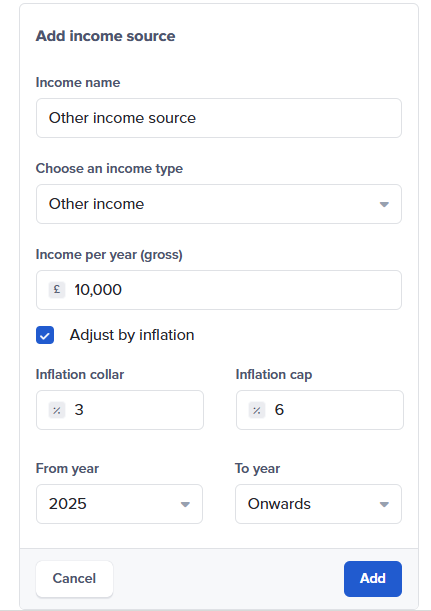
Below is the configuration screen when adding an ‘Other’ income source:
National Insurance Treatment
For income classified as ‘Other’, no National Insurance contributions are applied. This ensures clarity and avoids unintended NI calculations for income streams that do not attract NI in practice.
Income Tax Calculation
Income tax is calculated using the most up-to-date UK tax bands and rates available within Timeline. The system:
-
Applies the relevant personal allowance (subject to tapering where applicable).
-
Calculates tax progressively across each income band.
-
Deducts the total income tax from the gross amount to produce the net figure.
This ensures consistency with current legislation and alignment with broader financial planning assumptions.
Inflation Adjustment (CPI with Custom Cap & Collar)
The ‘Other’ income type can optionally be linked to CPI inflation. When enabled:
-
The income increases annually in line with CPI.
-
A custom collar sets the minimum annual increase.
-
A custom cap sets the maximum annual increase.
As shown above, advisers can define both values (e.g., 3% collar and 6% cap), giving precise control over how the income evolves over time. This is particularly useful for modelling income that is partially inflation-linked or contractually bounded.
Example
Suppose a client receives £120,000 per year from a non-standard income source classified as ‘Other’.
-
The adviser inputs £120,000 gross.
-
No National Insurance is applied.
-
Income tax is calculated using current tax bands.
-
The resulting tax liability is deducted to determine net income.
-
CPI indexation is enabled with:
-
A 3% collar (minimum annual increase),
-
A 6% cap (maximum annual increase).
-
This setup ensures the income grows within a defined range each year, providing both realism and protection against extreme inflation assumptions.
Conclusion
The ‘Other’ income type in Timeline Planning offers advisers flexibility when modelling income streams that fall outside predefined categories. By allowing manual gross input, applying income tax correctly (without National Insurance), and supporting CPI adjustments with a custom cap and collar, it provides both precision and control.
Used appropriately, this income type ensures bespoke client scenarios can be modelled accurately while maintaining alignment with current tax legislation and robust planning assumptions.