
Summary
- The Floor and Ceiling Rule applies a fixed percentage withdrawal with defined upper and lower limits
- Spending can fluctuate based on portfolio performance, but only within these boundaries
- The rule helps preserve portfolio value, especially during adverse market conditions
- It enforces disciplined spending adjustments, reducing the risk of depletion
- In Timeline Planning the floor starts at 15% below and the ceiling at 20% above the first year's withdrawal
- Particularly useful for managing sequence of returns risk in retirement
Description
The Floor and Ceiling Rule, introduced by financial adviser William Bengen, is a dynamic withdrawal strategy designed to balance flexibility with protection.
Instead of withdrawing a fixed income each year, the strategy recalculates withdrawals annually based on a fixed percentage of the current portfolio value. However, unlike a pure percentage rule, it introduces two constraints:
- A floor, which sets the minimum allowable withdrawal
- A ceiling, which sets the maximum allowable withdrawal
These limits are typically defined as percentages above and below the initial withdrawal amount and are maintained in real terms.
This means:
- When markets perform well, withdrawals can increase, but not beyond the ceiling
- When markets perform poorly, withdrawals decrease, but not below the floor
By enforcing these boundaries, the rule keeps spending adaptable while avoiding extreme changes. Importantly, it requires a willingness to reduce spending during downturns, which is a key driver of long-term sustainability.
How it works in Timeline Planning
- To use it, open the client's financial plan, click "Settings", and under "Plan settings" in the left menu click "Inflation & Withdrawal rules". Under "Withdrawal", select "Floor and Ceiling rule", then click "Save changes".
- "Set an annual lower limit (floor) of" goes from 0% to -50%, and "Set an annual upper limit (ceiling) of" from 0% to 50%, in 5% steps. The defaults are -15% and 20%.
- "Frequency" sets how often the rule is applied.
- The rule acts on the amount Timeline needs to withdraw from the portfolio after income, not on the whole spending figure. The withdrawal rate is that amount divided by the total value of the client's accounts.
- The floor and ceiling are set in today's money from the withdrawal in the first year. They're reset, along with the reference percentage, in any year when a spending phase or one-off item starts, or the year after one ends. No adjustment is made in those years.
- The floor and ceiling limit the level of the withdrawal, not how much it can change from one year to the next.
- The rule changes only the amount. Which accounts the money comes from is still set by the withdrawal order.
- The defaults are a starting point, not a recommendation. A rule that hasn't been calibrated for the client can lower the success rate.
Example
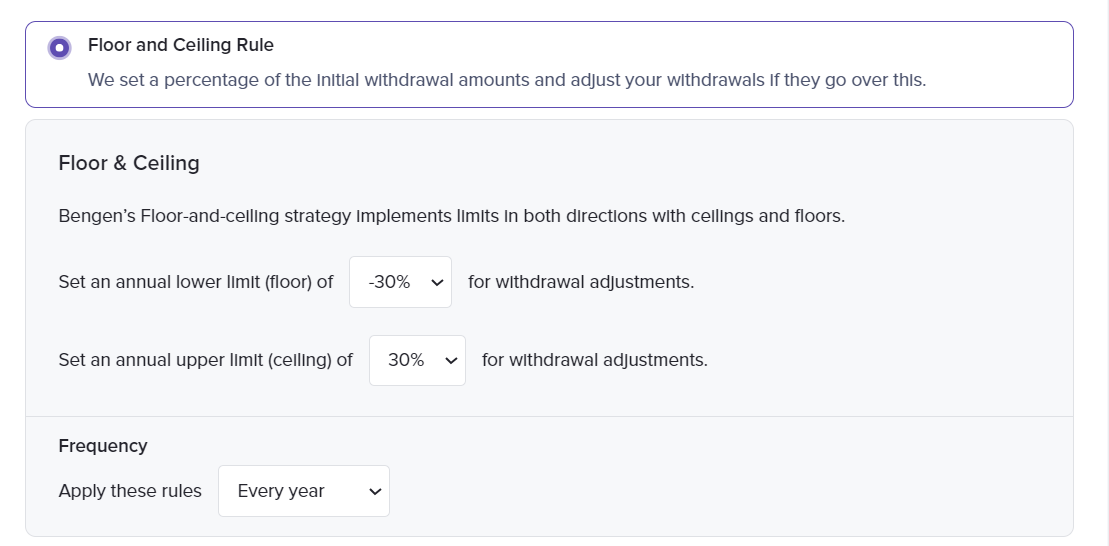
A retiree starts with a portfolio of £1,000,000 and withdraws £40,000 annually, representing a 4% withdrawal rate.
They set:
- A floor of minus 30%
- A ceiling of plus 30%
In real terms, this results in:
- Minimum withdrawal of £28,000
- Maximum withdrawal of £52,000
Each year, the withdrawal is recalculated as 4% of the current portfolio value.
- If 4% of the portfolio is greater than £52,000, the withdrawal is capped at £52,000
- If 4% of the portfolio is less than £28,000, the withdrawal is increased to £28,000
- Otherwise, the calculated 4% amount is used
This approach allows income to respond to market conditions while staying within a controlled range.
Conclusion
The Floor and Ceiling Rule provides a practical balance between stability and flexibility in retirement income planning.
By combining a percentage-based withdrawal with clearly defined limits, it enables clients to benefit from market growth while protecting against excessive income reductions during downturns.
For more on the other rules, read the related articles in the Cashflow: Inflation and Withdrawal Rules section.