The annual Budget is something that almost always descends into chaos, but perhaps this year, more than most, was truly a spectacle. There was plenty of speculation leading into Labour’s second Budget since taking power, but this year was perhaps one of the most leaked Budgets in recent memory. The lead-up to the 26th seemed to fuel investor speculation, as proposals such as income tax increases and the abolition of pension tax-free cash were floated and, in turn, dismissed. Yet the most unprecedented and unexpected leak was the actual OBR report, released the morning of, leading news sites everywhere to discuss the Budget before the Chancellor, Rachel Reeves, had even stepped up to the lectern.
Economic Backdrop for the Budget
Many had expected this Budget to be one of harsh measures with Reeves needing to plug the ‘blackhole’ in public finances. In the lead-up to her speech (or rather the report leak), gilt markets had been shaky, with many investors concerned about the high debt-to-GDP ratio looming overhead. When a potential income tax increase leaked, gilt markets reacted positively, driving yields on 30-year issues lower. Markets welcomed this, as it represented the government seeking alternative sources of income for public finances rather than relying on the already exposed debt market. If the government had announced the plan to increase its already looming debt, it would likely have spooked the gilt market.
Equity markets were generally less reactive than debt markets, with leaks not impacting the FTSE 100 or 250 to any considerable extent. In fact, across 2025, the various FTSE indices have proved strong performers, reaching new records throughout the year. Even sterling held relatively steady and in a strong position against the dollar and euro, leading up to the announcements. Reeves has made clear in her tenure that she wishes to fuel investment in the UK’s public and private markets. With backtracks on lowering the cash ISA allowance in her Mansion House speech earlier this year, many pundits thought it would likely be included within the Autumn Budget.
Finally, a key theme for Reeves going into the Budget was curbing inflation. Whilst nowhere near 2022 levels, inflation currently sits near 3.8% for the year to October which is well above the BoE’s target of 2%. Reeves was likely focusing on these key points whilst also paving the way for the BoE to cut interest rates before the end of the year. All these factors combined made for plenty of difficult choices given Reeves’ pledge not to raise taxes on working people in the party manifesto.
So, cutting through the speculation, what were the key points and takeaways from this year’s Budget?
Personal Tax
- Income tax and national insurance thresholds’ freeze extended to 2031.
- Cash ISA limits will be reduced for those under 65 to £12k per annum, whilst the full £20k is still available for stocks and shares investors.
- Basic and higher rates of tax for dividend income will be subject to an additional 2% tax increase. For property and savings income, there will be an additional 2% rate increase across all bands.
- Rules surrounding EIS and VCTs have changed, including the size of the underlying companies and lifetime investment limits.
- Income tax relief on VCT investments will reduce to 20%.
Corporations and Business
- Holding of corporation tax at current rates.
- Introduction of a 40% first-year allowance on main rate capital expenditure from January 2026. Available to both incorporated and unincorporated businesses on main-rate assets.
- The writing down allowance will be reduced from 18% to 14% from April 2026.
- Small and medium businesses will continue to benefit from the existing transfer pricing exemption.
- There will be lower business rates for hospitality premises, subsidised by rates from warehouses of large online companies.
Employment, benefits, student loans and pension changes
- Abolishment of NICs (class 2) voluntary contributions for people living abroad.
- EMI schemes to be made more generous.
- Those on Plan 2 of the student loan scheme will have their thresholds frozen at the 26/27 level for 3 years.
- The 2-child cap on the universal or child tax credit is to be scrapped.
- A cap on salary sacrifice pension contributions at which NI relief is applicable will be set at £2k/annum from 2029.
- Legal minimum wage for 21+ is rising to £12.71/hour, a 4.1% increase from April.
- Basic and new state pension payments to rise under the triple lock policy by 4.8% from April.
- There has been no change to the 25% tax-free cash for pensions.
Duties
- Vaping duty was introduced and tobacco and alcohol duties will rise.
- Temporary cut in fuel duty on petrol and diesel will be extended to September 2026.
Housing & IHT
- £1m 100% business property relief/ agricultural business relief to be transferable between spouses from April 2026.
- From April 2028, homes over £2m will pay an annual surcharge of £2,500 to £7,500 depending on value.
Transport
- Electric cars (including hybrid cars) will be subject to a new mileage-based tax from 2028.
- Regulated rail fares to be frozen next year.
The above summary is based on the Autumn Budget 2025 announcements and is intended only as an overview. It does not cover every measure in full detail and should not be relied on as a substitute for the official HM Treasury publications, Finance Bill documentation or professional tax advice.
Timeline’s Thoughts
There are several long-term impacts from this Budget, and whilst markets appear to be taking a slight sigh of relief, the average person may feel short on change in the coming years. The OBR has claimed that the measures in the Budget should raise £26bn in taxes in 2029-2030 and increase the previously razor-thin fiscal headroom to £22bn for the Chancellor. The cost of the measures, however, is that tax-to-GDP is at an all-time high of 38%, casting further doubt on Reeves’ pledge to help those sitting firmly in the middle of the national income spectrum.
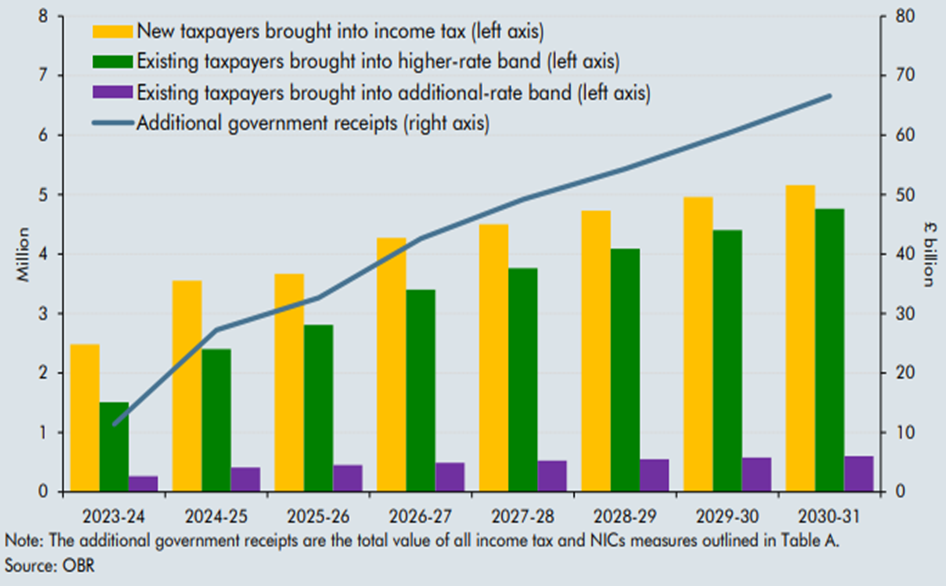
Perhaps the immediate elephant in the room to address is whether Reeves broke her manifesto promise. Whilst not directly raising taxes for the majority of people, the freezing of thresholds is the monetary equivalent of “it’s not cricket”. As a result of the freezes, many people will continue to suffer increased tax burdens due to fiscal drag and wage inflation over the coming years. The OBR has revised down its estimates of household disposable income to 2027, showing a gradual slowing of real wage growth, alongside rising taxes. This has a knock-on effect on household savings projections and potential long-term GDP growth for the UK. From the chart below, you can see that the majority of the impact of this freeze will fall on those who are transitioning from paying no income tax to the basic rate, as well as those who were previously at the basic rate and are now subject to the 40% band.
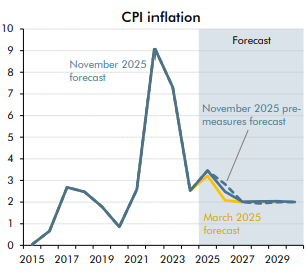
The Chancellor claimed in her speech that these measures would see inflation fall by 0.3% as per the OBR’s predictions. Whilst the news is positive, the small print of the report is not quite as blindly optimistic. The upward pressure from rising food and service prices is likely to keep inflation above target in 2025 (3.5%) and 2026 (2.5%), before reaching target levels in 2027. The 3.5% inflation for 2025 is above what was previously predicted in March of this year (3.2%), meaning it’s not quite as flattering a picture as previously thought.
Source: OBR (2025)
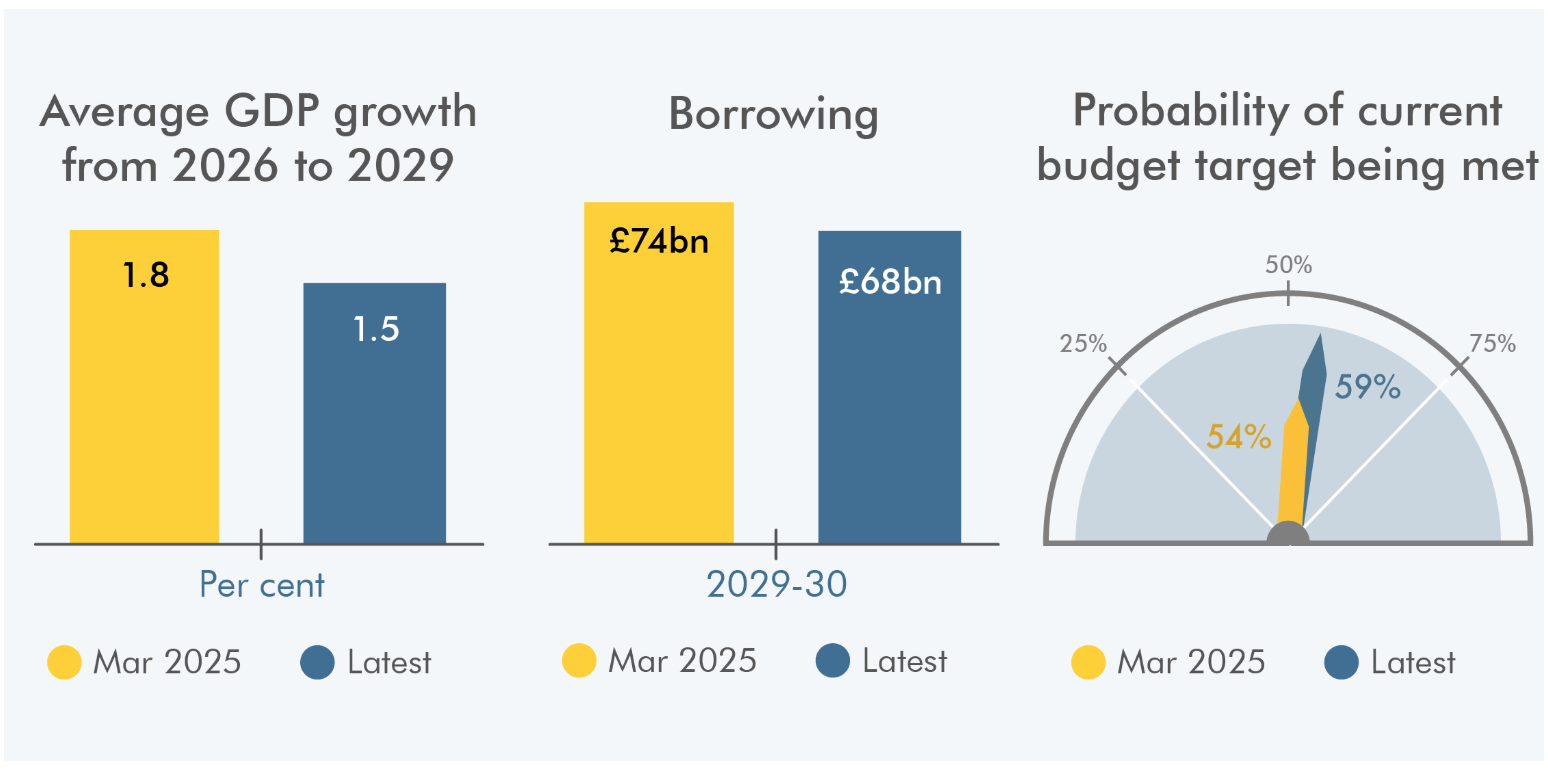
From a GDP perspective, it’s a similar story. Unfortunately, this Budget did not inspire high growth forecasts. The OBR has revised down its average GDP forecast for 2026-29 from 1.8% to 1.5%. The lacklustre predicted growth, teamed with current inflation levels and squeezed household incomes, will come at a substantial cost for working professionals. The lower GDP is partly due to the flat trend in output per worker in the UK, a lingering issue since COVID. Worker productivity is incredibly important and impacts things such as living standards and economic growth within a country. All these points to Reeves’ not quite keeping her promise that Labour would ‘kickstart economic growth’, but rather keep it relatively muted.
Source: OBR (2025)
Finally, this Budget did just enough to keep gilt markets on side. Bond markets appeared satisfied with long-maturity gilt yields falling, a sign that investors are (somewhat) confident that measures will not add to the current high government borrowing levels. Reeves will be hoping the BoE delivers her an early Christmas present in the form of a rate cut at its December meeting. A cut would give both Reeves and us consumers the breathing room we need, with mortgage rates likely to follow suit in the coming year, as well as reduce the government's interest burden on any potential new debt issuances. It will also be interesting to see how equity markets price in the lower GDP estimates as we approach the end of the year, and Reeves may hope her stamp duty reserve tax holiday on new UK listings will help spur public market growth. As we can see, there are still a few spinning plates being managed, and upon further inspection, markets might still react, just like they did after Reeves’ last Budget.
Final Thoughts
Another year and another Budget survived, just. Like many things tied to the markets, the Budget can elicit an emotional response in some people, particularly fear. Narratives are pushed by news sources each year, designed for clickbait and scaremongering. Mistakes are made when trying to pre-empt the Budget, which can lead to lasting consequences. Once again, financial advisers are vital in helping clients avoid knee-jerk decisions and stay calm.
%20(10)-1.png)