Another rather typical investment year in the bag.
Cast your mind back to the start of 2025. Markets were lurching about like a drunk uncle at a wedding. Volatility was everywhere. Headlines were apocalyptic. And the leader of the free world was live-tweeting global chaos seemingly every time he took a dump, from whichever porcelain “situation room” he happened to be in.
Markets tanked, and pundits once again declared the end of capitalism.
And, sadly but predictably, some investors bailed. They sold. They fled.
According to Calastone, UK investors pulled a record £6.7 billion out of equity funds in 2025, the largest equity outflows ever recorded, and double the previous record set in 2016.
Since the rather theatrically named “Liberation Day” in April, investors withdrew money from equity funds for an unprecedented seven consecutive months.
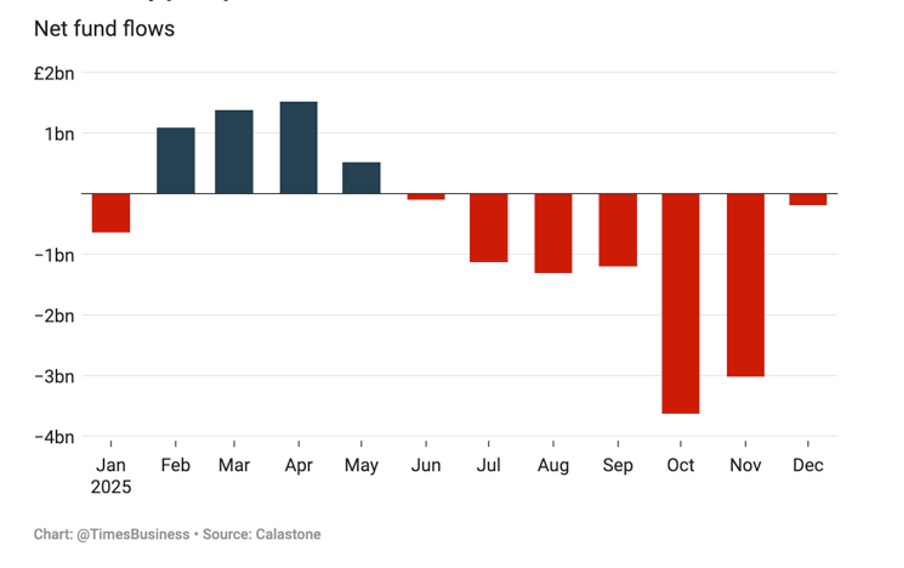
And where did all that money go? Cash. Money market funds. Fixed income.
Yeah, the investing equivalent of hiding under the duvet and hoping the monsters go away.
But here’s the bit that should really make you spit out your coffee.
Active equity funds haemorrhaged a whopping £19 billion in 2025.
Meanwhile, index fund investors quietly added £12 billion net.
The very investors who had entrusted their money to highly paid active managers, specifically to help “navigate uncertainty” were the first to abandon ship at the first sign of… uncertainty.
And these misguided souls are probably still patiently on the sidelines waiting for “certainty” to return, which, for the avoidance of doubt, is like waiting for your teenager to say: “Thanks for everything you do, Mum.”
I hope you weren’t one of them. I hope you stayed invested. And if you did — kudos to you. And kudos to your financial planner.
Because your portfolio hasn’t just recovered. It’s probably meaningfully up.
Global Equity Index, a basket of the best and brightest companies on the planet, delivered a tidy 14% return in 2025. Even a boring, grown-up 60/40 global equity / global bond portfolio returned over 10%.
Not bad for a year that supposedly marked the end of civilisation.
This is the classic investment lesson. The one we keep relearning. The one that never changes:
Temporary market drops aren’t a bug, they’re a feature. Volatility is the price of admission to the Investment Hall of Fame.
Over more than a century of market data, one simple truth stands out:
Declines are temporary. The advance is permanent. Everything else is just noise.
Behold the AI Bubble-Mongers
As if the geopolitical theatrics weren’t enough, the latter part of the year brought breathless chatter about the “AI bubble”, the terrifying concentration of the Mag 7, and the idea that US market dominance is somehow an existential threat to diversification itself.
These headlines are the financial equivalent of British weather forecasts: usually wrong, occasionally dramatic, and rarely useful.
As if giving the pundits the middle finger, the S&P 500 went on to notch up 38 new all-time highs in 2025 alone, with tech companies doing much of the heavy lifting!
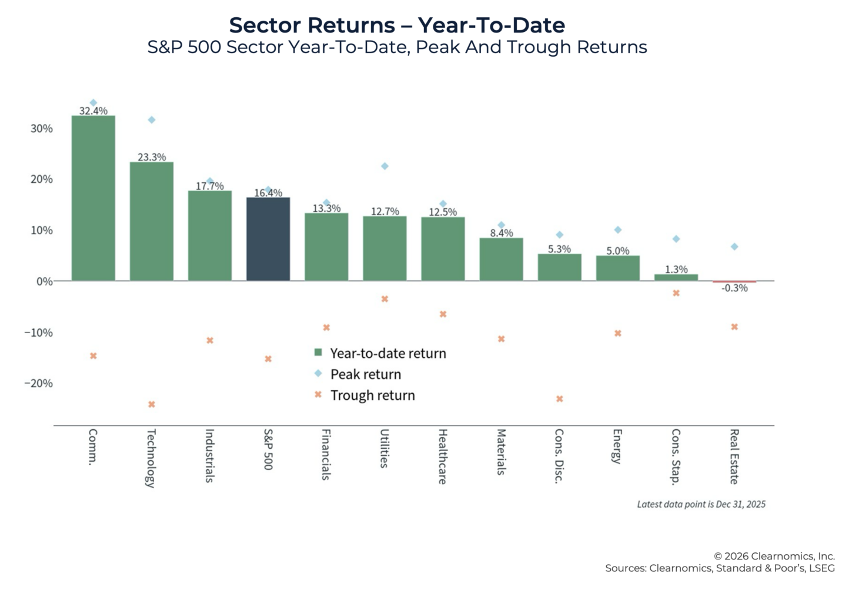
Chart by Kitces
But even a broken clock is right twice a day. The pundits did get one thing right. The US dollar weakened against a basket of major currencies.
US Equity returned over 16% in dollar terms. Translate that back into pounds, and you end up with around 9.6%. Hardly disastrous for a market that has returned over 120% in the five years prior.
Meanwhile, after more than a decade wandering in the wilderness, UK and European equities finally had their moment in the sun with a stonking 23%+ return.
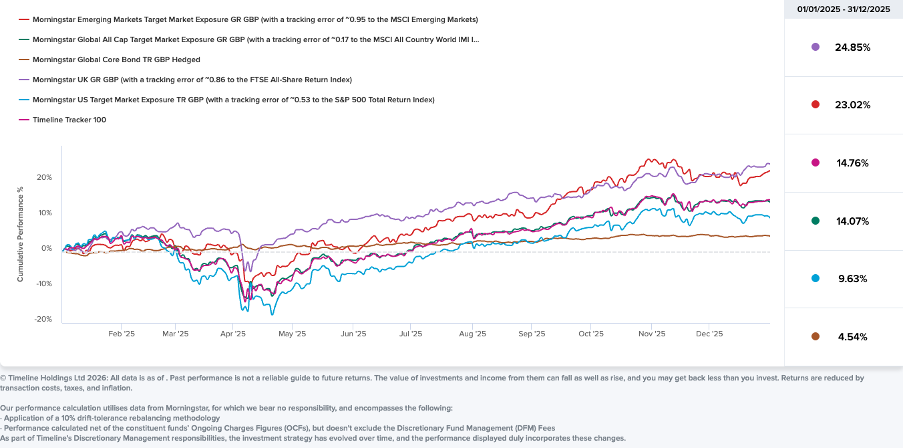
And this is where diversification quietly does its job. There’s an old saying that diversification means you’re always apologising for something. For years, global investors apologised for Europe while US equities shot the lights out. Last year, the roles reversed and suddenly we’re apparently apologising for US Equity.
Preparing for the Next Punch
The pundits are back out in force, they always are at the start of a new year.
Markets, meanwhile, will continue doing what they’ve always done: reward the patient investors who ignore the noise.
Let’s be clear: markets will fall again at some point. Historically, global equity returns are negative roughly one year in five.
Since 1925, we’ve had around 11 bear markets, defined as declines of more than 20%, roughly one per decade.
Every. Single. One. Has been followed by a stronger, more vigorous rebound.
The average bear market lasted 18 months, with an average decline of 34%.
The subsequent recovery? Six years and ten months, delivering a cumulative return of 461%.
Meanwhile, market commentators have successfully predicted fifty of the last three market declines.
You can bet on a market correction at some point. In fact, we’re probably overdue. Valuations are elevated by historical standards. But valuation metrics are a terrible market-timing tool.
If anyone tells you they know what markets will do next, ask them one simple question: “Why aren’t you on a beach somewhere, sipping piña coladas?”
The next temporary market decline will come.
When? How deep? What triggers it?
Your guess is as good as mine. And anyone who claims they know is lying or selling something.
So how does an evidence-based investor prepare without forecasting or market timing? Simple. You build a robust financial plan, one that is stress-tested across decades of market history. The good, the bad, and the utterly horrific.
Mike Tyson put it best: “Everyone has a plan until they get punched in the face.”
A great financial plan is built, not based on the assumption of linear returns but taking into account the variations of the market. It incorporates market declines of various depth, duration and recoveries.
And it’s an ongoing, lifelong interactive process, not an event. As Dwight D. Eisenhower beautifully put it: “Plans are worthless, but planning is everything.”
It’s about ensuring your plan can survive the inevitable temporary declines without derailing the life you want to live.
When your plan has been stress-tested across a century of market history, it becomes much easier to tune out the doom-mongers and stay invested when markets inevitably lose their rag.
And to calmly mutter the Serenity Prayer:
God, grant me the serenity to accept the things I cannot change,
The courage to change the things I can,
And the wisdom to know the flipping difference.
Source:
- Equity funds suffered record outflows in 2025, though post-budget certainty cut net selling sharply in December https://www.calastone.com/insights/equity-funds-suffered-record-outflows-in-2025-though-post-budget-certainty-cut-net-selling-sharply-in-december/
This article is produced by us for Financial Advisers who may choose to share it with their clients. Timeline
Planning and Timeline Portfolios do not offer direct-to-consumer products.

.png)