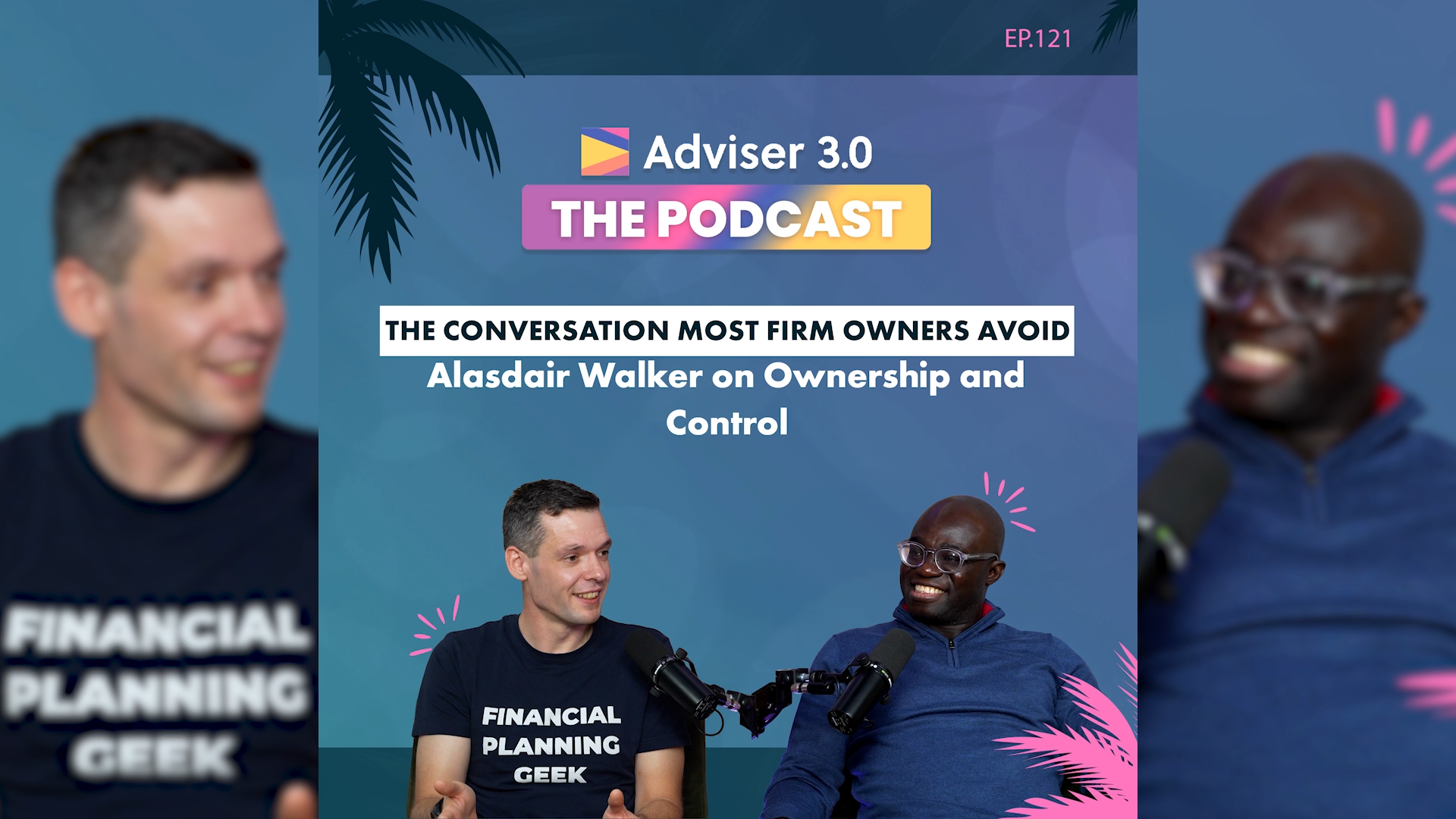
Ep.121 - The Conversation Most Firm Owners Avoid: Alasdair Walker on Ownership and Control
Every advice firm eventually reaches a point where growth, leadership and continuity come into focus. Yet the conversation many founders delay the longest is the one that shapes everything else: ownership and control.
In Adviser 3.0: The Podcast, we regularly explore what underpins sustainable advice firms. In Episode 121 with Alasdair Walker, Managing Director and owner of Optimum Financial Planning, the focus turns to internal succession, management buyouts and the long-term consequences of avoided conversations.
The discussion centres on leadership decisions that influence firms well before any transition takes place.
Why succession shapes firms long before any transition
Succession planning is often treated as a future task. In practice, it influences culture, decision-making and talent retention many years earlier.
Research into succession planning best practice shows that firms which prepare early are better positioned to maintain leadership continuity and organisational resilience. Guidance from the CIPD highlights how structured succession planning supports long-term performance and stability.
When succession is left undefined, uncertainty grows. Control remains concentrated, future leaders disengage and strategic thinking narrows.
Ownership and control as the real pressure points
A recurring theme in the episode is how assumptions replace clear conversations. Founders often believe successors want the same outcomes. Successors assume opportunity will arrive in time.
Without early clarity on equity, governance and decision-making, alignment rarely exists. Insight into internal succession planning shows that involving future leaders early strengthens trust, accountability and shared direction across generations.
Avoiding these discussions reduces clarity around control rather than protecting it.
Management buyouts as a deliberate alternative
Selling to a third party is often viewed as the obvious route when founders step back. Management buyouts offer an alternative that supports continuity, culture and independence.
Well-structured internal transitions rely on early planning, realistic valuation and open communication, as outlined in this perspective on management buyouts as a succession strategy.
As discussed in the episode, internal ownership works best when incentives and expectations are addressed well in advance.
Why selling becomes the default outcome
When ownership conversations are delayed, optionality narrows and selling often feels inevitable.
Analysis of why succession planning matters in professional firms shows that businesses without a clear strategy are more likely to pursue external sales under pressure, increasing risk for owners, staff and clients.
Selling itself is not the issue. Losing choice over timing and direction is.
Where AI fits into the discussion
Later in the episode, the conversation turns to AI adoption in financial planning, a theme explored across several Adviser 3.0 episodes.
Technology can improve efficiency and support workflows, but it does not resolve unclear ownership, governance or leadership structures. Tools amplify decisions already in place.
Starting earlier than feels comfortable
Ownership and control influence firms long before transition becomes unavoidable. Addressing these topics early gives founders greater influence over outcomes and direction.
The central message from Episode 121 of Adviser 3.0 is clear. Firms that engage with succession early maintain control over their future. Those that delay often find their options narrowing.