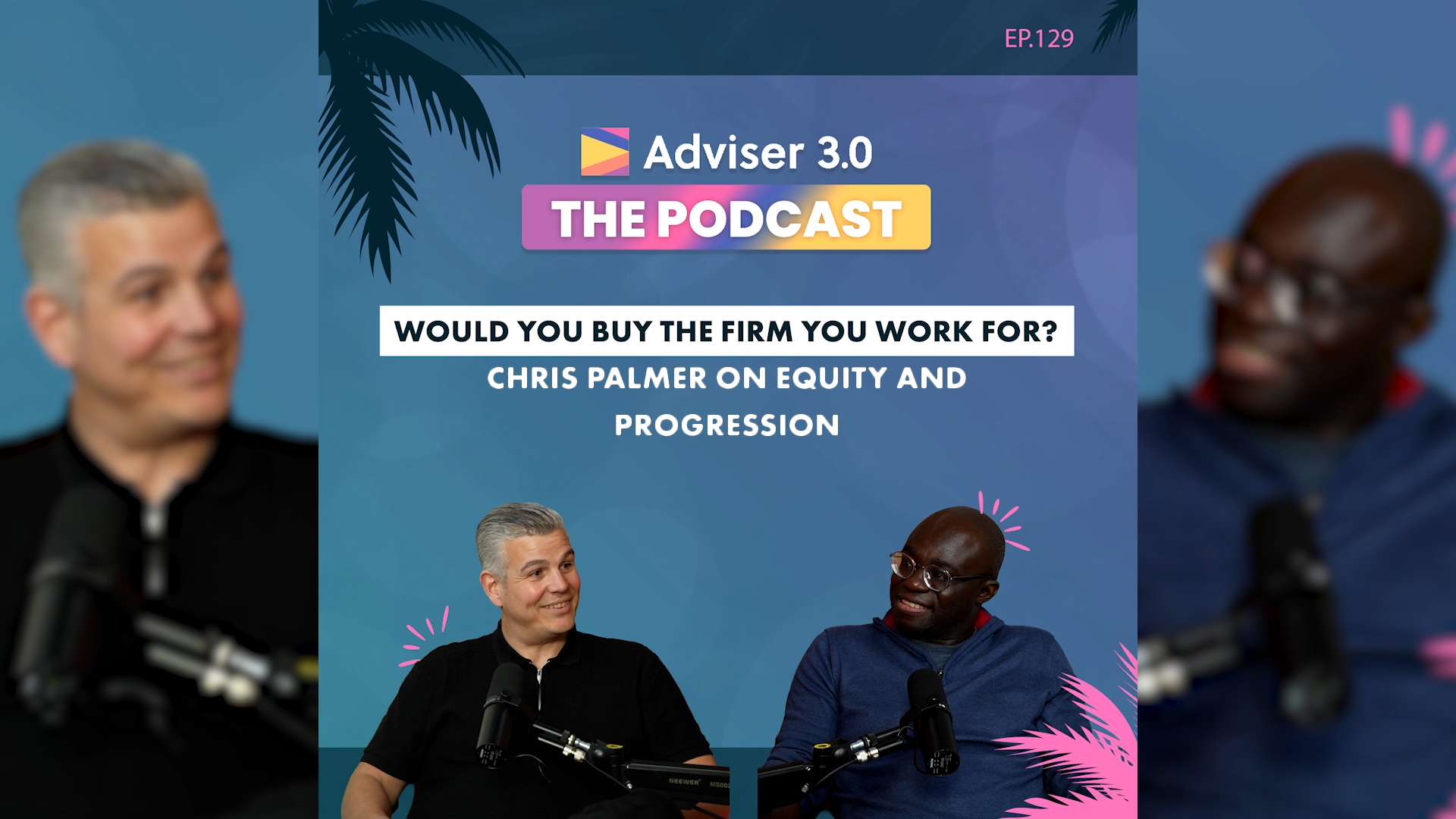
Would You Buy the Firm You Work For? Chris Palmer on Equity and Progression
Chris Palmer’s journey into financial advice was never mapped out.
From joining the Navy at 16 to starting as a cashier during the financial crisis, his career developed through opportunity, pressure and decision-making at key moments. What followed is a path many advisers consider but few execute: moving from employee to equity holder, and ultimately managing director of the firm he joined.
This episode explores what it really takes to turn a role into ownership, and why more financial advisers should be thinking about equity, not employment.
From Military Discipline to Financial Advice
Chris spent over a decade in the military before transitioning into financial services. That shift was not driven by ambition within the profession, but by circumstance.
What carried across was discipline, structure and a clear sense of progression. Those traits became critical as he entered banking during the financial crisis, starting at the bottom and learning quickly in a highly process-driven environment.
For many UK advisers, this pathway into the profession is familiar. Early roles are often product-led and restricted, with limited exposure to holistic planning.
It is only later, often through experience or a move into independence, that advisers begin to understand the full scope of what financial planning can offer.
The Shift to Independent Financial Planning
Chris’s move away from banking marked a turning point.
Stepping into the independent space exposed a broader model of advice. Conversations shifted from products to outcomes, from transactions to long-term planning. Tools like cashflow modelling became central to client conversations, helping advisers demonstrate suitability and map long-term financial outcomes.
This shift reflects a wider trend across the profession. As highlighted in industry coverage from FT Adviser, cashflow planning is increasingly seen as where the real value of advice sits, rather than in product selection alone.
For advisers, this is often the moment where the role becomes more meaningful and more commercially valuable.
Redundancy, Risk and the Move Into Equity
The defining moment in Chris’s career came through redundancy.
Rather than returning to another employed role, he stepped into a smaller firm and began to see the opportunity beyond employment. Within a short period, he approached the owners about becoming part of the business.
This led to a management buyout and a transition from employee to shareholder.
That move required risk. It involved funding challenges, negotiation and long-term commitment. Yet it also created something most employed advisers never access: control, influence and equity.
For financial advisers thinking about progression, this is the key distinction. Income grows through clients. Wealth is built through ownership.
Equity and Progression in Financial Advice
A core theme of this episode is how advisers think about progression.
- client bank size
- revenue generation
- seniority or title
Chris offers a different lens. Equity changes the equation entirely.
Ownership aligns incentives, shapes decision-making and creates long-term value. It allows advisers to influence culture, strategy and direction, rather than simply operate within it.
As the regulatory environment evolves, this becomes even more relevant. The introduction of Consumer Duty has raised expectations on firms to deliver consistent, measurable client outcomes, increasing the operational and compliance burden across the profession.
Building a Firm That Lasts
Since becoming managing director, Chris has focused on building a sustainable, scalable business.
- hiring advisers across employed and self-employed models
- completing acquisitions with high client retention
- centralising operations to improve efficiency
- prioritising culture and long-term team fit
One of the most important lessons from the episode is around culture. A firm can have strong revenue and still fail if the internal environment is not right.
Chris is clear that if people leave, the responsibility sits with leadership. That mindset has shaped how the business hires, develops and retains its team.
Independence vs Consolidation
The episode also tackles a growing tension in financial advice: independence versus consolidation.
With increasing regulatory pressure, many smaller firms are choosing to sell. The cost of compliance, technology and operational infrastructure continues to rise, making it harder to remain independent.
There are valid reasons for this. The FCA’s guidance emphasises the need for firms to consistently deliver good outcomes for clients, which requires robust systems, governance and oversight.
However, Chris argues that independence still plays a critical role.
- offer more personalised client relationships
- maintain flexibility in advice
- create competitive pressure across the market
The risk is that without growth or collaboration, many of these firms may struggle to survive long term.
The Future for Financial Advisers
For advisers listening to this episode, the takeaway is clear.
The industry is changing. Regulation is increasing. Consolidation is accelerating. Technology is reshaping delivery.
Against that backdrop, the question becomes more important:
Are you building a career, or are you building ownership?
Chris Palmer’s journey shows what is possible when advisers think beyond employment. Progression is not always about moving firms or increasing income. Sometimes, it is about stepping into risk, taking equity and shaping the future of the business itself.
Final Thoughts
Careers in financial advice are rarely linear.
They are shaped by moments of uncertainty, by decisions made under pressure, and by the willingness to take opportunities when they appear.
For many advisers, the idea of ownership feels distant or unrealistic. This episode challenges that assumption.
Because the real question is not whether it is possible.
It is whether you would take the opportunity if it was in front of you.
Would you buy the firm you work for?