
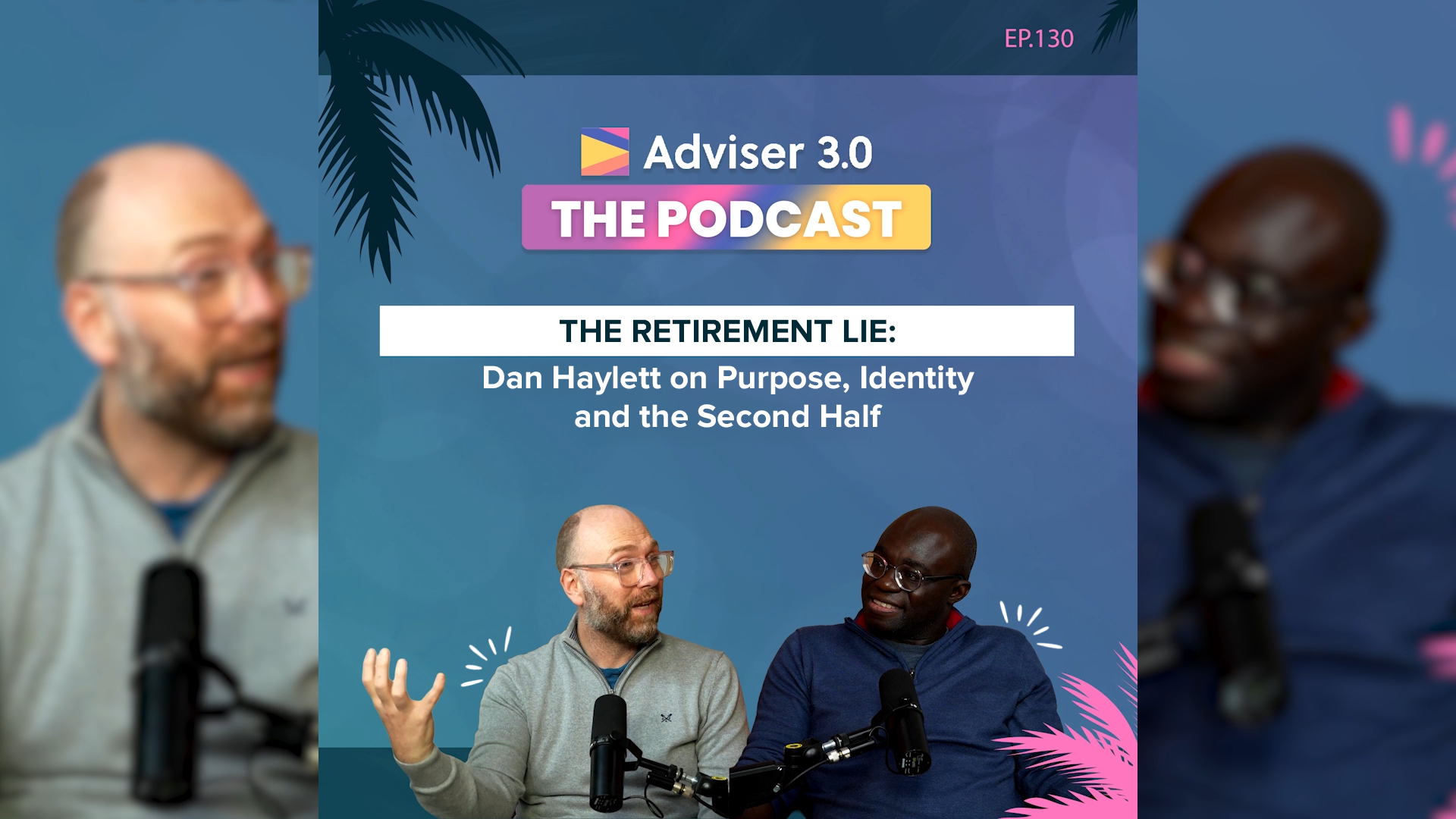
Abraham sits down with Dan Haylett, financial planner and author of The Retirement You Didn't See Coming, for a conversation about the lie at the heart of retirement planning and what advisers need to do about it.
We've Been Sold a Destination That Doesn't Exist
The retirement industry has spent decades selling a fantasy. Keep saving. Hit the number. Here's a brochure with a happy couple in matching white linen bounding down a beach. Dan has watched clients reach that summit and find fog where the view was supposed to be.
His diagnosis is simple and uncomfortable: most people spend their entire working lives focused on what they're retiring from, and almost no time thinking about what they're retiring to. They've given everything to climbing the mountain, and nothing to what happens when they get there. The result is clients with bulletproof plans who can't bring themselves to spend the money, who feel purposeless three months in and quietly start asking about going back to work.
A great financial plan, Dan argues, does one thing really well: it removes financial fear. That's it. It doesn't tell you who you are without your job. It doesn't rebuild your structure, restore your identity, or answer the question of why you're pulling back the duvet in the morning.
People will die with massive bank accounts and huge amounts of regret. And I'm sure most of us aren't in this for that.
A Man-Made Concept Built for Factories
Retirement as a concept is barely 110 years old. It was invented to move older workers out of factories and replaced with younger ones. The original pension age was set at a point where most people wouldn't live long enough to collect. That's the foundation we're still building on.
The problem is we're applying a factory-exit mentality to a world of knowledge workers who are, in many cases, reaching peak wisdom and capability right at the moment they're expected to step back. Dan frames the second half of life differently: as a child, you have freedom but no wisdom. In your working years, you accumulate wisdom but you're largely shackled to the corporate machine. In the third phase, you have both. Freedom and wisdom together. That's not a wind-down. That's arguably the most powerful position you've ever been in.
The capital that matters in that phase isn't just money. It's time, energy and a lifetime of accumulated knowledge. The question is what you choose to do with it.
Purpose Doesn't Have to Be Grand
Dan pushes back hard on the idea that purpose has to be life-changing. People hear the word and immediately think foundations, movements, legacies. Then they feel inadequate because they can't identify theirs.
Purpose might be teaching your grandchildren to play golf. It might be mentoring a junior professional a couple of days a month. It might be sitting with your partner on a Sunday afternoon with a bottle of wine and actually being present for it. That last one sounds unremarkable. For a client who spent thirty years at the office, it isn't.
Freedom without structure is just chaos in pyjamas. Human beings need struggle in order to feel like they're progressing.
Viktor Frankl said it first: what humans need isn't the absence of struggle, it's meaningful struggle. A worthwhile direction to move towards. Dan is direct about what happens when people retire without doing this work. Unstructured days that go beige. Relationships that strain under the sudden weight of constant proximity. An inability to spend the money that was supposed to make everything easier. And a real link, he argues, between purposeless early retirement and accelerated cognitive decline.
Why This Is the Adviser's Job
Dan makes the case that human-centred retirement planning isn't a nice-to-have. It's where the profession has to go. Clients won't talk about this stuff with anyone else. They come in thinking it's a money problem. It rarely is. And advisers who can hold both conversations, the numbers and the human, are the ones who'll stay relevant.
His view on what's coming for financial planning is worth sitting with. The numbers side will be commoditised. Fast. Two clicks, thirty seconds, done. What can't be commoditised is the ability to sit with someone in the moment of their life where everything is changing and help them make sense of it. The advisers running annual review meetings and telling clients they'll never run out of money are doing less and less of the work that actually matters.
The future isn't a meeting. It's a continuous relationship. Content that sparks thinking between conversations. Questions that open things up. A service that is there when the client needs it, not when the calendar says so.
.png)