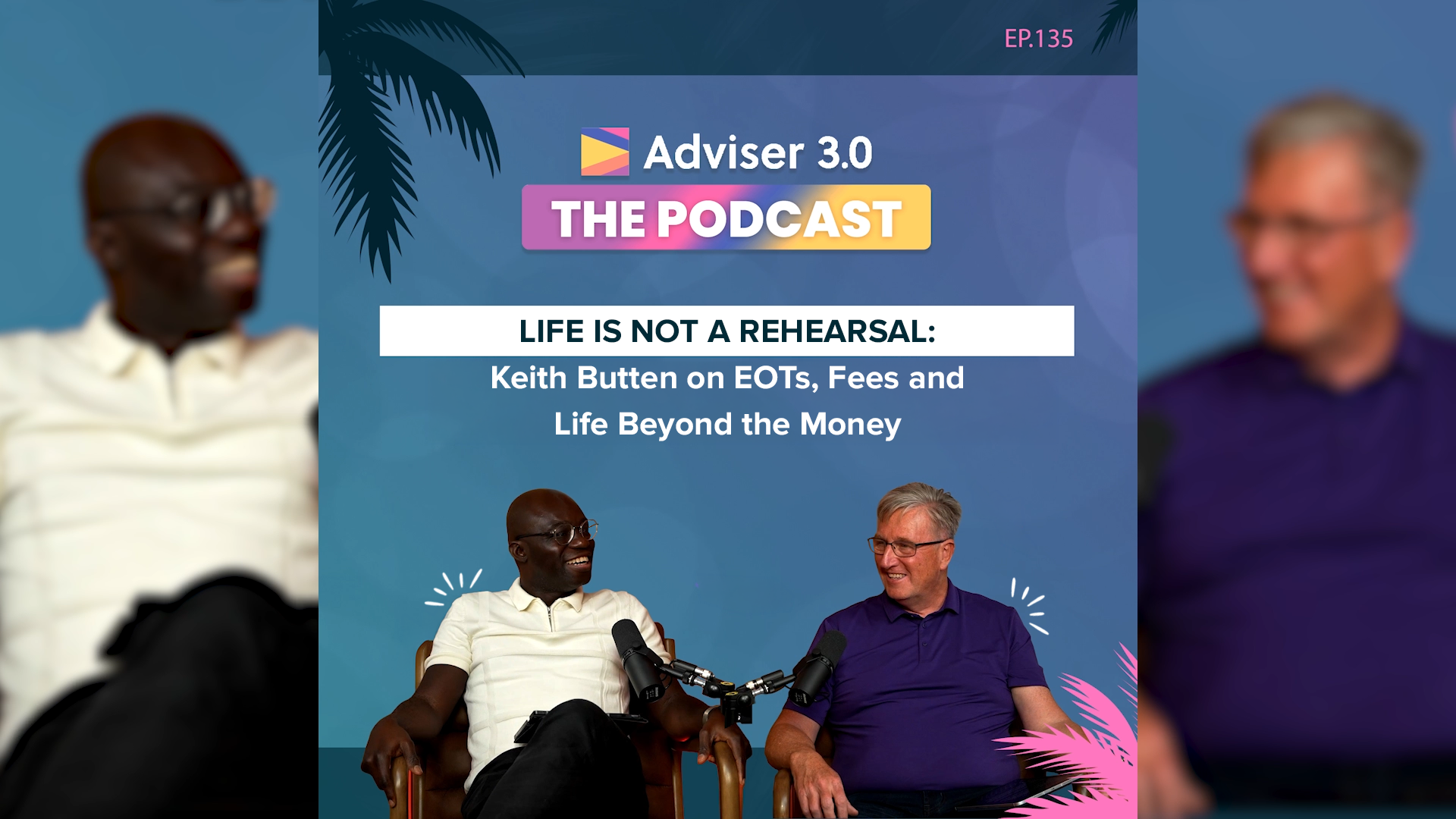
What does it actually take to build a financial planning firm that lasts, not just one that sells? Keith Butten, CFP Certified Financial Planner and co-founder of boosst, has spent four decades finding out. In this episode, Abraham sits down with Keith to explore the philosophy behind one of the UK's most distinctive lifestyle financial planning businesses, from scrapping self-employed advisers and building from a blank piece of paper, to a fee model designed around service levels and client selection rather than volume.
From the Wild West to a Blank Piece of Paper
Keith started out in what he calls the Wild West of financial services, a pure sales environment where volume was everything and the advice came second. He was good at it, won all the awards, built a team of six advisers, scaled to 18 people. But when he drew a diagram of everyone in the business and their dependents and compared it to the revenue, he realised he was generating half of it himself. He cut back fast, and began building something more deliberate.
The real turning point came when his son Josh joined the business at 18. Within a couple of years it was clear Josh was serious, which meant the business could no longer be a lifestyle operation for Keith alone. It needed to be designed. In 2017 they started building boosst from scratch, launched in 2018, moved into a new office in 2019 complete with a lake they created themselves. The spa-like setting with its pizza oven and team gym was not an accident. It was a statement about the kind of firm they intended to be.
Why Fans Beat AUM as a Metric
Keith is direct about what he does not measure. AUM is a business number, he acknowledges, but it cannot be the driver for a lifestyle financial planning firm. If you are telling clients to spend their money and live their lives, you are not optimising for accumulation. The metric that matters at boosst is the proportion of clients who become genuine fans, people who refer others, who trust the firm with their lives, not just their portfolios.
Clients are really important. But what makes a business is converting them into being true fans of the operation and what you're doing.
The numbers he does share are striking. Turnover of £2.8 million, profit of £1.2 million, and approaching half a billion in AUM with a team of around 14. That is a 45% pre-tax profit margin, roughly three times the median for a solo IFA doing £250,000 in revenue. Keith puts that down to two things: the right fee structure and ruthless client selection. boosst receives around 150 referrals a year and converts roughly one in three, taking on only 48 new clients annually. When every new client arrives via referral and you pick the right ones, he argues, everything else follows.
Service Levels and the Fee Model
boosst runs four tiers of service. Full Boost is the flagship, a complete lifestyle financial planning service for clients who need cashflow modelling and everything that comes with it. More Boost sits below that for clients with genuine technical complexity but who do not need the full planning process. Little Boost is a lighter touch service, starting at around £950 a year. And then there is a no-meeting service for a small number of situations where clients simply want a defined set of deliverables without any contracted face time.
The key principle is that clients do not choose their service level based on price. Price is the outcome of the service they need. If someone needs carry-forward calculations or complex pension work, they cannot opt down to Little Boost because it is cheaper. The grid determines the service, and the service determines the fee. Caps and collars keep workflow manageable and margins predictable.
We don't have somebody come along and say, well, I only want to pay £900 a year. That's not the conversation. It's about: for you, you really need this part of our service.
Building People, Not Just Planners
The Bright to Boost development programme has won awards and Keith gives it away freely. The core idea is simple: match the work to where each person is in their qualification journey. If someone is sitting a tax exam, route the tax work their way. If the technical lead spends an hour coaching instead of half an hour doing it himself, that is not inefficiency, it is investment. The goal is always outstanding financial planners, not competent ones, and Keith says that framing alone will put some candidates off. He sees that as a feature, not a bug.
Pay is transparent and team-based. Salaries may be below London rates, but there is a team bonus paid twice a year, structured around the Employee Ownership Trust. Josh and Keith now come into the bonus scheme too. No one at boosst is self-employed. Everyone is employed, everyone knows what everyone else is on target for, and in a few years the team will begin receiving profit distributions on top.
The EOT Decision: Infinite Over Exit
This is the section of the conversation Keith is most animated about. He and Josh sold 100% of boosst into an Employee Ownership Trust, and he is clear that the decision had nothing to do with money or tax efficiency. Both of them already had enough. The question was about what kind of business they wanted to leave behind.
It's simply about how the business is best owned to be infinite. The business needed to be something that could last without needing a buyer.
Keith's concern about consolidation is not abstract. He watched a friend sell a non-financial business to the buyer who promised to keep everything the same. A year later, two people had gone, pay rises were 2%, and the Christmas bonus had not happened. He sees the same pattern repeating across the financial planning profession and believes independent firms that stay fiercely independent are looking at an enormous opportunity as clients begin to notice the difference.
The EOT structure also solves a long-term problem for Josh. In 20 or 30 years, when the business has potentially quadrupled, the last thing Josh needs is the same succession headache Keith faced. By moving to 100% employee beneficial ownership now, with direct shares issued to Josh, Gabby, and Jennie, the business has a retention and recruitment mechanism that salary alone cannot match. When team members start receiving meaningful profit distributions, the conversation about leaving becomes a very different one.
Life Beyond the Money
Keith had cancer in 2017. He does not dwell on it, but it informs how he talks about life and work. He has a list of five reasons he would stop seeing clients, and none of them have been triggered yet. He leads training, stays technically sharp, and takes the view that stepping back from meaningful mental engagement carries its own risks.
The boat arrived during Covid, when a walk around a marina turned into a question about whether people were allowed to use their boats, and then into a purchase. He sold the first one at a small profit, bought a newer one in 2023, and now takes client meetings on the water in summer as he travels up the Thames. A place in Portugal came next. He talks about all of it not as indulgence but as demonstration. A lifestyle financial planner who is not living a deliberate life has a credibility problem. Keith does not have that problem.
Life is not a rehearsal. The things you want to achieve need not only a reliable financial plan, but also action.