
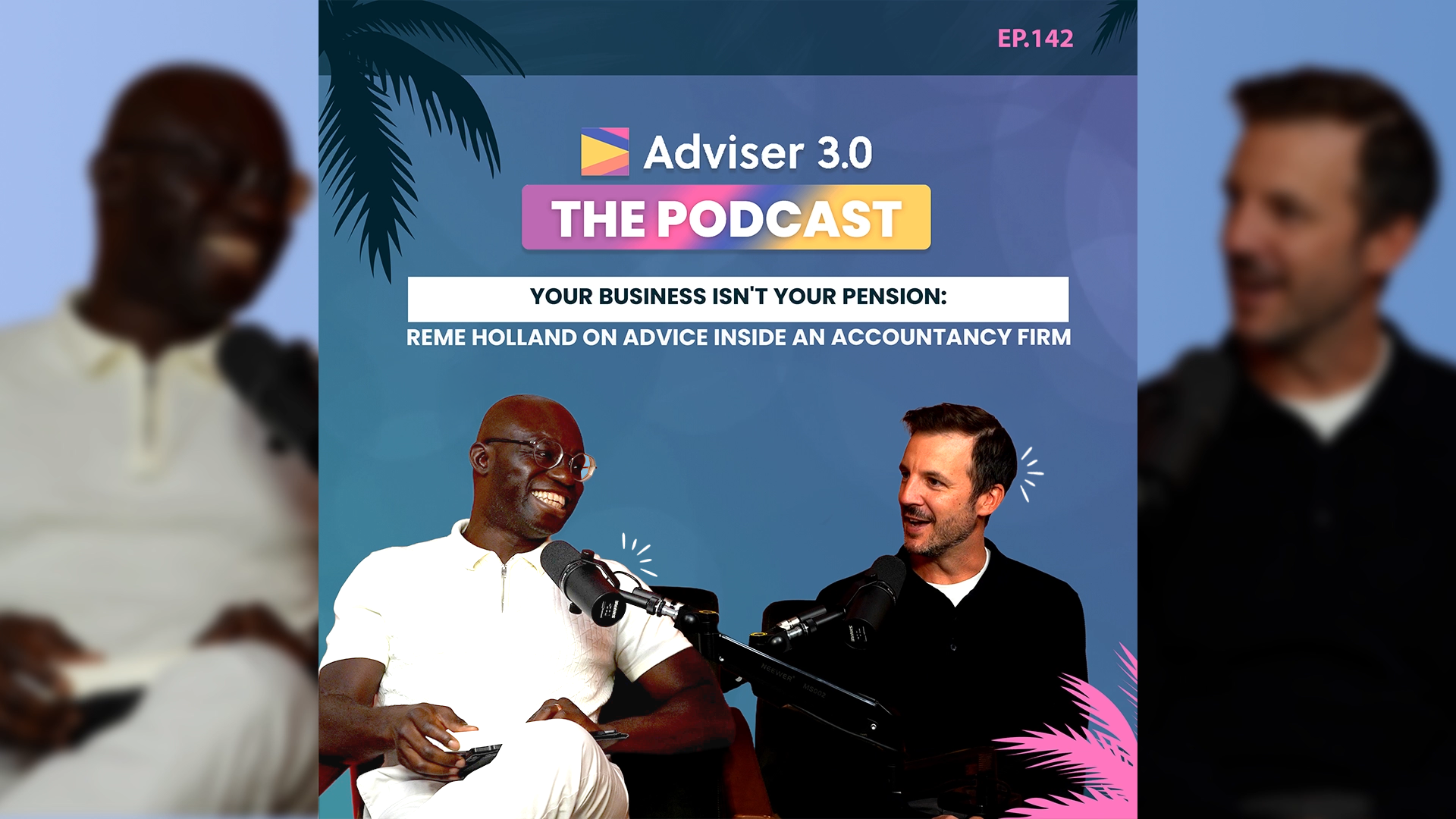
Abraham Okusanya sits down with Reme Holland, Partner at Albert Goodman and Managing Director of Albert Goodman Financial Planning, to explore what it really takes to run a financial planning business inside a regional accountancy firm, from accountant referrals and fee models to private equity and the future of the partnership.
One Step Closer To A Yes
Reme's route into financial planning didn't start in a planning office. After studying multimedia, he answered an advert promising a job talking to people and found himself knocking on doors on a commission-only basis. It wasn't glamorous, but it gave him thick skin and a lesson he still leans on: you can't help everybody, but you can always ask the question, and a no is just a no.
For every door that you knock, you're one step closer to a yes.
From there he moved into a building society, then into bancassurance at HSBC and Lloyds, where he spent years managing people and checking that clients got the right outcome. The move into the IFA world opened his eyes. The bank's safety net of training and compliance was gone, but in its place was the whole market and, with cash flow modelling, the chance to explain to a client why a recommendation made sense rather than simply what it was.
Your Business Isn't Your Pension
At Albert Goodman, financial planning is a separate limited company wholly owned by the accountancy partnership, and Reme wears both hats: a seat around the partners' table and the managing director role in the planning business. The appeal for clients is simple. Instead of repeating the same story to three different professionals, they can sit in one meeting with a planner and a tax consultant and get joined-up advice.
That matters most for owner-managers, who have a million things on their minds and very little time for their own finances. It also gives Reme the chance to tackle his biggest bugbear.
When they say my business is my pension, I say it really isn't. Let's be honest, your pension is your pension.
The accountant's introduction is a real advantage, Reme argues, because planners have to work much harder to earn trust than accountants or solicitors do. But it comes with a trap. If the accountant says "you've had a great year, go and see Reme about an employer pension contribution", the client expects exactly that and nothing more. The planner's job is to open up the wider conversation: what the contribution means for the client's future, what happens to the business if a shareholder dies, and where cash flow planning fits in.
It's about opening up those conversations to make sure that we don't become just transactional and that we are providing that holistic advice for clients.
Support Heavy, Adviser Light
When Reme arrived, the planning business had been looked after for several years by the firm's former managing partner, an accountant who had stepped in to help. Accountancy and financial planning are very different businesses, and it showed. The team was support heavy and adviser light, with nowhere near enough capacity to speak to all the clients the accountancy side could introduce.
One of his first moves was to look at the review team. They were having excellent conversations with clients, covering risk and what had changed since last year, before an adviser took over. Reme realised those conversations were the heart of the adviser's role, so he moved the review team into adviser roles and built up the paraplanning team as the work grew.
The accountancy-style timesheets went too. Every member of the planning team had to log their day, they were universally disliked, and by Reme's account they weren't producing any data worth having. He also brought in a single, consistent fee structure, so a client gets the same experience and the same charges whichever office they walk into.
Beyond The Percentage Fee
Albert Goodman offers percentage, fixed fee and time-costed charging, depending on the work. Plenty of what an accountancy-linked planner does doesn't fit neatly into an ongoing percentage fee, from pulling together a business owner's information to administration on a small self-administered scheme. Having options means the firm doesn't have to shoehorn that work into one model, and Reme says it makes charges easier for clients to understand.
Do look at not just the percentage charging model. Do look at the other bits, and you don't have to be exclusive one or the other.
Abraham pushes him on the value of recurring revenue, and Reme is candid. Most of the business still comes from ongoing percentage fees, and that makes him nervous. A market correction can throw his projections for the partners out of the window, and the changes to how pensions are treated for inheritance tax mean that more clients may now be drawing money down. It is the right advice for those clients, but it eats into that recurring base. For firms without an accountancy practice on hand, his advice is to pick up the phone to local accountants, arrange a coffee and find ways to work together.
Custodians, Not Sellers
That advice comes with a warning: do it before the smaller firms are swallowed up by private equity. Reme sees a lot of PE money flowing into accountancy, both in the South West and across the country. Albert Goodman gets approached regularly, but the partnership has decided it is not interested.
We see ourselves as custodians of the business. So it's not our business to sell.
Staying independent has its challenges, he admits. PE-backed rivals have cash for acquisitions and systems, while Albert Goodman's partners have to fund that investment themselves. But it also creates opportunities, with experienced people from PE-backed firms looking for somewhere that still feels like a partnership.
The bigger worry is what happens to the next generation. Making partner has long been the gold standard for accountants, and Reme loves the energy around the partners' table. As technology takes over more of the grunt work, the skills that make a good partner matter even more. If PE money keeps limiting those opportunities, good people will miss out.
If PE money continues at the rate it does and opportunities are limited, then there's going to be good people who don't get that opportunity. And I think that would be a real, real shame.
The Ten-Year Plan
Reme describes himself as four years into a ten-year project. The aim is to unpick years of legacy so that the client experience starts with what the client needs and works backwards, rather than starting with internal processes and hoping they fit. That means an app so clients can reach the firm however and whenever they want, more client events, and more time for advisers to spend in conversation.
He is clear about where technology fits in that picture. It is there to give advisers time back, not to replace them.
No one's getting replaced by Claude or any other AI, but they are only a tool.
The final piece is the clients themselves. Alongside the SMEs and family businesses the firm has always looked after, its growth in Bristol is bringing in new types of clients, including tech start-ups. For Reme, the future is bright. The job now is to get his head down and get on with it.