
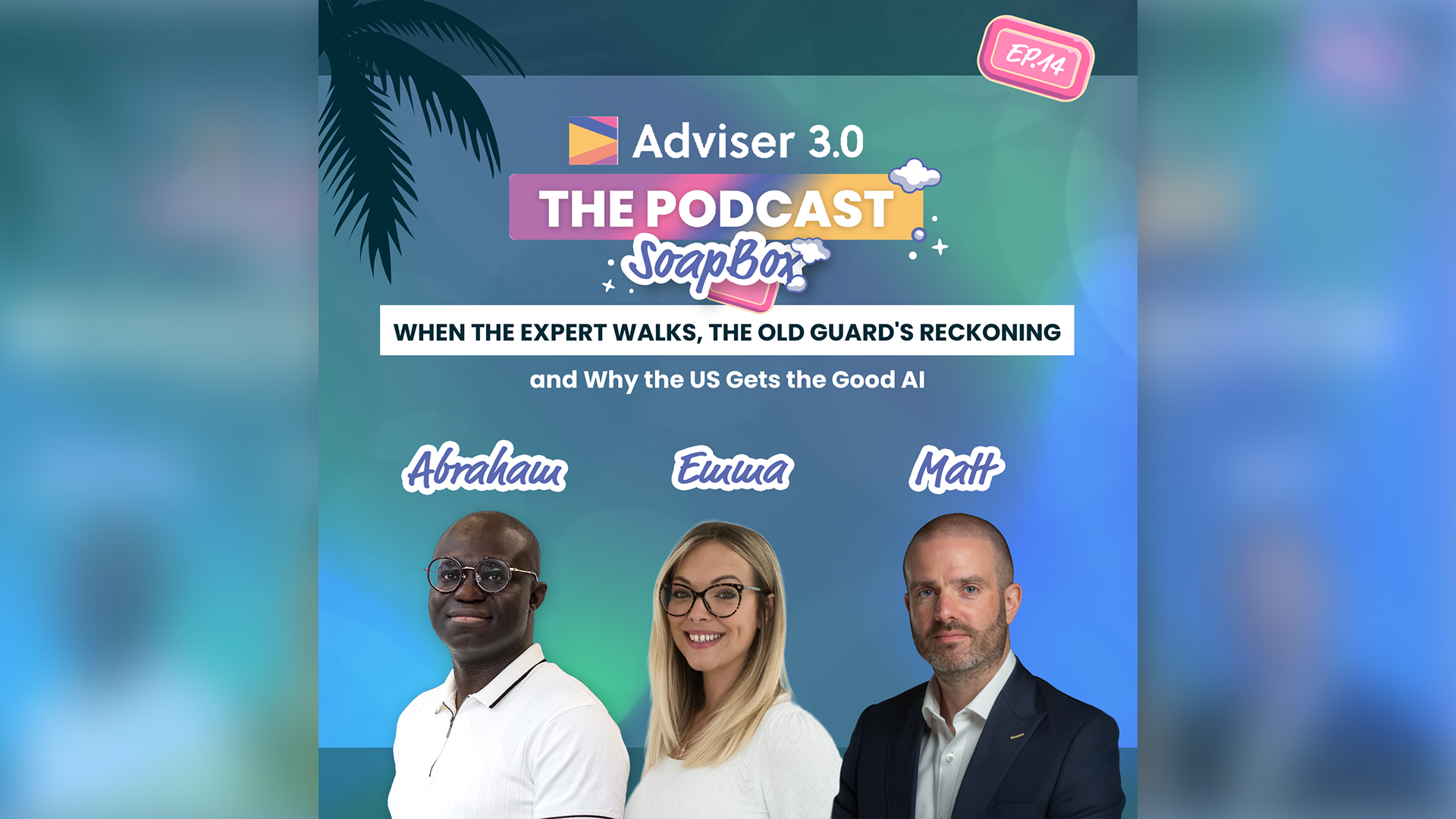
Abraham Okusanya and Matt Pitcher are back around the SoapBox, and this week they are joined by Emma Bird, Financial Planning Director at Hansford Bell. The episode opens on the news that a long-trusted technical and tax resource is being pulled in-house, what that leaves for the independent advisers who relied on it, and why the veteran who built it is striking out on his own all over again. From there the talk turns blunt: accountability at the very top of the profession and a high-profile regulatory ban upheld on appeal, the so-called adviser shortage that Emma argues the profession has largely invented, and, in Matt's AI Corner, why a leading AI lab plugging straight into US adviser tech has left the UK looking a long way behind.
When the Expert Walks
A technical and tax resource that a large slice of the independent sector has leaned on for years is being taken in-house, closed to the wider market from next April so that it serves one big firm alone. The panel's question is simple and awkward: what is the buyer actually left with once the person who built it walks out of the door, and can the content stay current without him? For everyone else in the industry, the consolation is that the veteran behind it is not retiring quietly. He is starting again, setting up a rival service for advisers, which the panel reckons is good news for the independents left looking for somewhere to turn.
"They're taking the person that created this masterpiece that everybody can use at this moment in time. And they're sort of getting rid of that."
The Old Guard's Reckoning
A high-profile regulatory ban is upheld on appeal, and the panel reads it as a marker of something larger than one case. A generation of senior figures, mostly men, is finally being held to account for behaviour that was never acceptable and is only now coming to a head. Emma's angle is about what all of this signals to anyone weighing up a career in the profession, and why governance earns its keep precisely when it is tested rather than as a box-ticking exercise. She is equally clear that a handful of bad actors should not tar an entire industry, and that most of the people she has worked alongside are nothing like the headlines.
"Culture isn't what's written in your staff handbook. It's about what people actually see when something does happen and raises concern."
The Shortage Myth
The people around the table can see the demographic problem in the mirror, but Emma's challenge is sharper than the usual call for more advisers. The profession complains there is no new blood coming through, she argues, while only ever hiring the already-qualified, applying entry requirements the current generation of advisers never had to meet themselves, and overlooking capable people already sitting in their own offices and across the banks. Her own route, from a standing start with a degree and a bit of banking experience to director and part-owner in around six years, is the proof of concept. The fix, she says, starts with firms being willing to grow their own rather than poach the finished article.
"You don't necessarily have to be super smart to be successful. You have to just be willing to learn. And then everything else will come."
Why the US Gets the Good AI
In Matt's AI Corner, the news is that a leading AI lab has begun connecting straight into US adviser technology, landing in the same week as one of the biggest US adviser conferences. The catch for UK firms is data. Data-protection rules make it hard to point that kind of firepower at client data on this side of the Atlantic, which is the one thing that would genuinely move the needle for a working planner. The panel's steer is not to judge the technology by the sorry state of UK financial-services tech, and Abraham sets out where Timeline's own Penny fits for firms that want the upside while keeping client data contained and in the UK.
"Do not look at financial services tech in the UK and use that to judge the quality of AI."