
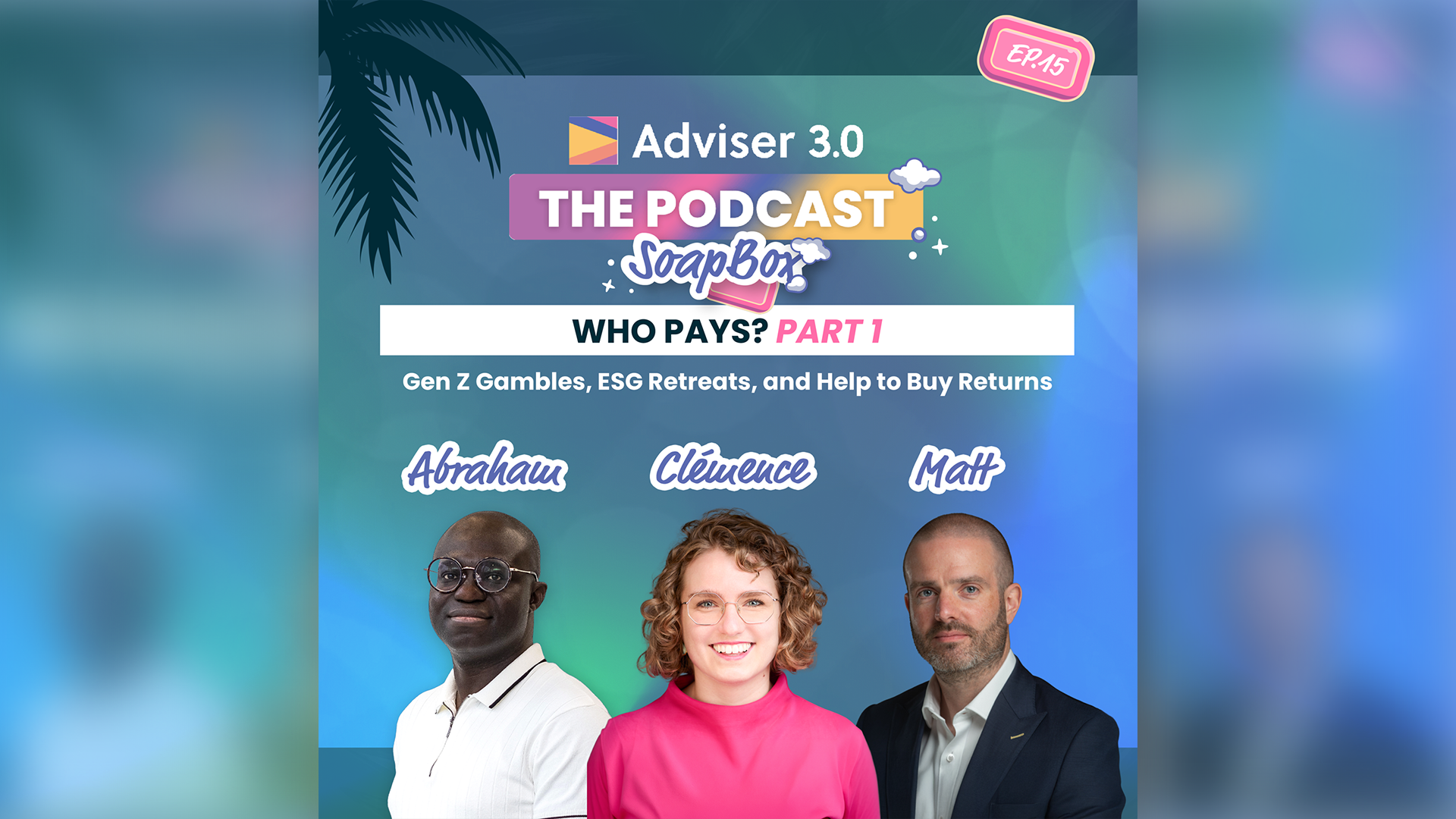
This one ran long, so SoapBox Ep.15 comes in two parts. In Part 1, Matt Pitcher and Abraham Okusanya are joined by Clémence Chatelin, Chartered Financial Planner at Ovation Finance in Bristol and a leading voice on sustainability in financial planning. It starts with a big question about the future: are our cash flow models planning for the world we actually face? From there the panel tackles why younger investors are losing faith in mainstream investing, whether ESG ever deserved its moment, and the government's new Your First Home scheme, which brings back Help to Buy with just a 2.5% deposit. Running through all of it is one question: who pays?
Planning for a Less Stable World
Clem opens with Goodstock, the community bringing financial planners, academics, NGOs and campaigners into the same room to talk about the future. Her point is practical rather than ideological. A client's dream of a house in Spain looks very different once wildfires arrive. Homes in flood-hit areas are becoming harder to insure. Food and water bills may not rise at a tidy 2 or 3% a year. Planners, she argues, need to be confident enough to have those conversations and build that resilience into the plan.
Abraham agrees on the resilience but not on the gloom. Playing devil's advocate, he asks whether the next 20 years could really be worse than the worst 20 of the last century, and points to the long-run data showing the arc of progress moving forward. Matt brings it back to the cash flow model, where the worst-case red line usually means retiring at the start of the 1970s.
"We can't plan for the world as we wish it to be."
Gen Z Gambles
Matt raises data suggesting the younger generation is growing cynical about mainstream investing and leaning instead into crypto and prediction markets, chasing quick wins rather than long-term returns. Clem compares it to the lottery. When people have little faith that things will get better, they start hoping for a miracle, and that disillusionment spreads well beyond their portfolios. The planning lesson, she says, is to help parents understand what their children are really facing, so that surplus wealth reaches them at the right time.
"It breeds apathy. Apathy is hugely dangerous to democracies."
ESG Retreats
Is the pullback from ESG being driven by advisers or by clients? Clem suggests something is getting lost in translation, because most people say they want their money to do good while many advisers report little interest. She also thinks sustainability was sold on the wrong promise. It was pitched as a way to make more money, when it is really about values and stewardship. Abraham goes further. He never believed there was any empirical reason for ESG to outperform, and sees the retreat as the cycle turning. Where the panel lands is the conversation itself: ask clients what they would not want to invest in, and be honest about the trade-offs.
"We money people are just mercenaries. We just do whatever the markets want us to do."
Help to Buy Returns
The government's new Your First Home scheme offers first-time buyers a 20% equity loan on new-build homes with just a 2.5% deposit. Clem has lived through the original Help to Buy and shares what nobody told her: the cost of remortgaging out of it, the fees, and what happens when prices fall instead of rise. Her advice is to treat any scheme with suspicion until you have every detail. Matt is just as critical, arguing that the old schemes inflated housebuilder bonuses at taxpayers' expense. Abraham, who bought his first home through shared ownership, makes the case for ownership anyway, while agreeing that the real problem is that Britain simply isn't building enough homes.
"The fix is probably a big crash in house prices and fixing the rental market."
Part 2 follows on Friday, with vanishing billionaires, a shrinking London Stock Exchange and the panel's Budget predictions.