
Government debt, particularly developed market debt, has continued to climb in recent years, starting with increased spending levels in response to the COVID pandemic. It’s naturally caused unease amongst some investors, with few signs that the level of debt will be falling anytime soon. However, it is worth noting that whilst high, government debt figures (including debt-to-GDP) are not at unprecedented levels.
History Can Repeat Itself
Government defaults are rare, but not impossible, as we know from the Greek debt crisis culminating in 2012. In historical terms, 147 governments have previously defaulted on debts since 1960 (World Economic Forum 2022), which highlights that, whilst not a common occurrence, it certainly isn’t something that is out of the realm of possibility [1]. Depending on the country and the value of the outstanding debt, the impact of these defaults will vary. Sovereign debts, unlike companies, cannot be liquidated, and there are no national or international courts that can enforce payments in these circumstances.
Russia entered a technical default in 2022 after sanctions prevented it from servicing its dollar-denominated debt through international payment systems. The repercussions of this mainly resulted in Moody’s downgrading Russian bonds to ‘junk status’, leading to high borrowing costs for the nation. This tied into sanctions on Russia due to their invasion of Ukraine, but really, the global impact was relatively minor as the markets had already priced this in. Whilst Russia was an unusual case, the important takeaway here is that governments have defaulted before and the global economy has continued to recover from such events.
Is it different this time?
Given the current levels of debt, Timeline has been asked whether we think there’s a debt crisis emerging on a global scale. In truth, this question is almost the equivalent of asking us, ‘How long is a piece of string?’. A debt 'crisis' can be almost impossible to define, as one country's crisis could well be another country's normal debt environment.
As an example, the UK sits at roughly 1:1 debt-to-GDP currently, which has caused some jittery investors to push up the yield price in 2025 [2]. However, Japan is over 2:1 debt to GDP and faces far lower yields, signalling that investors are more comfortable with this level of debt [3]. The truth is, these two countries have different fiscal and monetary environments and different debtors, which are only a couple of reasons for the disparity. The global debt landscape is incredibly complex and continues to evolve in line with monetary and fiscal policies from governments in response to various events.
Sovereign debt and interest rates often, in turn, have a knock-on effect on corporate debt within a country. So, are we seeing a trickle-down effect of a debt crisis in this market? In short, not really. S&P released their default report in February [4], highlighting that the number of companies unable to meet their obligations has held relatively steady in recent years, with signs pointing to these numbers trending down:
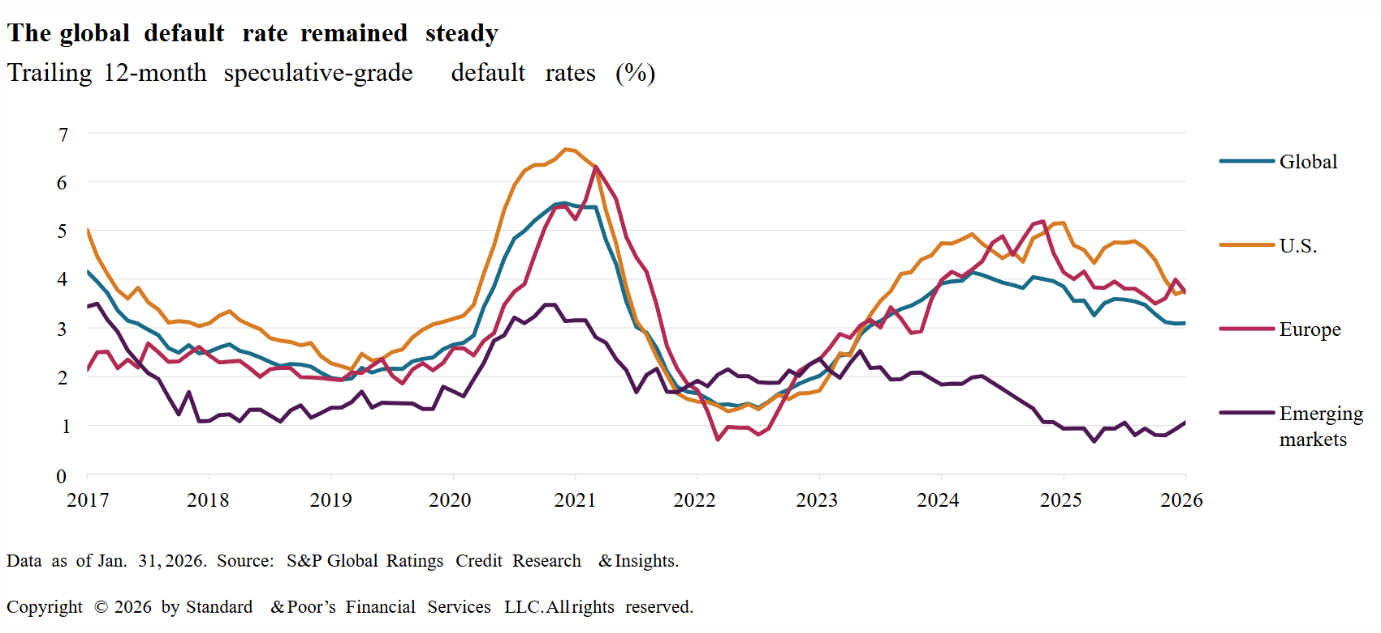
This is a positive sign; however, like all financial markets, defaults and credit patterns can be relatively cyclical. The current debt environment, from a public and private perspective, is elevated; it is far from unprecedented levels. No one can know what will happen in the markets, and Timeline is the first to admit we can't predict what will happen in the future.
So what does it mean for portfolios?
It's important to consider fixed income's role in a portfolio before getting into the weeds of the markets. At Timeline, we view fixed income as a defensive asset and an effective diversifier from equity holdings. We invest in investment-grade bonds, limiting potential default risk, whilst also investing in bonds across the maturity spectrum to help maximise diversification benefits. All investing comes with inherent risks, even cash. However, fixed income provides a solid defence, backed by historical data and empirical evidence, for equity holdings as the two asset classes have low correlation over the longer term.
Overall, whilst we understand the apprehension that might come from the current global debt environment, it's important to focus on the longer-term. No one knows what will happen in the markets, but taking a diversified approach is a solid way to help mitigate the risks we can face over the longer term.
References
[1] BoC –BoE Sovereign Default Database, 2022.
[2] House of Commons Library, Public Finances: Economic Indicators, 2025: https://commonslibrary.parliament.uk/research-briefings/sn02812/
[3] M&G Investments, Japan’s debt mountain: A crisis or a misunderstanding? 2025: https://www.mandg.com/investments/professional-investor/en-gb/insights/mandg-insights/latest-insights/2025/05/understanding-japans-complex-debt-situation#:~:text=It%20can%20be%20rolled%20over,economies%20in%20terms%20of%20interest
[4] S&P Global Ratings, 13 Feb 2026, Default, Transition, and Recovery: January Corporate Defaults Almost Entirely U.S: https://www.spglobal.com/ratings/en/regulatory/article/default-transition-and-recovery-january-corporate-defaults-almost-entirely-us-based-s101670056.
This commentary is for general information purposes only and has been compiled from sources believed to be reliable. Any views, opinions or estimates expressed in this commentary, including any forecasts or forward -looking statements, constitute the author’s judgment at the time of writing, are not guaranteed and are subject to change without notice. None of Timeline, its directors, officers or employees accepts liability for any loss arising from the use hereof or reliance hereon or for any act or omission by any such person, or makes any representations as to its accuracy and completeness.
This commentary does not constitute an offer or solicitation to invest, it is not advice or a personal recommendation, nor does it take into account the particular investment objectives, financial situation or needs of individual clients and it is recommended that you seek advice concerning suitability from your investment adviser. Past performance is not a reliable indicator of future results; investments can do down as well as up, and you may not get back the original capital invested.


.png)