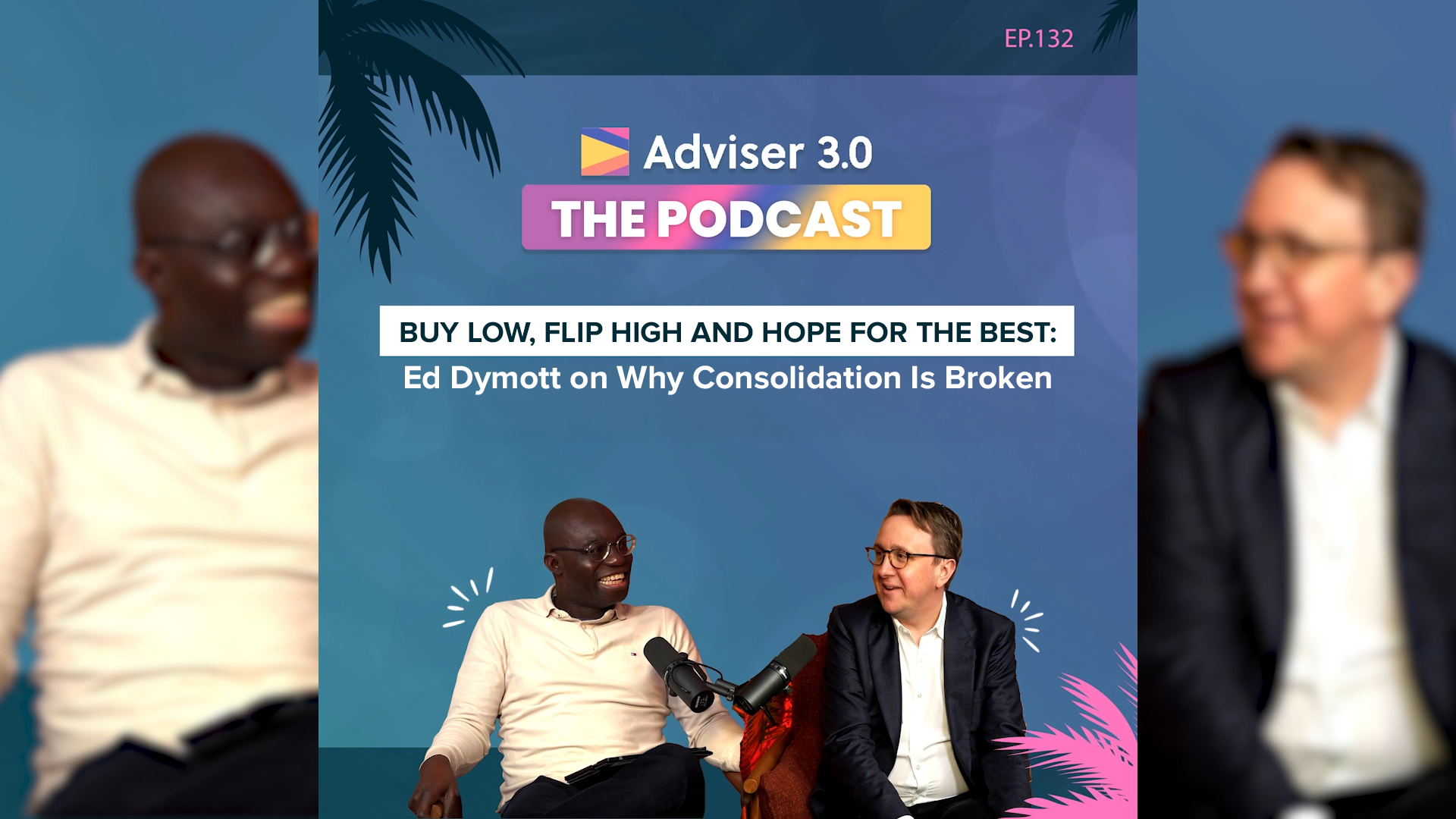
The logic seemed watertight for a while. Buy IFA practices at seven times profit, hold them loosely, do not spend too much on integration, and sell the whole thing at fifteen times. Repeat.
Ed Dymott thinks that playbook is broken. And as CEO of Benchmark Capital, which has been acquiring and supporting adviser firms for over twenty years and looks after around 35 billion in client assets, he has watched it fail up close.
In this episode, Ed joins Abraham Okusanya to go deep on what the consolidation wave actually produced, where the cracks appeared, and what a genuinely sustainable model for financial planning infrastructure looks like. It is a candid conversation from someone who has strong opinions on the profession and is not shy about sharing them.
THE CONSOLIDATOR TRAP
The private equity thesis for financial advice was always about the spread between acquisition multiples and exit multiples. Buy fragmented, aggregate, present as a single scalable entity, sell at a premium. The problem, as Ed explains, is that the bit in the middle matters enormously.
If you buy a firm, keep costs low to protect margin, and do not invest meaningfully in the adviser value proposition, the advisers notice. They were not the ones who participated in the sale price. They did not choose the acquirer. And increasingly, they have options.
"The idea that you can buy out IFA practices at seven times profit and sell the whole thing at fifteen times and not do very much in between, I think that hypothesis is now proven to fail."
Ed is clear that there are exceptions. He points to Evelyn Partners and Succession as examples of businesses that genuinely transformed what they acquired and delivered real returns for investors. But they are the exception, not the rule. For many consolidators, the model depended on cheap integration and low adviser pay, and that combination is now generating the very trend that threatens them most.
THE BREAKAWAY WAVE
For every advice business being bought, Ed argues, another is being born. The breakaway trend, where advisers leave employed roles at consolidators or private banks to set up their own firms, is one of the most significant forces reshaping the market right now.
The drivers are structural. Earn-out periods end. Principals take the economic value and exit. The advisers who built the client relationships, who did the day-to-day work, find themselves employed by a firm they did not choose, on pay scales that do not reflect their contribution, with limited upside and no equity stake. For entrepreneurially minded planners, the calculation is increasingly simple.
Ed describes taking advisers from some of the consolidators where basic earnings doubled on moving to a self-employed model with Benchmark, doing the same work with similar clients at a lower cost to those clients. The numbers are stark. In some employed models, the adviser is receiving as little as eight to ten per cent of the revenue they generate. Benchmark's model aims to pay two to three times that.
"We also do a lot in the private banking and top end of the wealth management space, whereby some of the higher end advisers are going through the same trend, thinking about how they build and get value for their own equity."
BUSINESS IN A BOX
Benchmark's proposition is built around removing the friction of running a firm so that advisers can focus entirely on clients. Technology stack, compliance oversight, regulatory cover, practice management support, PI insurance, products and solutions: all of it provided, all behind a single login.
The model deliberately accommodates both poles of the market. Advisers who want the full integrated stack, using Benchmark's in-house platform and investment solutions, can do so. Those who want to remain whole-of-market and independent can do that too. Ed is emphatic that Benchmark competes on value, not lock-in, and that its in-house solutions have to stand on their own merits rather than being the only option on the menu.
He also makes a point about how technology unlocks this. Benchmark is investing heavily in proprietary technology, with around 100 people working on it and tens of millions of pounds committed over the next few years. The target is to remove 6.5 hours of adviser time per client from the advice process, which Ed believes could increase client capacity by around 50 per cent and halve the support staff required. That kind of productivity gain is what makes a sustainable model work at scale.
AI AS COPILOT, NOT REPLACEMENT
Ed is not worried about AI replacing financial planners, and he makes the case with more rigour than most. He references a conversation with the CEO of Anthropic, who described financial planning as one of the last professions he expected AI to disrupt, on the basis that trust, relationship and accountability are precisely the things AI cannot replicate.
The mechanical parts of the advice process, documentation, research, report generation, much of the admin, Ed believes around 80 per cent of that friction can be removed by AI acting as a copilot. That is a good thing. It frees advisers to do more of the work that actually creates value: the coaching, the life planning, the big decisions where a client needs a human being in the room.
What AI cannot do is underwrite the advice. ChatGPT cannot be held accountable. It cannot be complained about to the Financial Ombudsman. And for decisions that most people only face once in a lifetime, the regulatory wrapper around regulated advice carries real weight.
"Trust, peace of mind, the quality of the planning and the coaching. Technology is not going to replace those elements of financial planning."
THE PROFESSION GROWS UP
Ed's longer view is that financial planning is on the path to becoming a genuine profession, comparable to law or accountancy, with the same mix of large national firms, strong regional practices and specialist niche operators that characterises those markets.
In that world, the current economic distortion, where leaving a large firm to set up independently can immediately double your earnings, gradually corrects. The profession matures. The infrastructure gets better. The ecosystem players, whether that is a technology provider, a network, or a firm like Benchmark, create the conditions for all kinds of planning businesses to thrive without forcing them into a single mould.
He also has a generous word for SJP, which will surprise some listeners. Whatever its failings on product restriction and adviser choice, it brought new talent into the profession, looked after an enormous number of clients, and provided a genuine home for many planners over many years. The criticism is targeted and specific, not a dismissal.
Five years from now, Ed expects Benchmark's DNA to be the same: the best infrastructure for high-quality financial planners, wherever they are on the journey from start-up to succession. The technology will be further along. The breakaway trend will have reshaped the market. And the profession, he believes, will be stronger for it.