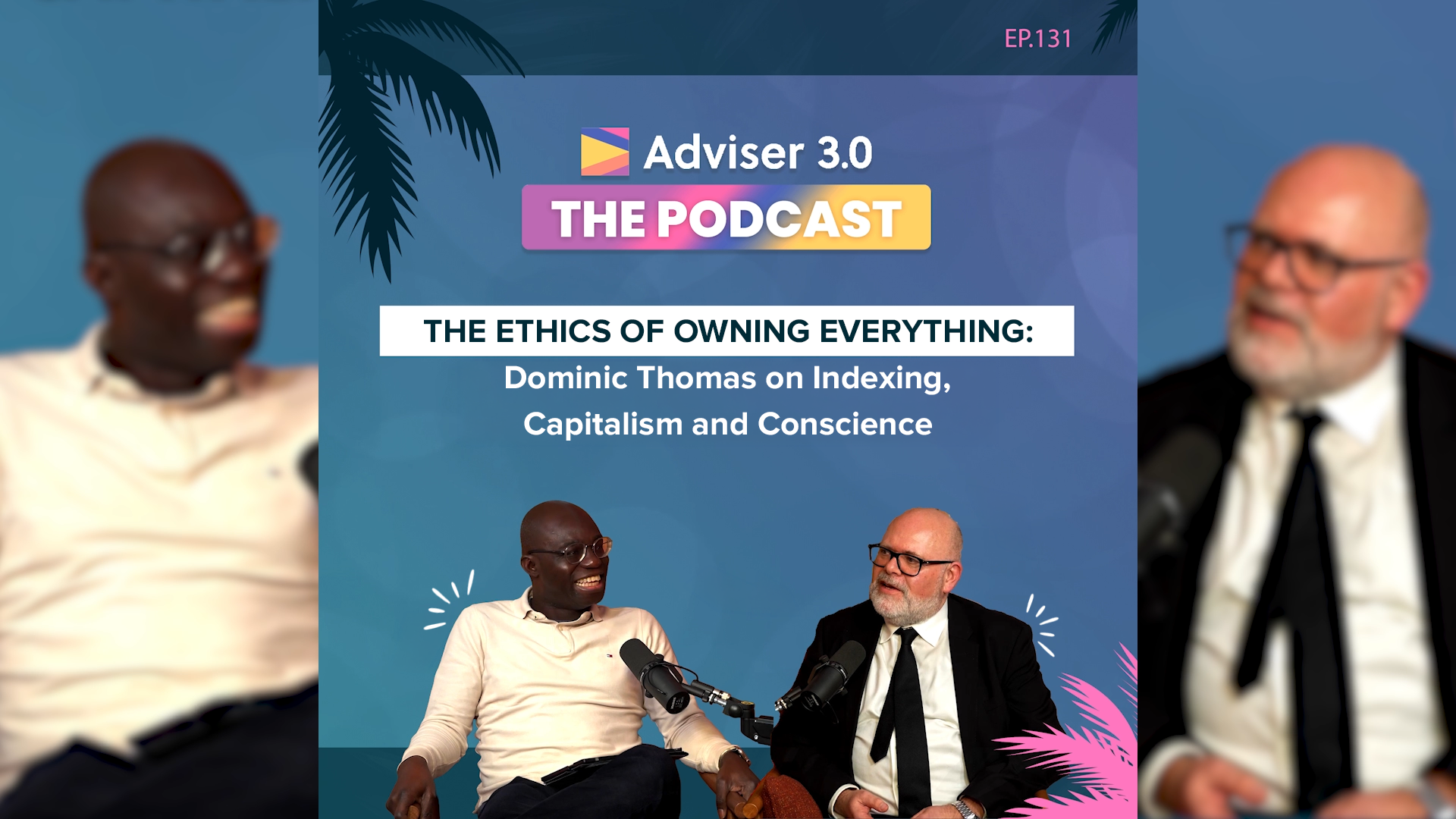
Abraham sits down with Dominic Thomas, founder and principal of Solomon's IFA, for a conversation about the ethics of owning everything and whether the profession is honest enough about the values underneath its portfolios.
Owning Companies You Disagree With
Dominic Thomas has been a fee-based financial planner since 1999, more than a decade before RDR made it fashionable. He set up Solomon's IFA on retainers and AUM fees partly out of conviction, partly because he wanted to sleep at night without worrying about clawbacks. Over 25 years the firm has grown into something more deliberate: a tight family business in Cobham, built on long-term relationships and a set of values that Dominic brings openly to his work.
Those values create friction when it comes to passive investing. He believes in the evidence and understands why you buy the haystack. But he finds the "great companies of the world" framing genuinely uncomfortable, because not all of them are great. Some, in his view, are actively harmful. When you own the whole market, you own all of it: the polluters, the monopolists, the companies whose externalised costs have not yet landed on anyone's balance sheet.
When I look at the big charts of capital market growth, there is another story beside it, the human stories, the exploitation, the damage to the environment. That is a price that has not been built in yet.
He is not arguing for active management and he is not anti-capitalism. But he thinks the profession has a habit of glossing over this tension rather than sitting with it. ESG investing offers a partial response, but it comes with its own limitations. His conclusion is not a neat one, and he is honest about that. The discomfort is real. He thinks planners should name it.
America, Concentration, and the Political Question
The conversation sharpens when it turns to US concentration in global equity portfolios. Dominic approaches it from two directions at once: the investment case and the political one. He is troubled by the scale of American dominance in global indices, and more troubled still by what he sees as the behaviour of the current US administration, the coercion of allies, the capitulation of major corporations, the use of economic power as a weapon.
He is quick to say he loves a great deal about America, and that his frustration comes precisely from expecting more. But he puts the question plainly: if a government is using economic integration as a form of leverage, does that change how you think about allocating your clients' capital to its companies?
On a bad day, when I feel particularly vexed, I want to punish corporate America because political America is being a bully. I don't think I'm alone in that.
It is not a question the profession spends much time on. Dominic thinks it should. Abraham pushes back with the standard case for staying invested. The exchange is one of the most honest in recent memory on this programme.
Is Wealth Creation Always Good?
The thread running through the episode is a bigger question: is wealth creation inherently good? Abraham argues that the companies generating these returns are, broadly speaking, making the world better. Dominic is not so sure. He draws a line between wealth that comes from genuine innovation and wealth that comes from monopoly power, borrowed leverage, or harm that simply has not been priced yet.
He references Cory Doctorow's writing on the decay of technology platforms, and the Gapminder data on global living standards. His broader point is that capitalism is the best system we have, but best available is not the same as good enough. The expansion of wealth inequality is vast, and the concentration of that wealth in the hands of individuals more powerful than many governments is, in his view, a problem rather than an inevitability.
Building a Firm Around Enough
Dominic has been building Solomon's for 25 years. It is now a family firm in the most literal sense: his son-in-law is the other qualified adviser, his daughter handles marketing, and his other daughter's partner is training through the firm. He did not plan it that way. It evolved through relationships and through a belief that good financial planning requires genuine long-term trust.
He wants to reach five advisers, each managing around 100 client families. The FCA data suggests that is around the sweet spot for a smaller firm, enough scale to be meaningful, small enough to keep the culture. His clients, he says, mostly do not want unbridled consumption. They want enough. The job is helping them work out what enough actually looks like, and building a plan around that.
That is what this conversation keeps coming back to. Not the mechanics of investing, but the values underneath them.