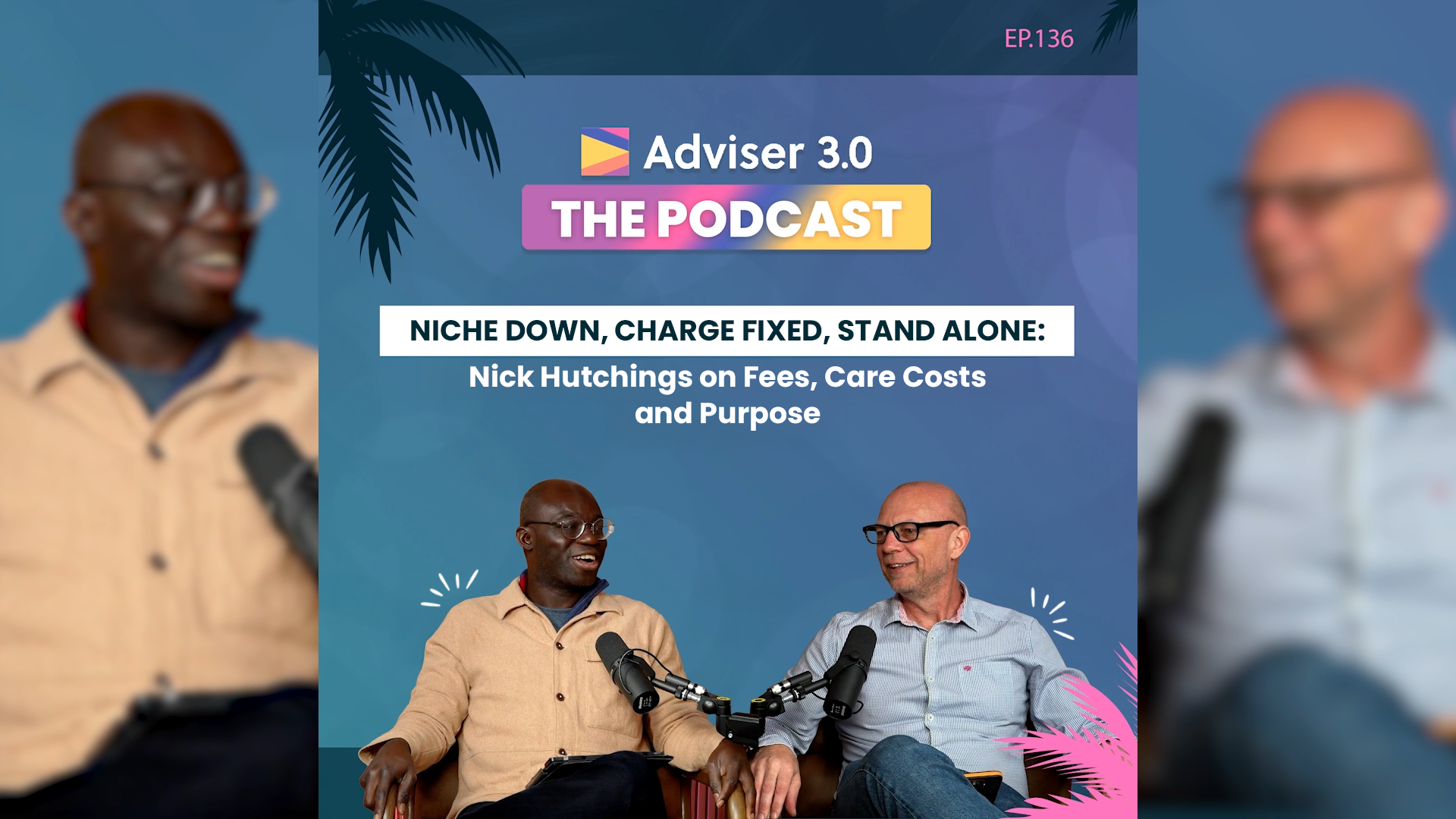
Nick Hutchings spent years being acquired. Firm after firm, acquired. Each time, a compromise he wasn't willing to make. So he went solo, built his practice around fixed fees and evidence-based investing, accidentally niched into retirement, and ended up on the Martin Lewis show along the way. In this episode of Adviser 3.0, he joins Abraham Okusanya for a conversation that's as honest about the hard parts of going it alone as it is about why doing so was the only option that made sense.
The Long Way Round
Nick started in financial services in 1997, at a firm he describes as the Wild West of financial advice: sell as much as you can, the answer is our product. He stayed in the industry through RDR, pension freedoms, and more than a decade as a BDM at Standard Life. But it took losing his best friend at 45 and discovering the world of financial planning through Paul Adamson to make him change direction.
The path to going solo was anything but direct. He joined firms, each of which was subsequently acquired. Each time, he found himself facing a compromise he wasn't willing to make: restricted investment ranges, networked structures, cultural fits that didn't fit. Eventually, rockwealth Reading offered everything he would have built himself, and he joined two and a half years ago.
"If I was going to set up my own firm, it would have effectively looked like rockwealth, just with a different name. Evidence-based investing, fixed fees, financial planning at the centre. That's what I was looking for."
Fixed Fees, No Apology
Nick is not evangelical about fixed fees in the sense of telling everyone else they're wrong. But he is clear about why they're right for him. The argument is simple: percentage-based fees create structural conflicts of interest. They incentivise consolidation regardless of whether it's appropriate. They cross-subsidise wealthy clients at the expense of less wealthy ones. And they tie the adviser's income to the portfolio, not the planning.
His approach uses the VECTR framework, borrowed from Alan Smith, to price client engagements: value, experience, complexity, time, overheads and risk. Some clients pay more. Some have had their fees reduced. The goal is to charge for what the work actually costs, and to feel authentic doing it.
"My clients know exactly what they're paying. It helps me feel authentic. Each to their own, but for me, it's the right thing."
He's also honest about where he fell short. He didn't build inflation-linking into early client agreements, and getting around to doing it has been harder than expected. He is working through it, but the implementation friction is real, and he says so plainly.
Accidentally Niched
Nick didn't set out to become a retirement specialist. He got there gradually, drawn by where he thought both the need and the wealth were concentrated. Watching his father retire in 2012, lose his sense of purpose, fall into a depression, and die in 2019 gave that professional observation a personal weight. He believes retirement killed his father, and that belief shapes how he works with clients.
His practice now focuses almost entirely on people at or in retirement. He does pro-bono work with their adult children, helping 20 and 30-year-olds stuck in default pension funds that are unlikely to suit them. And he thinks deeply about the psychological transition into retirement, not just the financial mechanics of it.
"Most people don't prepare properly for retirement. They might prepare financially, but they don't prepare psychologically for the transition."
The Retirement Lounge and the Martin Lewis Show
A year ago, Nick launched The Retirement Lounge, a podcast aimed at people approaching or in retirement. He's now 30 episodes in. It came directly out of his own podcast habit: he walks his dog for two hours a day and spends most of that time listening. The podcast led, indirectly, to an appearance on the Martin Lewis show on ITV, where he answered live questions on annuities and care fees to a national audience.
The Martin Lewis experience was instructive. You get 10 to 15 seconds to answer questions that any financial planner would instinctively answer with "it depends." The algorithm then served him the post-show social media commentary, including confident declarations that annuities are always bad because of what you could get in the S&P 500. He has a wry, patient view of all of it.
"The first word from any question a financial planner gets is always going to be 'depends.' And you've got 15 seconds. You just have to say as much as you can."
Nick has also been quoted in the Telegraph on care fees planning and has further press interest following from that. He's approaching capacity as a solo adviser and is beginning to think about bringing in trainee advisers. The compounding effect of content, media and referrals is doing exactly what Pete Matthews told Abraham it would do, years in.
The Care Fees Conversation Nobody Is Having
Nick's most distinctive specialism is care fees planning, and specifically deferred care fees annuities, a product he argues is massively underused, and for reasons that are not difficult to explain.
Care in the South East now averages around £2,000 per week. For a family with a parent who has attendance allowance, a state pension and other income covering £40,000 a year of a £100,000 annual cost, the shortfall is £60,000 a year. An immediate needs annuity might cost £240,000 to cover that gap. A deferred care fees annuity, which pays nothing for the first two years but then pays for the rest of the person's life, might cost £120,000. The maths is straightforward. But the incentive to recommend the cheaper product is not there for advisers charging a percentage of the premium.
"I asked providers what percentage of annuities bought are deferred care fees annuities. It's a really small number. Single or small double digits. But for me, about 50% of the annuities my clients buy are deferred. Because I charge fixed fees, I don't care which one they choose."
He also educates care home staff about care fees annuities, because many have never heard of them. The conflict of interest in the care fees advice world is, he argues, more explicit than almost anywhere else in financial planning, and charging fixed fees is the cleanest way to remove it.