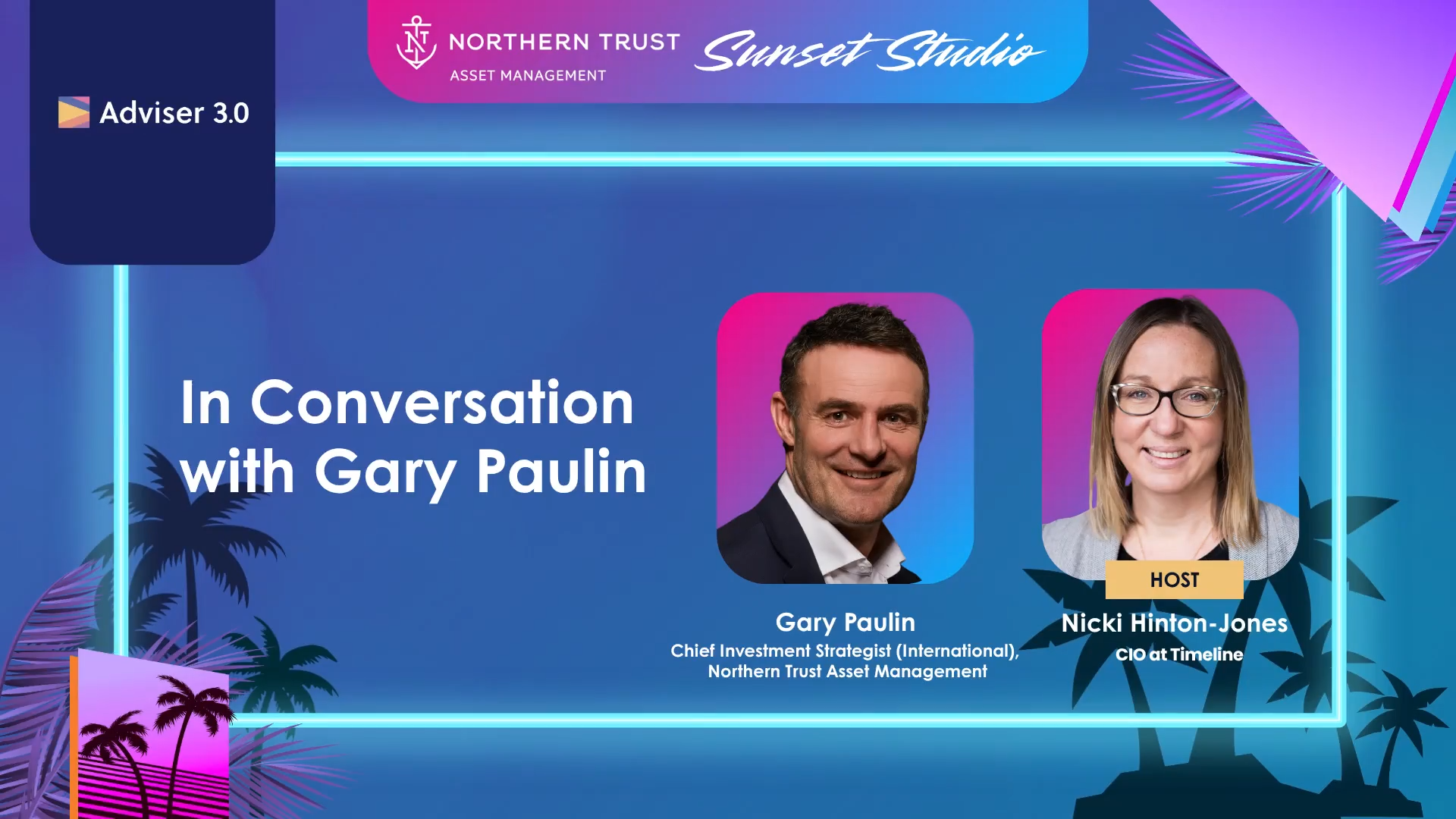
Recorded live at Adviser 3.0 2026, this is the fourth and final Sunset Studio Session. Nicki Hinton-Jones, CIO at Timeline, sits down with Gary Paulin, Chief Investment Strategist, International at Northern Trust Asset Management, for a conversation that opens with a confession: every major career move Gary has ever made has landed within days of a market top, from the Russian debt crisis to nine eleven to the Global Financial Crisis. What follows is less a warning than a lesson in how to read risk when the range of outcomes feels wider than usual.
The Career That Calls the Top
Gary opens with a self-deprecating tour of his own timing. He arrived in the UK the same week as the 1998 Russian debt crisis, researched pets.com as a Merrill Lynch intern just before the dot-com bubble burst, started full time in downtown Manhattan on 9/11, and set up his research brokerage Aviate Global thirteen minutes from the top tick in the Euro Stoxx before the Global Financial Crisis. He sold that business just before Brexit, then joined Northern Trust Asset Management on Liberation Day last year. His conclusion is not that he is cursed, but that markets recover from things that felt career-ending at the time, and that this is worth remembering when the news feels unusually heavy.
Risk is the gap between what we can see and measure, and what we can't see or imagine.
He credits this framing to Elroy Dimson, the London Business School professor behind the Global Investment Returns Yearbook. The point, Gary says, is that advisers and clients can all see the jobs AI will disrupt and the inflation risk from the Strait of Hormuz, but almost nobody is pricing in the jobs AI will create or the upside from a more normalised Middle East, a shift he notes the Israeli and Omani stock markets have quietly been pricing in throughout the conflict.
The Psychology of Patience
Nicki and Gary spend real time on why clients make bad decisions at the worst moments. Gary leans on Peter Lynch's One Up on Wall Street ("if you sell in desperation, you always sell cheaply"), Buffett's line about markets transferring money from the impatient to the patient, and Jason Zweig's Your Money and Your Brain, which found that investment losses activate the same part of the brain, the amygdala, that processes mortal danger. That is the neurological basis of the fight-or-flight sell decision, and Gary is candid that he still feels the pull himself when markets fall.
If you missed the ten best days in markets over the past twenty years, you've halved your return.
Why Mega Trends Are the New Macro
Gary argues that the old playbook, reacting to non-farm payrolls on a Friday afternoon, no longer captures what actually moves markets. He points to the same week ChatGPT launched in October 2022, when every analyst in a Bloomberg survey was forecasting a US recession for 2023. AI had other ideas. His broader thesis is that "micro is now macro": understanding a handful of technology companies tells you more about the macro picture than traditional data does. He illustrates this with Hong Kong's port authorities buying autonomous trucks, a decision driven less by the appeal of the technology and more by a retiring workforce with no succession, since younger workers are choosing to be influencers over dockworkers.
Is the US Stock Market Too Concentrated?
On the question every adviser is fielding from clients, Gary makes three points. Concentration has been higher before (railroads made up 63% of the market at their peak, well above where the "Magnificent Seven" sit today). Current concentration is a lot lower once you adjust for valuation, since these stocks have derated relative to their earnings growth. And most importantly, he argues, the comparison to prior bubbles misses that these are not really seven companies.
These seven stocks aren't companies so much as conglomerates. The Magnificent Seven have bought over eight hundred companies between them.
He also pushes back on the idea that these businesses are simply a proxy for the US economy, noting they generate roughly half their revenue outside the US, while acknowledging that AI capital expenditure this year alone could add two and a half percent to US GDP growth, roughly matching total GDP growth last year.
The Case Against an AI Bubble
Gary runs through the five classic signals of a bubble, concentration, overspending with no return, circular financing, leverage, and euphoria, and argues none of them hold up the way they did in 2000. On euphoria specifically, he points to the fact that "is AI a bubble" is now one of the most common questions he gets from clients as evidence against euphoria, not for it, quoting John Templeton's line that bull markets die on euphoria, not scepticism. On overspending, he notes that every dollar of AI capital expenditure is currently backed by at least a dollar of order backlog, and that Anthropic's annualised revenue went from roughly $9 billion in December to $44 billion in April, a scale of growth he says the market has never seen before.
Less than three percent of US households currently pay for an LLM. That's like having a Ferrari and only using it in reverse.
The Disinflation Argument
Perhaps the most contrarian call in the conversation: Gary believes new Fed chair Kevin Walsh will be more dovish on rates than markets currently expect, not because inflation is under control, but because AI is acting as a disinflationary force in the same way China's entry into the WTO did in the 2000s. He credits this framing directly to language used by Walsh and Treasury Secretary Scott Bessent, both of whom he says view AI as allowing central banks to run the economy hotter without triggering inflation, a dynamic he compares to the Greenspan era of the 1990s.
What Could Go Wrong
Asked for the risk nobody is pricing in, Gary skips the obvious answers. He is more concerned about the growing anti-AI protest movement in the US, which he compares to the backlash against nuclear power in the 1970s that contributed to the decade's oil shocks and lost economic growth. His bigger worry, though, is something more mundane: a range-bound market, where valuations grind sideways for over a decade the way they did between 1968 and 1982, even while individual sectors and stocks perform very differently underneath the surface.
Most money is not lost in war. Most money is lost in peacetime.
The Closing Advice
Asked what he would tell advisers guiding clients through the next five years, Gary keeps it simple: be patient, prepare rather than predict, and be deliberate about who you spend time with. Bears might sound smarter, he says, but it's the bulls who make the money.