
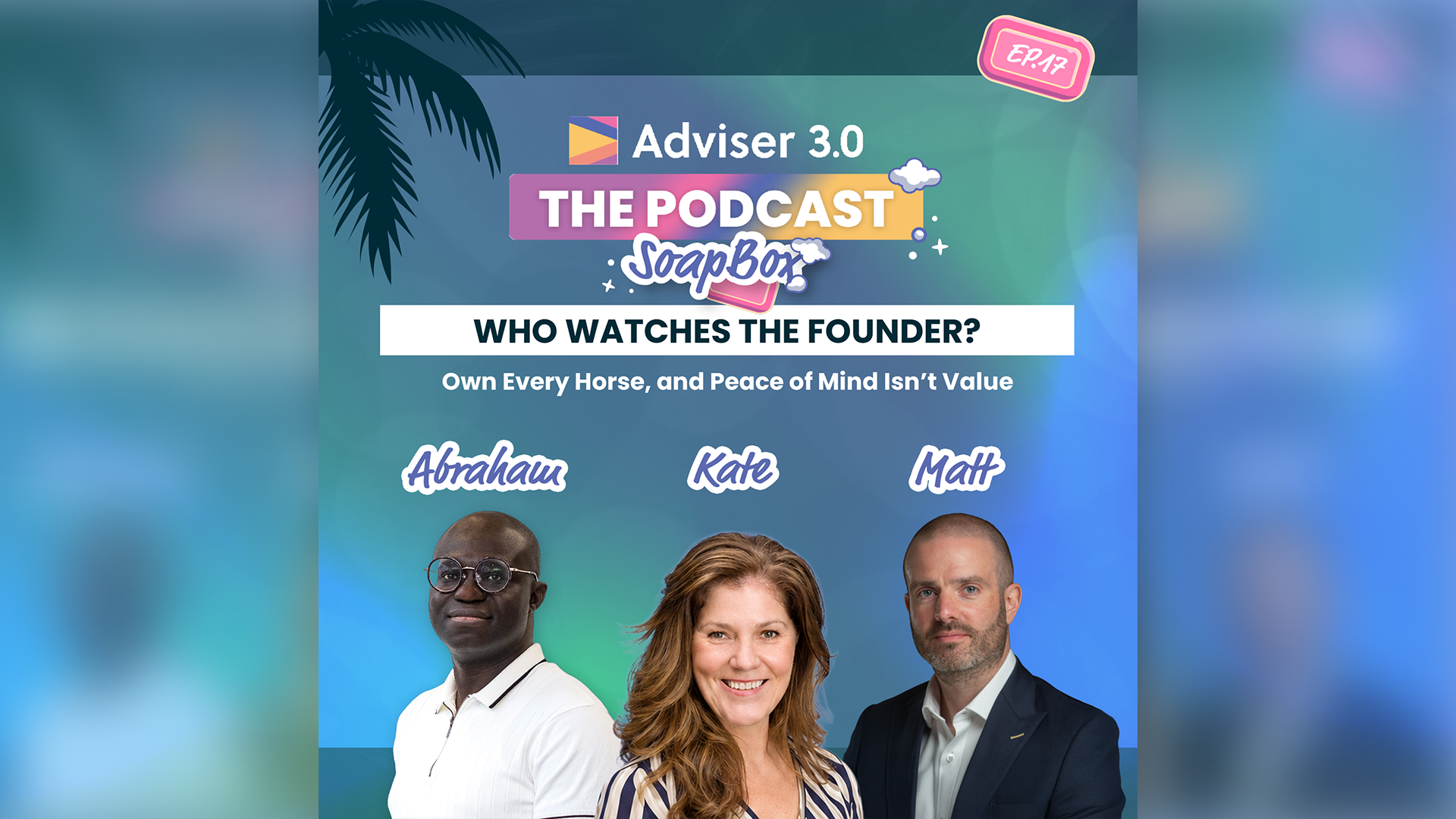
Abraham Okusanya and Matt Pitcher are back on the SoapBox, joined by Kate Hudson, Managing Partner, Advisory Services at GSI (Global Systematic Investors). Kate has more than 30 years in financial services and global asset management, including setting up Dimensional's adviser business in Australia and New Zealand. The panel asks who should have been watching as Jensen Huang resigns from Nvidia, takes on an active manager's claim that diversification no longer works, weighs up the government's plan to nudge savers into a default retirement income, and asks how advisers prove their value now the FCA says peace of mind won't cut it.
Jensen Resigns
Jensen Huang has resigned as CEO of Nvidia, the world's largest company by market value, and Kate is clear about what kind of story it is. GSI holds the stock in one of its funds, and as an ESG integrated investor, governance is where it looks first. A brilliant entrepreneur running the business with no chairman and no accountability layer above him is a risk shareholders have a right to know about, however well the share price has done. For Kate, the problem was never how many people reported to him. It was who he reported to, and where the succession plan was.
Abraham agrees the board needed more independence, but defends the founder. One exceptional person can make an outsized difference, and the history of Silicon Valley is full of boards that sacked founders and destroyed value, which is why founders now fight for control through super voting shares. Board governance, he argues, is no fail safe. Matt worries that founder-led giants now list straight in among the biggest companies in the world, with no time to grow into proper governance. Kate's answer is that markets work: let entrepreneurs earn big rewards as long as it's transparent, and let the market judge. It already has, by marking the company down when the governance failed.
"I think this is a governance story first and last."
Concentration in Index Funds
An active manager has argued that in a world of AI and mega cap hyperscalers, diversification no longer works, and investors need concentrated portfolios instead. Kate has heard it before. She joined Dimensional during the tech boom of the late 1990s, when everyone said this time was different and diversification was finished. Then the market turned, and diversification still mattered.
She points to the long run research: a tiny minority of stocks has driven nearly all the stock market's wealth creation, and periods of heavy concentration have come round again and again. If you don't own every horse in the race, the odds are you miss the winner. Matt adds that a long winning streak from one manager is exactly what the maths predicts when there are tens of thousands of them. Abraham brings the Morningstar evidence that index funds are less concentrated than active funds by any objective measure, and Kate pushes it further, arguing for breadth across countries, sectors, size and factors to improve on a cap weighted index.
"Concentration is not a crisis. It's not a bubble, it's not an anomaly. It's how equity markets work."
The Stronger Nudge
The government is consulting on guided retirement: steering workplace pension savers into a default retirement income, rather than leaving them to work it out alone. Matt sees good intentions, and agrees people underestimate how long they will live, but worries it will make it harder for advisers to move clients out of workplace schemes. Abraham calls the likely outcome an annuity in all but name, and warns that judging each pot in isolation could push people through a door they can't come back through.
Kate, drawing on Australia's experience, backs a simple default because complexity leads to no decision at all. Her concern is the other end: people who should not be in the default must find it easy to get advice and get out. Matt is blunt about the profession's limits. Advisers aren't set up to serve another slice of the population, so the mass market needs a nudge that works.
"It has to be simple, has to be automatic because people do not like making decisions."
Peace of Mind Isn't Value
The FCA's latest work on price and value makes it clear that firms must evidence the outcomes they deliver, and that peace of mind alone won't count. Matt says that will sting for planners who have traded on it for years, and flags the paper's warning about some clients subsidising others through differential pricing. Abraham explains why the bar is so high: value has to be proven for the end client, through the whole chain of costs, and even being cheaper than the market isn't enough on its own.
Kate's tool is a simple question. Take every benefit you claim and keep asking "so what?" until you reach an outcome the client actually cares about. Saving tax becomes more money, which becomes retiring early or helping the children. She argues the data to prove it is already there, in platform trading records, cashflow models and CRM systems. Matt adds the final piece: get it on record, in the client's own words.
"So what is my value? I saved tax, so what?"