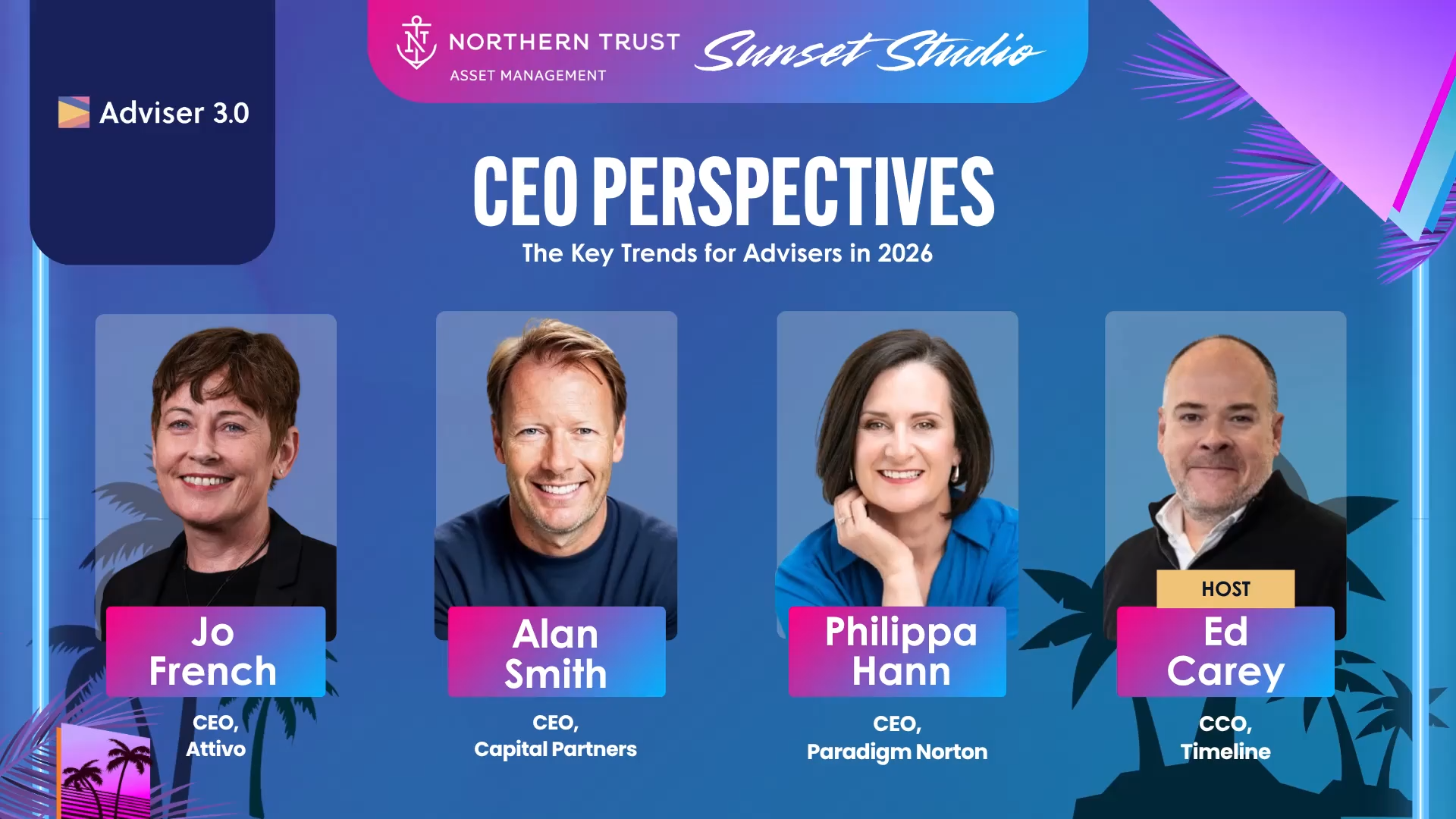
What does it actually take to run a high-performing financial planning business in 2026? This is the first of our Sunset Studio Sessions, recorded live on stage at Adviser 3.0 2026. Ed Carey, CCO at Timeline, chairs a frank panel conversation with three CEOs who are doing things differently: Philippa Mather of Paradigm Norton, Jo French of Attivo, and Alan Smith of Capital Asset Management.
The discussion covers four of the biggest topics shaping adviser businesses right now: AI adoption, business growth, referrals, and talent. What follows is a summary of the key themes from the session.
Blockbuster Got an App
AI is the topic everyone has an opinion on, and the panel didn't hold back. Philippa Mather set the tone early: she isn't an AI sceptic, but she isn't drinking the Kool-Aid either. At Paradigm Norton, the approach is deliberate followership rather than leadership. "We are curious. We are playing with it, but it is certainly not leading our business."
Jo French described a contrasting approach at Attivo. Rather than reaching for a general-purpose generative AI tool, the firm spent two years training its own large language models around its own financial planning advice policy. The goal was to eliminate what she called "the human verification tax" — the need for a person to check everything a machine produces. By training on its own data and compliance framework, Attivo can automate compliance checking of client meetings at the point they happen, without needing manual review after the fact.
"If you start from training a large language model around what your data set is, then you remove the need for a human to have to check something that a machine created — because it's actually something you trained the machine to produce."
Alan Smith offered the most provocative frame for where the industry currently sits. His Blockbuster analogy: most firms are doing the same things they always did, just slightly faster. Meeting note-taking was the obvious early win, but it simply pushed the bottleneck downstream to suitability reports and follow-up work. The more interesting question, he argued, is what an AI-native business would look like if you started from scratch today. Why write a suitability report at all, if the legislation doesn't require one? Why not replace it with a client portal that is always on, always updated, and answers questions in real time?
"The idea is do the same things but do them slightly faster or slightly more efficiently. Let's go back to basics and let's not do them at all if we don't have to."
Philippa's pushback was pointed: the industry has been predicting transformative AI timelines for years and has consistently been wrong. The only thing advisers can reliably control is how well they serve clients with the people they have. Client portals and better technology are valuable, but she wouldn't put them in an AI bucket — she'd put them in a "how do we serve clients better" bucket.
The Growth Problem Nobody Wants to Talk About
Ed Carey laid out an uncomfortable fact: strip out what the stock market has done, and most adviser firms are not meaningfully growing. The structural reasons are well known — roughly half of all regulated adviser firms in the UK are sole traders, and the average adviser age sits in the late fifties. Many of those businesses are lifestyle businesses with no real ambition to scale, and that is entirely rational. They have enough. Referrals trickle in naturally. Growth happens without anyone really trying.
But for firms that do want to grow, the panel identified a critical insight: 65% of new clients come from referrals, 15% from digital, and 5% from partnerships. Converting a cold prospect requires roughly four times the effort of a referral, because trust has to be built from zero. The maths strongly favour a systematic approach to referrals.
"If you were to put up a show of hands and ask 'do you have a structured, systemised, repeatable, scalable process for referrals?' — I promise you, 99% of people would say no. It just happened."
Philippa described the challenge of pivoting Paradigm Norton from an acquisitive growth model to an organic one after taking over as CEO. The shift exposed a skills gap: advisers who had been handed client books didn't know how to go out and get new business. Rebuilding that muscle has taken time, coaching, and incentives. Her summary: "I have built an entire career on going and having a coffee. That's how it works. People buy people."
Jo French added a note of realism on the cost side: onboarding a new client properly takes 30 to 50 hours. For a firm pursuing organic growth, that has to be factored into capacity planning before anyone agrees to take on five new clients a year.
Attracting the Next Generation
The average age of a UK adviser sits in the late fifties. By contrast, the average adviser age at Paradigm Norton is 44, at Attivo it is 38, and at Capital Asset Management it sits around 44. All three firms are meaningfully below the industry average, which matters for succession and for the character of the firms.
Philippa attributed Paradigm Norton's position in part to being employee-owned and female-led — both of which draw certain kinds of talent. Seven new hires joined last year without the firm struggling to recruit. The bigger priority now is performance management: giving people the environment and expectation to be excellent, not just present.
Alan Smith pointed to TRAP, the podcast he co-hosts, as an unexpected recruitment engine. Two hundred and fifty people attended a live event the night before the conference, with an average age in the thirties. A steady flow of direct messages and emails arrive from talented people in their twenties who heard the podcast and decided financial planning was a career worth pursuing. The profession has a reputational problem — it sounds like it's about money and spreadsheets — but once people understand what it actually involves, it becomes genuinely aspirational.
Performance Management as a Competitive Advantage
Philippa described Paradigm Norton's approach in direct terms. The firm runs weekly half-hour one-to-ones for every direct report, every week. Six-monthly talent reviews use a nine-box grid mapping performance against potential. Anyone sitting in the bottom-left corner is expected to move, whether that means improving or moving on. "There is nowhere for anyone to hide. Some people love it. Some people hate it. If you hate it, that's great. You will leave with our love."
"One-to-ones are absolutely far more effective than any AI, as far as I'm concerned. We have increased productivity. We have increased every point on our employee survey."
Jo French agreed that performance management is a learnable skill, not a natural one. The hardest part is teaching managers to have difficult conversations. Done well, it creates a culture where high performers feel supported and challenged rather than held back by colleagues who are coasting.
Alan's final point on talent was optimistic: the next decade will not be short of people wanting to enter financial planning. The battle will be creating environments worth joining. Culture, hybrid working, clear progression, and genuine purpose will be the differentiators for the firms that attract the best people.
Listen to Adviser 3.0 Available on Spotify, Apple Podcasts and YouTube