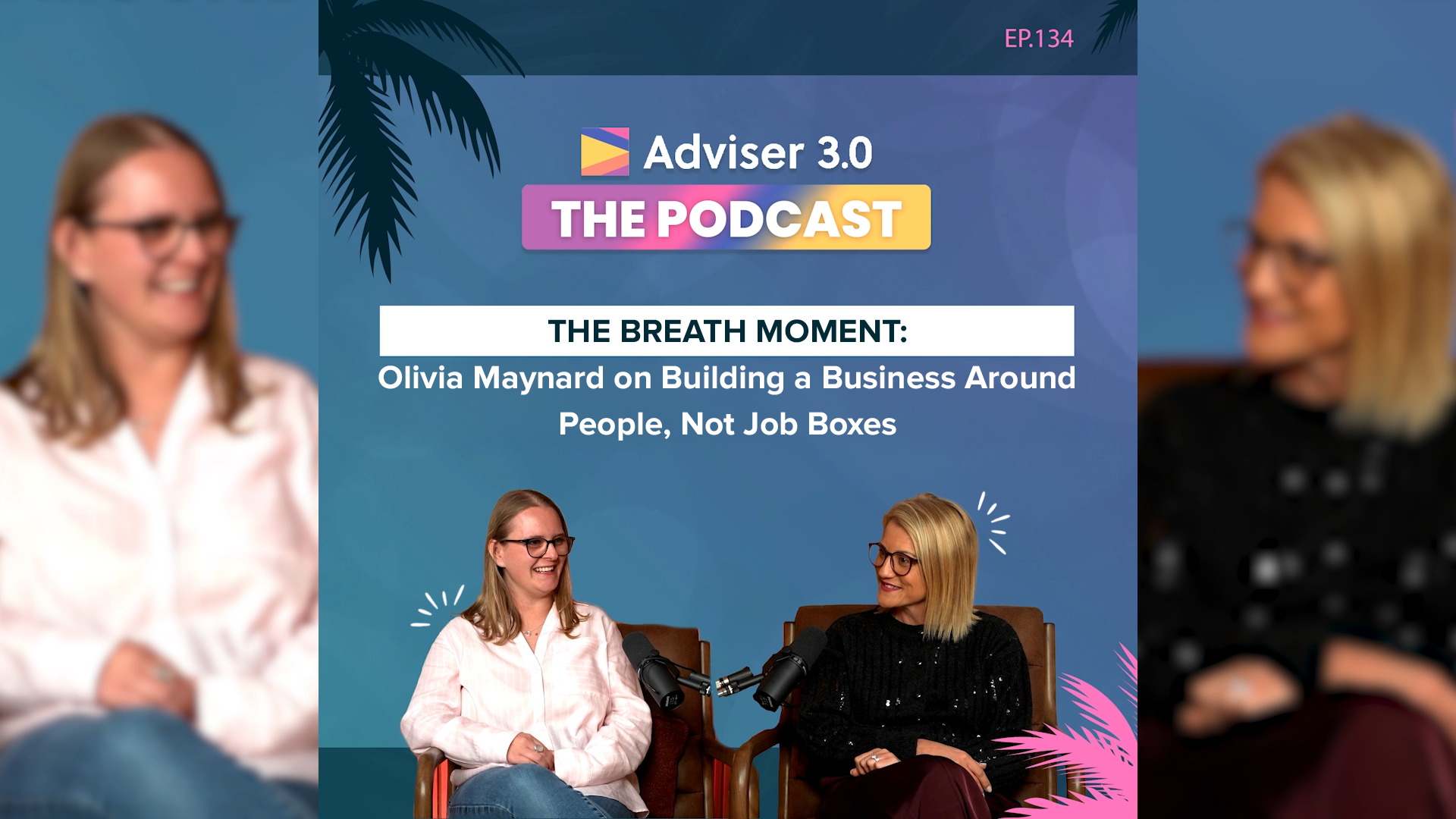
Olivia Maynard joined TFP Financial Planning as an administrator at 18. She went through the Aspire apprenticeship, qualified as a chartered financial planner, and eventually became Managing Director without ever planning to. In this conversation with Kate, she talks about the moment she realised financial planning was more than a job, why she stepped away from advising to run the business, and how she has built a culture where nobody is confined to their job title.
The Breath Moment
Olivia did not set out to be a financial planner. She had applied for a midwifery degree, got in, and walked away after a mock procedure involving a balloon and a dummy. Finance found her instead, through an admin role at a small firm in Essex where she was encouraged to sit in client meetings from the start.
What hooked her was not the technical side. It was a feeling she kept witnessing across the table from clients. She calls it the breath moment: that exhale when someone finally lets go of anxiety they have been carrying, in some cases for decades.
"You see people release that breath and you don't know how long they've been holding it. It could have been 20 years. It could be 12 months. But they sit there and go, oh. And I think we do that. We let them let go of that tension."
It is the reason she still believes financial planning is one of the most extraordinary jobs in the world, even after stepping back from doing it directly. The mission did not change when her role did.
From Planner to MD
The move into operations was not planned either. Olivia returned from maternity leave to find TFP's ops function had disappeared, and the three directors were trying to split the workload between them. Within a month it was clear that was chaos. Rather than hire externally, Olivia put her hand up.
She had grown up around family businesses. The operational instincts were already there. But more than that, she saw a different kind of impact available to her: instead of helping a handful of clients directly, she could build the engine that allowed the financial planners to help far more people, at the standard the firm had always wanted to reach.
The transition was not without friction. People are protective of their expertise, and financial planners are no different. What made it work, Olivia says, was refusing to box anyone in, including herself.
No Job Boxes
TFP's culture is built on a simple premise: people do their best work when they are working on things they are genuinely drawn to, not just the tasks their job title implies. Olivia has embedded this deliberately, from the physical layout of the office (no assigned desks, so anyone can pull up alongside whoever they are most useful to that week) to the training needs analysis she runs annually, which asks explicitly about interests outside a person's current role.
"If you really think you're drawn to marketing and you love what Dan does and you want to learn more about that, tell me. And if you don't want to tell me during the year, this might be your annual prompt."
The same logic applies when it comes to communication. One of her most formative lessons as a leader came from realising she communicates the way she wants to be communicated to, giving just enough information to act. Her previous practice coordinator needed full context to feel confident. Neither approach was wrong. But once they named it, they could design around it, and then teach the whole team to do the same.
Sports Team, Not Family
TFP does not describe itself as a family. It describes itself as a sports team. The distinction matters. A family offers unconditional belonging. A sports team offers something different: a place where everyone is expected to perform, where talent is celebrated but so is the ability to collaborate, and where tenure is not guaranteed just because you are good at your job.
The model also has a name for what it explicitly rejects: the brilliant jerk. Someone who is technically excellent but corrosive in how they operate. At TFP, that is not a trade-off worth making.
When competing views collide, the firm uses a principle borrowed from some of the better-known tech cultures: disagree and commit. You make the case, you hear the other side, and if the majority goes a different way, you back the outcome fully, even if you would have chosen differently.
Resilience, and Its Limits
Olivia's first pregnancy, during Covid, ended in an emergency. At 30 weeks she was taken to hospital, told she was in organ failure from severe pre-eclampsia, and had her daughter delivered by emergency C-section that same day. The baby, born at just over 2 pounds, spent seven weeks in neonatal. Olivia's husband's paternity leave ran out before their daughter came home.
She tells the story calmly, almost matter-of-factly. What strikes her most in retrospect is that she logged on the morning after. She emailed from a hospital waiting room during what turned out to be an ectopic pregnancy two years later. She was, by her own account, a bad example.
"Since then I've come back in and been like, team, do not follow my example. That is a terrible example. If any of you ever tried to do that, I would confiscate your laptop."
Resilience and adaptability are qualities she actively looks for when hiring. But she is honest that she has had to learn, and is still learning, where those qualities end and unhealthy habits begin.
What's Coming
Olivia's view of the next five years for financial planning is less about roles disappearing and more about roles transforming. She is watching the paraplanner market shift, with more technical specialists moving to outsourced models, and she does not think it is purely about efficiency. She suspects some of it is about value: people leaving firms that made them feel replaceable.
Her own bet is on the inverted pyramid. Fewer support staff at the base, more financial planners at the top, and a bigger operational layer in the middle making sure everything runs. Technology enables the lean structure, but it does not replace the human parts. If anything, the race to automate everything that can be automated is really a race to have more time for the things that cannot be.
TFP's ambition is to become the UK's voice on retirement planning. Not just a well-regarded Essex firm. The goal is content, education, and presence at a national scale. Olivia says it without apology. There is no prize, she points out, for having nothing to aim for.
Enjoyed this episode? Listen to Adviser 3.0 on your favourite platform.