For years, financial advisers have been told that empathy is their ultimate competitive advantage, the moat that no algorithm can cross. But what if that assumption is the most dangerous bet in the profession?
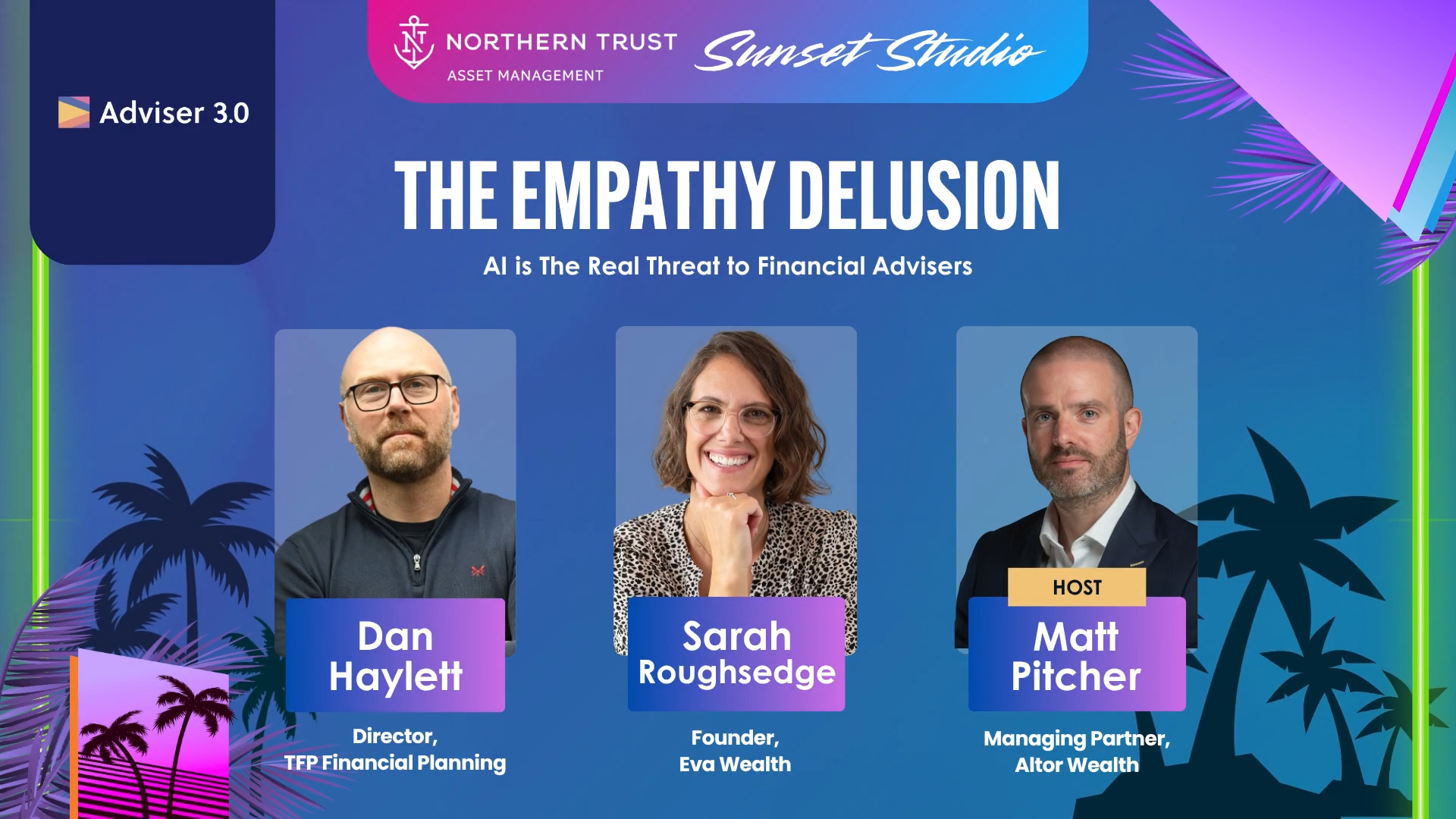
Recorded live at the Adviser 3.0 2026 conference, this special live edition of SoapBox takes Dan Haylett's viral LinkedIn article, The Empathy Delusion, as its starting point and tears into one of the most urgent questions facing the advice profession today. Host Matt Pitcher is joined by Sarah Roughsedge, Chartered Financial Planner and Founder of Eva Wealth Management for Women, and Dan Haylett, Director of TFP Financial Planning and Founder of Humans vs Retirement, for a debate that is equal parts sobering and energising.
The Numbers That Change the Argument
The debate opened with a live audience poll: is empathy our primary defensible moat against AI? Two thirds said yes. One third said no. And the panel spent the next hour making a compelling case that the confident two thirds might want to think again.
Dan Haylett, whose LinkedIn article sparked the session, laid out the data: 28 million UK adults now use AI for money management and financial questions, making it the number one use of AI in this country. Sixteen million have asked AI for specific financial advice. These are not people who tried a chatbot and gave up. They are people finding something useful, something that works for them, often in ways that human advisers do not.
"When we see what people are using AI for, and the stats around how it's showing better empathy in the words of the user than an actual human being, then we can't just say that's rubbish. We have to respect what the public are doing and how they're using it." — Dan Haylett
The Shame Nobody Talks About
One of the session's sharpest moments came from Sarah Roughsedge, who raised something that had gone largely undiscussed throughout the conference day: the shame many people feel around money. Seeking financial advice from a human involves exposure, judgement, the sense of being assessed. AI removes that barrier entirely.
Dan built on this with research from the mental health space, where therapy delivered by well-trained AI models is producing striking outcomes, with users reporting that they feel less judged, less stupid, and less burdened by someone else's frameworks being placed on them. The parallel to financial advice is direct. Clients are arriving at AI conversations they would never have had with a human adviser, and some of them are getting genuine value from it.
"One of my very first meetings with a couple, she looked at me and said: I feel so uncomfortable talking about all of this in front of you. I'd rather be talking about my sex life." — Dan Haylett
The Business Model Question
If the empathy argument is shakier than the profession assumes, what does that mean for how advisers charge and who they serve? Matt, Dan, and Sarah approached this from different angles, and the honest answer is that there is no single answer.
Dan sees a profession that could split into two distinct models. One is a micro-family-office approach: fewer clients, deeper relationships, genuinely complex work that AI can assist with but not replace. The other is an AI-augmented subscription model, always-on financial planning for hundreds or thousands of people at a time, with human advisers stepping in at significant moments. Both could work. Neither looks like the current norm.
Sarah made a point that the role of the adviser in the client relationship will become a more valuable commodity, not less, precisely because the more technical and administrative layers beneath it are being automated. But that only holds if advisers actively develop the skills that cannot be replicated: coaching, challenge, the ability to sit with complexity and ambiguity in a way that an affirming AI still struggles with.
"Being clever is almost redundant now. We've got the cleverest thing that's ever lived. We need to know how to use it. We need to look at human patterns." — Dan Haylett
Pascal's Wager and the Kodak Moment
Dan closed with a framing that cuts through the noise. If you invest in making your business AI-ready and you are wrong about the scale of disruption, you will have built a more efficient, more robust firm. If you are right, you will still have a business when others do not. The Blockbuster moment for financial planning is not hypothetical. Anthropic has signed as an LPL in America. Barclays Wealth is returning to the market. Lloyds is moving in the UK. The structural changes are already in motion.
The new qualifications the profession needs are not more technical exams. They are AI prompt engineering, psychology, coaching, and a much deeper understanding of what human connection in a financial planning context actually means and where it is genuinely irreplaceable. That, the panel agreed, is where the work is.
Listen to Adviser 3.0 Available on Spotify, Apple Podcasts and YouTube