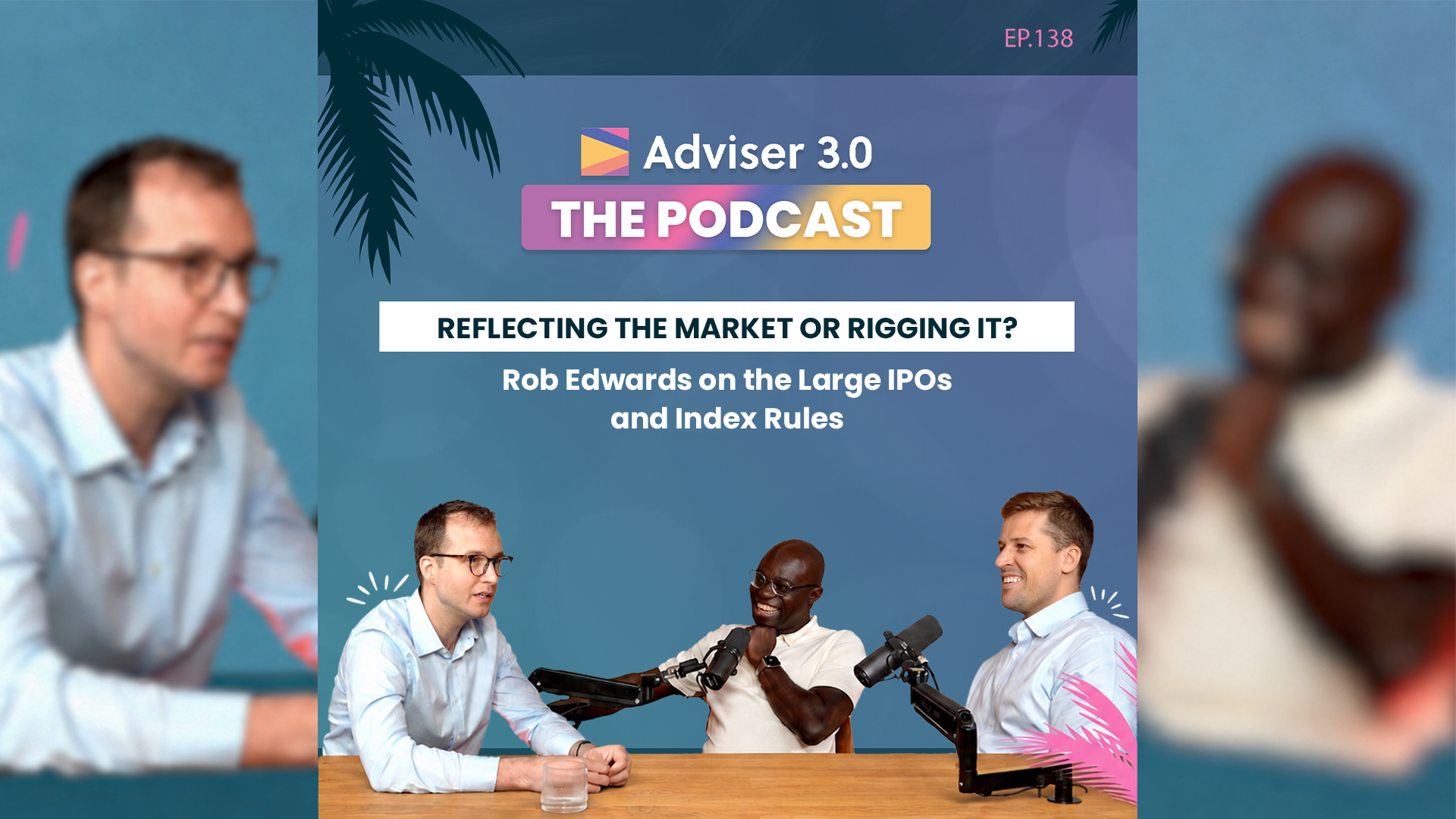
When SpaceX finally hit the public market, a chunk of the coverage read like an accusation: that index providers had quietly bent their own rules to wave the giants through. Rob Edwards, Global Head of Product and Research at Morningstar Indexes, thinks that gets the job exactly backwards.
In this episode, Abraham Okusanya is joined by Timeline's Head of Investment Strategy, Laurentius van den Worm, to press Rob on the mega-cap IPO backlash, the mechanics almost nobody explains properly, and the bigger questions advisers keep circling. Is passive really passive? Is concentration a threat? And who actually decides what sits inside your clients' funds?
When a Trillion Dollar Company Goes Public
For most of stock market history, a company listed while it was still small, then grew into the large-cap space if it earned the right to. That pattern has broken. Companies now stay private far longer and generate enormous value before they ever ring the bell, which is how a name arrives on the public market already worth more than most of the index it is joining.
The instinct is to assume a giant lands as a giant holding. It does not. Broad equity benchmarks are weighted by free float, the slice of shares actually available to the public, and a company like SpaceX releases very little of itself at listing. So it enters a broad US benchmark at a fraction of a percent, well outside the top 100, rather than crashing in near the top. What changes the picture is time. As lock-ups expire over the months after listing, early investors sell their shares into the market, the float climbs, and the weight ratchets up with it.
"Our job is to accurately reflect the passive composition of the market. If we sit on our hands and don't react to changing dynamics, we're not doing that job well."
Reflecting the Market, Not Reshaping It
That framing is the heart of Rob's answer to the backlash. Index providers usually live behind the scenes while asset managers take the spotlight, so being cast as the villain of the mega-IPO story was new territory, and some of the coverage, he says, made it sound as though Elon Musk had been personally knocking on their door. His rebuttal is simple: you cannot tell an honest story about the market and leave out the companies that have come to define it. Reacting to that is the job, not a betrayal of it.
He also welcomes the scrutiny rather than deflecting it. Index construction sits inside a real framework, regulated in Europe through benchmark rules, run through consultations, and published transparently so any investor can read the methodology and timing for themselves. Holding index providers and asset managers to account, in his view, is healthy for everyone.
The Concentration Question
If there is a genuine worry lurking under the IPO noise, it is concentration. The Magnificent Seven has quietly become a magnificent nine or ten, and the weight of the top ten holdings in the big US index is now roughly three times what it was in 2016. The same pattern shows up in emerging markets, where the top names carry a similar share. Europe is the outlier, still far more diversified, having never grown its own crop of mega-weighted giants.
Should advisers lose sleep over it? Rob is relaxed. Take a snapshot of the largest holdings in any decade and the names change as the economy changes; AI dominates now, something else dominated before. He points to work from Professor Hendrik Bessembinder showing that most individual stocks fail to beat Treasury bills over their lifetime, and that a tiny cohort, on the order of 40 companies, has driven more than half of the entire market's return. The lesson he draws is the old one: it is extremely hard to pick the winners in advance, so you are usually better owning the whole haystack than hunting for the needle. Capping a runaway holding is sometimes warranted, often for regulatory reasons such as UCITS limits, but an uncapped index remains the truest mirror of the market.
Will Indexing Break the Market?
The other perennial charge is that passive investing is quietly corroding the market itself: distorting price discovery, and handing active managers an easy trade because everyone rebalances on a known schedule. Rob's response is to turn it around. If there were a reliable way to front-run the index and profit, plenty of very smart people would already be doing it, and the inefficiency would close almost immediately. Far from breaking markets, he argues, index investing has been one of the great wealth-building tools of the century, encouraging exactly the habits, regular investing and staying the course, that serve ordinary savers well.
The mechanics help too. Providers reconstitute on staggered schedules rather than all on one day, and methodologies like CRSP's "packaging" spread the trading across several days to soften the impact of any single change. As Rob puts it, the index provider sends the ingredients and the fund manager bakes the cake, with a toolkit of techniques to manage tracking error along the way.
"If there were a way to game it, people would be doing it and making a lot of money. Any real inefficiency gets solved almost immediately."
Taking On the Index Giants
Behind the debate sits a genuine shift in the industry's balance of power. Morningstar has completed its acquisition of CRSP, the Center for Research in Security Prices, spun out of the University of Chicago and home to more than 65 years of market history and the benchmarks behind trillions of dollars of US equities. For a firm that has long seen itself as a challenger, it is a decisive step into the mainstream, alongside the biggest names in indexing.
Rob is candid about why he thinks there is room to challenge. The dominant index brands, he argues, have grown less through innovation than through inertia: benchmarks are sticky, switching is painful for a portfolio manager a decade deep into one, and the incumbents have monetised that stickiness with steady price rises. That, he believes, is the opening for a more commercially flexible provider with deep research heritage behind it.
"They haven't necessarily succeeded off innovation. They've ridden the wave and monetised it. There's real appetite for a challenger."
The Sustainable Investing Reset
Few areas have swung as sharply as sustainable investing. In the six years since Rob moved to Europe, the narrative has flipped, with the US and Europe now pulling in opposite directions on appetite for ESG. His long-term view stays bullish, but he is clear-eyed about what went wrong. The industry lumped very different ideas, values-based exclusions, materiality and governance, into one label, then watched sustainable strategies outperform in the late 2010s for reasons that turned out to be circumstantial rather than virtuous, essentially an overweight to richly rated technology. When that reversed, faith in the whole concept went with it.
What he expects next is quieter and more tangible: a "2.0" focused on things you can actually measure, such as which companies are putting real capital into lower-emitting projects rather than simply making pledges. Institutions, with their long holding periods, remain committed even where they no longer make noise about it, and Rob points to growing interest in values-aligned approaches, including a faith-based benchmark Morningstar developed with the Vatican Bank.
Why Your Benchmark Might Be Lying to You
For advisers, one exchange lands closest to home. The CFA's own criteria describe a good benchmark as transparent, investable and specified in advance, which points straight at a broad market index. Yet almost no active fund benchmarks itself against one. They measure against peer-group averages instead, comparisons you cannot actually buy, often muddied by fees and by a wide spread of very different strategies bundled together. Rob agrees the peer group rarely tells the full story and thinks regulators could helpfully push the industry toward truer benchmarks.
The same problem scales up into multi-asset and model portfolios, where a convenient 60/40 line or an industry composite gets used because building and licensing a proper blended benchmark is genuinely fiddly and costly. Much of Rob's early work went into better multi-asset benchmarks precisely so advisers without the time or budget to construct their own have a credible passive yardstick to measure against.
The Next Frontier
Where does all of this go next? For Rob, the frontier is private markets. He can picture a future five to ten years out where retail investors get access to the next SpaceX before it ever lists, at a reasonable cost, rather than that opportunity being reserved for institutions. An index for private assets is no longer a far-fetched idea, and it is the thread Abraham and Laurentius agreed was worth a whole episode of its own.