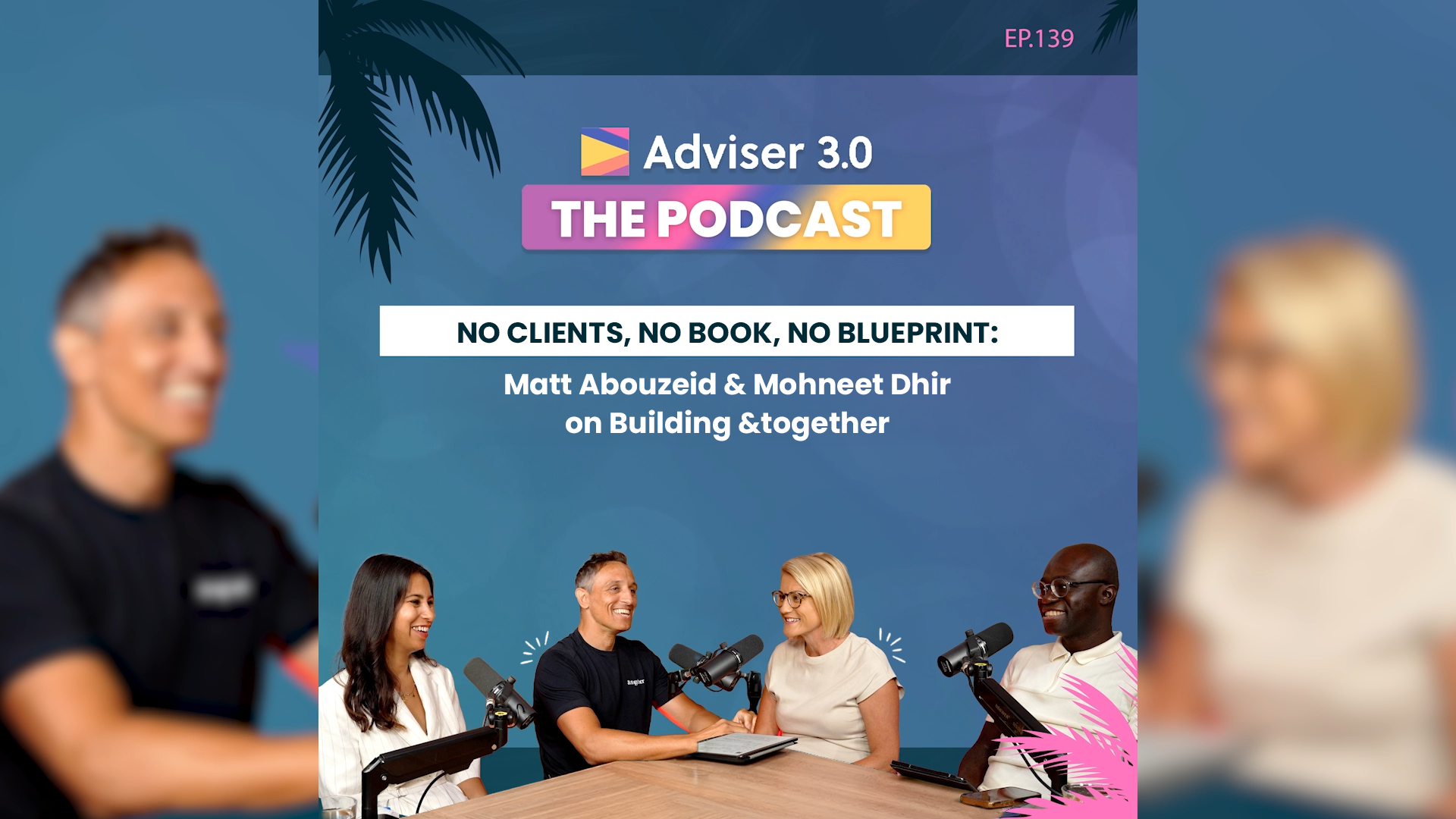
Abraham Okusanya and Kate Phillips sit down with Matt Abouzeid and Mohneet Dhir, the co-founders of &together, for the unvarnished story of leaving senior roles at Vanguard to build an independent financial planning firm from a blank sheet of paper. No clients, no book, no blueprint. Just two people, a shared conviction, and a fixed date in the diary.
Whose Dream Are You Living?
The decision did not arrive all at once. Mohneet Dhir was heavily pregnant, third trimester, when the conversation turned serious. She was leading the multi-asset team behind Vanguard's LifeStrategy range, had just hired someone brilliant, and by her own account it was a hard thing to walk away from. Vanguard is a good place to work. But the more she and Matt talked, the more natural the idea felt, and a line from a book of great speeches she was reading at the time crystallised it.
One of the speeches said: whose dream are you living? And that, for me, was the bottom line. If I wanted to do something I felt truly passionate about, it had to be now.
For Matt Abouzeid the pull was similar, if slower to surface. Fifteen years at Vanguard, working across the adviser channel, the wealth managers and finally the big institutional deals, had given him a rare vantage point on what an outstanding private client business actually looks like. He had turned the idea over for years without ever finding the courage. What made it possible in the end was a mix of things: the loss of his father a few years earlier, which sharpened the questions he was asking himself, a frugal upbringing that had hardwired him as a lifelong saver, and mentors at Vanguard who were fierce advocates of financial planning done properly, simple, low cost and disciplined. The odds of two people who see investing the same way being ready to jump at the same moment were, as they both note, vanishingly small.
Planning the Leap
From the first serious conversation to handing in their notice took twelve months. It began on a business trip to Ireland, the two of them out in Dublin delivering financial planning presentations, where Matt first raised the idea and they started working through the why. Why do this, why them, what do they actually believe? That, they agreed, would be the North Star they refused to budge from. The how, the regulation, the infrastructure, the proposition, came in the second half of the year.
They were deliberate about the money too. With a working spouse and years of saving behind them, they built in a buffer on the assumption they would earn nothing for around two years, then modelled the business itself line by line: what would year one actually cost, in February, in every month, sense-checked and sense-checked again. The worst thing you can do, Mohneet argues, is go in financially desperate, because that is when you start cutting corners.
You look down and it's quite scary. Start from zero. No clients, no leads, no momentum, no introducers.
Getting regulated was its own puzzle. An adviser who had been through direct FCA authorisation urged them not to attempt it: difficult, time consuming, expensive, and if the regulator says no it will not always tell you why, leaving you back at the start like a game of snakes and ladders. So they looked instead at networks, spending months understanding how each one worked and where a firm with strong views but no prior experience of running an advice business would fit. They landed on New Leaf, a structure that gave them support without surrendering their autonomy. Throughout, they were struck by how generous the adviser community was, and by how much the encouragement mattered, because leaving a big corporate job to strike out alone is a lonely business. They at least had each other.
Then they put a date in the diary that could not move. First of October. Having wavered through the autumn, they went away at Christmas and agreed to decide, cleanly, in the new year. Both came back in January certain. That was the psychological point of no return.
A Firm Built for Founders
Ask them what gap in the market &together was built to fill and neither reaches for the obvious answer. The starting point was not a competitor analysis but a question on a whiteboard: how do we deliver the very best possible outcome for the client? Everything else works back from there.
We're not optimising for revenue. We're not optimising for scale. We're not optimising for margin. We're optimising for client outcome.
For Mohneet, that conviction is rooted in her own story: a childhood in India marked by a stretch of financial difficulty that taught her, young, how much money shapes the decisions available to a family. She became a regimented saver, and she carries a low tolerance for the jargon and needless complexity that clouds so much financial advice. The investment piece, she argues, has a job to do, but it does not need to be complicated to do it well. For Matt, the choice of who to serve came from a simpler question still: how do I build a working life I actively enjoy and could happily do forever? The answer was to spend his days around people he finds genuinely interesting, which, given how many of his friends are entrepreneurs, pointed straight at founders.
Choosing a single client type is, they explain, a decision to immerse completely. All they think about is the founder journey, its phases, and the moments a founder will need them. They spend time with the wider ecosystem that surrounds their clients, the fractional CFOs, the M&A lawyers, the PR specialists, hosting round tables and, a couple of weeks before recording, presenting to a room of founders at the Business Growth Fund in Manchester. The point is to see the patterns, to speak the same language, and to make the advice sharper for it.
Winning Clients From Zero
On the taxi ride back from the airport after that Dublin trip, Matt sketched a set of concentric circles on a piece of paper: who do we know, who do they know, who could they introduce us to? That drawing became the earliest map of how a firm with no clients would find its first ones. In practice the growth has come in three phases. First, the inner circles, the professional and social networks of two people who have spent two decades in the industry. Matt is careful to separate a polite introduction from real advocacy, the difference between someone who will happily mention your name and someone who insists you are the person their contact has to speak to. Business development, he stresses, is not an afternoon activity. It is a constant.
Client number one was a friend who had recently exited his business and was already being courted by a private bank, an impressive individual by any measure. Friendship gets you a hearing, but not the mandate, so they sat down and presented properly, explaining what they do, how they do it and why they are structured differently. They won it, and now oversee the family's assets. From there the routes diversified. Most recently, the videos they have been posting on LinkedIn and YouTube, some now pulling in tens of thousands of views, have started to bring people to them directly. One such enquiry arrived cold and turned into a competitive tender against three other advisers, then a final two against a long established, chartered and highly respected firm, exactly the kind of level playing field a ten month old business is not supposed to reach, let alone compete on.
A quieter surprise has been the investment professionals, hedge fund and active fund managers among them, who have become clients. Flattering, Mohneet says, and revealing. One portfolio manager admitted that left to his own devices he would simply tilt to value stocks, and specifically wanted an adviser who would push back on his biases. &together gave him a quick, polite no to the requests that did not fit, then presented a plan built on simple, market cap, buy and hold foundations. He loved it. The lesson she draws is a human one: even the most expert investors benefit from someone they trust enough to challenge them, and the hardest part is often just asking in the first place.
War Wounds, Fees and the Road Ahead
Ten months in, the picture is not all idyllic, and they are candid about it. What has worked is the partnership itself: they talk constantly, stay transparent, keep each other in check and have worked every client together, so both know each account intimately. What has been harder is more prosaic. They still lack a settled office, moving between home and coworking space, and both now want a base to go into. Some of the early marketing spend, Matt admits, they would deploy differently with hindsight. And the home life sacrifices are real, the sense of never quite switching off, the mind always half on the business.
Mohneet tells it best: her six year old recently informed her that you are not supposed to work on Saturdays, and asked why she was. Managing energy, the discipline of sleep, food and exercise, is the part they both find toughest. But the fundamentals are landing. Client acquisition has been strong, client advocacy higher still, and revenue has run comfortably ahead of a deliberately cautious first year forecast, while costs have stayed tightly controlled. Year two is about becoming better known, building proper partnerships and turning every client into a genuine advocate, with a fractional marketing lead coming in to help.
On fees, they deliberated for a long time, because the charge sits at the heart of the outcome they keep talking about. The reference point is Vanguard, which grew enormously over Matt's fifteen years there without its client first North Star ever shifting, proof, he argues, that you can optimise for client outcome and still have everyone win. &together settled on an ongoing fee that tapers down as assets grow, so loyalty is rewarded over time. They considered a flat fee, arguably the fairest structure of all, but worried it risked clients disengaging in year two, weighing a monthly standing order against a new fridge. The overriding aim is to get as many people as possible into financial planning and, crucially, to keep them there for the long run.
People like loyalty to be rewarded. As clients stay with us and their assets grow, lowering the fee just feels like the right thing to do.
Abraham and Kate have already booked them in to return in twelve months. On this evidence, the next set of war wounds will be worth hearing.