
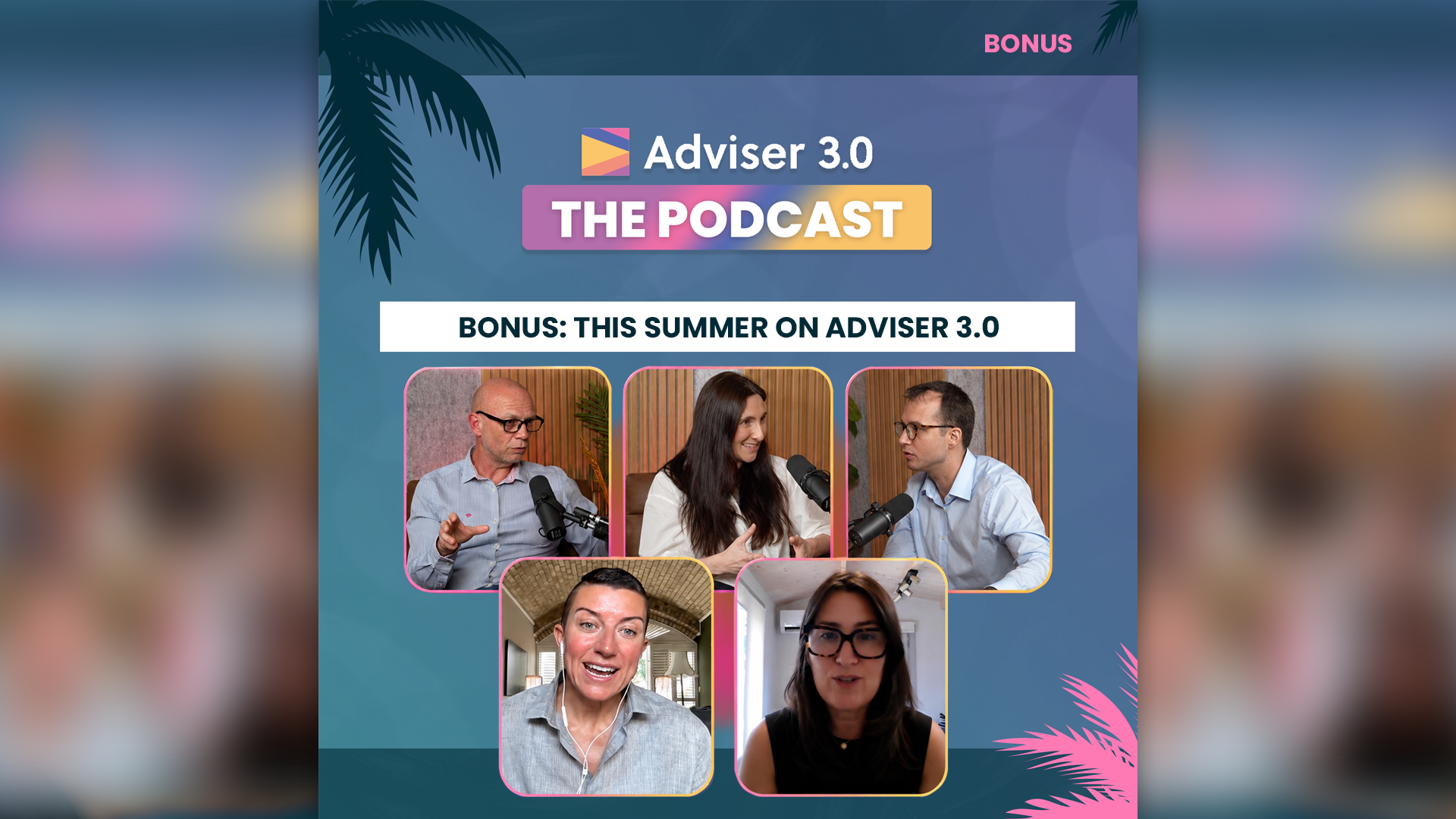
The team is off the usual schedule this week, so here is a look back at the summer just gone. Across the main show and over on SoapBox there has been a run of conversations worth a second listen, and we have pulled six of them together into one bonus episode. Honest talk on fees and on what really stops a firm growing, a hard look at a giant of the profession, the truth behind this year's loudest market story, and a genuinely divided debate on the advice gap. Every conversation is available in full below.
Care Fees and the Fixed-Fee Case
First up, Nick Hutchings of Rockwealth joined Abraham for a conversation as honest about the hard parts of going solo as it is about why it made sense. The stretch worth revisiting is on care fees, the corner of retirement planning most advisers never touch. Nick walks through the difference between immediate and deferred care fees annuities, why so few people know the deferred option even exists, and how the cost of care has climbed to the point where it can quietly decimate an estate in a few short years. His case for charging a fixed fee on this work is really a case about conflict. When your income does not depend on the size of the premium, you can sit squarely on the client's side of the table.
It reduces the surprises, it is transparent, and it takes away that conflict, which is the biggest thing for me.
Are Platforms Skimming the Cash?
Over on SoapBox, Matt and Abraham were joined by Caroline Hawkesley of Craven Street Wealth for one that keeps rearing its head in the trade press: the interest earned on cash held on platforms, and who it really belongs to. With the regulator pushing for clearer disclosure, the panel works through where a platform legitimately adds value and where it does not, and what advisers ought to be asking about the cash sitting in their clients' accounts. Abraham, who runs a platform himself, does not dodge the more awkward version of the question.
The Growth Wobble
Victoria Hicks of Melo has seen inside more advice firms than almost anyone, having been involved in over a hundred transactions. Abraham wanted to know why so many firms reach a certain size and simply stall. Victoria's answer begins with mindset, the owner who still sees themselves as an adviser first and a business owner second, and moves into what she calls the growth wobble: the uncomfortable truth that real growth is never a straight line, and that the hardest calls a founder ever makes are almost always about people.
The people who got you to where you are are not always the people who will get you to where you want to be.
Cracks in a Giant
Back on SoapBox, Michelle Hoskin brought three decades in the profession to a question a lot of people have been circling: why, after years of looking untouchable, are advisers starting to walk away from one of the biggest names in the business? Michelle's take is refreshingly even-handed. The model that once made that firm a great home for a certain kind of adviser was built for a different era, and as the tools and support that used to justify it become available everywhere, the reasons to stay are thinning. She is not surprised it is happening, and she does not expect it to stop there.
The Truth About Those Mega-Cap IPOs
Rob Edwards is global head of product and research for indices at Morningstar, which makes him the person to ask about this year's loudest market story: the arrival of giant private companies like SpaceX into the index, and the accusation that index providers quietly changed the rules to let them in. Rob's explanation is a good deal calmer than the headlines. These companies release only a sliver of their shares at first, so they enter the index at a tiny weight and grow into it gradually as more stock reaches the market. The much-hyped arrival, it turns out, is close to a rounding error at the point of entry, and the actual number genuinely surprised the room.
Our job is to accurately reflect the passive composition of the market. If we sit on our hands and do not react, we are not doing our job.
What Advice Gap?
To finish, Victoria Hicks returned, this time on SoapBox alongside her Melo colleague Gaynor Rigby, for a proper back and forth on the advice gap. Gaynor's opening provocation sets the tone: for all the industry talks about it, most of the public has no idea the phrase even exists. From there it becomes a genuine difference of view, with Gaynor and Abraham landing on opposite sides of whether a lower tier of qualification and targeted support is the way to reach the people who need help. It is thoughtful, it is funny, and it does not resolve neatly, which is rather the point.
If I went out onto the streets of Leeds and asked a hundred people to tell me about the advice gap, they would look at me like I had grown two heads.
That is the season, near enough. Every one of these conversations is available in full below, and there is far more in each than we could fit into one bonus episode. Adviser 3.0 returns to its regular schedule next week.