Decumulation: the nastiest, hardest problem in finance?
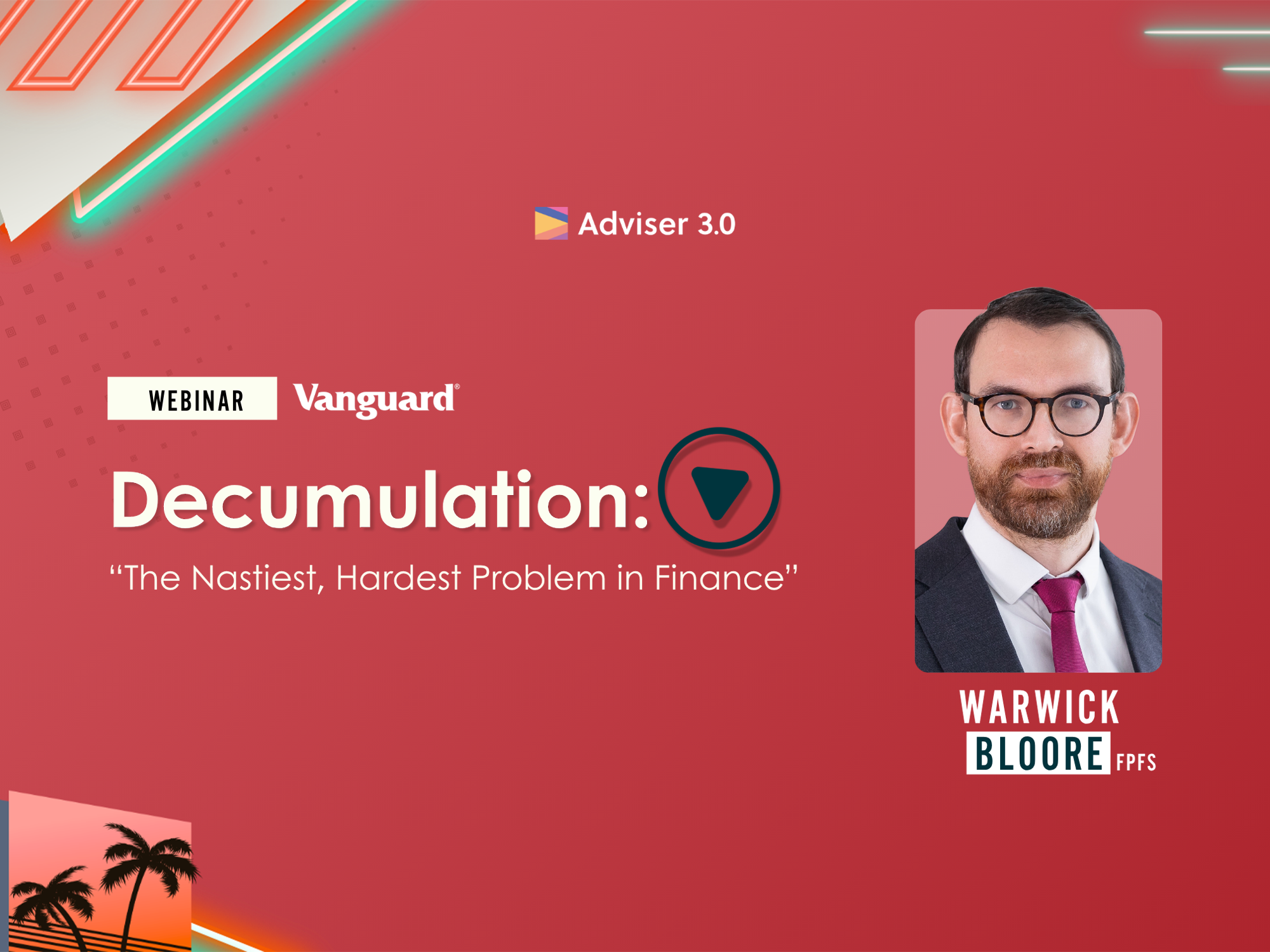
Nobel laureate William F. Sharpe once called decumulation the nastiest, hardest problem in finance. In this Adviser 3.0 session, Vanguard's Warwick Bloore explained why, and set out three areas that reward a closer look: how clients spend, the role of secure income, and how drawdown is managed. What follows is a summary of the themes discussed. It is illustrative rather than prescriptive, and none of it constitutes advice.
So today, we're here to talk about decumulation, possibly the nastiest, hardest problem in finance. I'll set the scene and say that we are time boxed to an hour today, so this isn't time to cover literally everything around this topic. It is a huge topic. But my objective today is to give you a few interesting areas, which are perhaps worth a closer look and hopefully a few interesting takeaways. So let's begin. But before we get into it, I just wanna give a brief intro around my team and a bit about me and my role at Vanguard. So you may have heard the name before. We're a team called advisory research center, and, basically, we're here to deliver relevant, interesting, useful thought leadership to advisers to use in their practices and with their clients. We cover a lot of ground. We cover investing. We cover financial planning, and we cover practice management. And a topic as big as this, it very much straddles all three of these. And now a bit about myself. So before joining Vanguard, I was an adviser. I actually spent twelve years looking after clients before moving over to asset management. So in the work that we do, I really do try and put the adviser lens on it. This, of course, is the work me. In the interest of balance, it's probably fair for me to show you the fun me. So here I am just relaxing at home with the good book. So, hopefully, Jade, gives you a sense of the sort of person you've got in the room with you today. It comes across. It comes wholeheartedly. Yeah. Perfect. There you go. So that's me, and that's my passion around accumulation. K. So that's then getting to the main bit here. So the title of the presentation, that's not just something I made up. That's actually a quote from someone who's pretty famous. So as Jake said, we're gonna keep this interactive, so we've got a quiz question for you at the beginning. So I've got four options here. Wait till you hear all four of the options before putting your guess in the chat. Was this said by pop star Katy Perry? Was this said by actor Arnold Schwarzenegger, aka the Terminator? Was it sent by Bill Bengen, creator of the four percent rule, or was it said by William Sharp, creator of the Sharpe ratio? Cast your votes, please, and then Jake will keep you posted in what's appearing in the chat. So a, b, c, or d, what are we gonna guess here? We'll give it a few seconds for the votes to cut through. Already got full names. Not even a b, c, d. William Sharp. We've got first of we got d from Daniel. Sharp, d a. Lovely. Cheers. Cheers, Roy. Thank you for that. A. It's gotta be for Roy, isn't it? D d d d d, c from Jasmine, c from Davis, and a from Harry Law coming in. Wanna put us out of our misery? Yeah. Let's let's time box that one in. Okay. So if you said Bill Bengen, I'm sorry to say you're just as wrong as if you said Katie Perra, Arnold Schwarzenegger. The answer was in fact William Sharp, creator of the Sharp ratio. He actually said that fairly recently. I think it's in the last decade. He didn't particularly elaborate on that, but one of the things we could do today is just perhaps dig into that part and think about, you know, why might it be such a nasty heart problem, which is then a good segue into the agenda today because the first part is basically that. We're gonna set the scene around accumulation. Why is it topical? Why is it difficult? And then on top of that, we got three modules. I like to call them modules. The first is around spending approaches and the methodology you may have there. The next is around the role of annuities or secure income in the decumulation, strategy. And the fourth part of this is looking at decumulation drawdown management aka bucketing, something which is pretty topical at the moment. So as I said, doesn't cover everything we could talk about around decumulation, but, hopefully, it's a good spread of topics and, hopefully, gives you a few interesting ideas to take away in your work with your clients. So let's begin. Why is the accumulation difficult? I think that's the first question to ask ourselves. So the mental framework I've got for looking at this is basically, it's full of uncertainty, and it's full of risk. If you double click into the uncertainty, the first thing to say is that the time horizon is hugely uncertain. As an adviser, you've got no idea how long your clients are going to live. They don't know how long they're gonna live, and it can make a big difference to the time horizon you've got a plan. Next, you've got expenditure uncertainty because, frankly, if you ask many people how much they're spending today, they struggle to give you a good answer. Is that even more difficult to project into the future and think about how that expenditure curve may change during retirement. So, again, more uncertainty around the withdrawals that need to take place. Next, you've got goal balancing. And what I mean by that is for most people, retirement spend, that's gonna be their main accumulation goal. But on top of that, they may be thinking about their legacy. They might be thinking about philanthropy. They might be thinking about lifetime giving. So then they've got to balance these altogether, and that's further uncertainty in this space. Then on the risk side, first thing to say, as soon as these taps turn off when you retire or the income coming in, you've immediately lost your course correction power. And if you haven't planned properly, then it's really quite difficult to get yourself back on track. Connected with this, you've got sequence of return risk, and then remember too that this is a stage of life where people are gonna be older, these vulnerabilities can start to creep in. So again, that's all happening on the risk side. And I'd say too that wrapped around all of this is just the psychological transition going from a worker to someone who's retired. Yes. The finances is one side, but planning your new life, that's quite a big thing to deal with too, which also makes this quite a difficult topic. So I think we can say, yes, it is challenging, and there's many aspects to it. Now why is it topical? Many of you will be aware that a couple years back, the FCA did a thematic review in which they looked specifically how advisers were dealing with retirees in the advice they were giving, and they called out a few things. So what they did is they looked at a number of firms, and, yes, they found some really good practice, but they also found some shortcomings. Now the shortcomings, to talk through a couple of these, first of all, there were some issues around the calculations or the rates or the assumptions that advisers were using when they were thinking about portfolio sustainability. Next, this idea of risk profiling capacity for loss, there were some issues there as well. And then thirdly, no. Lack of consideration of all the possible retirement options, including secure income. So the first three here are highlighted because this is effectively what we're digging into today. So clearly very much on the FCA's mind as a result, it should be on the advisor's mind and that means everyone's thinking about their CRP, for example. So let's then dig into the first problem, which I'm gonna call the sustainable withdrawal problem. Now I've mentioned this already. Let's talk time horizon. Now planning a retirement would actually be a lot more straightforward if you knew what the time scale was, but that's not how life works really, which is when you think about longevity, it's a distribution of possible outcomes. What we have here on the screen is life expectancy data for men and for women. You've got the top line in green. This is average life expectancy, but then you've got the additional rows which shows progressive life expectancy with, for example, the red one being your ninetieth percentile. So you've got a one in ten chance of reaching ninety eight if you're a woman. Now what we're gonna do next is we compare this average and this distribution to the expected retirement age in the UK of a typical person. So in this case, we picked sixty four for women and sixty five for men. Now I'll acknowledge that if you're dealing with wealthy individuals, then perhaps they'll be retiring a bit earlier. Not always. You'll find you have entrepreneurs who just keep working and working and working, but we're making an assumption here. But the point I'd like to get to is if you compare an average life expectancy to the ninetieth percentile life expectancy, I e the red line, you've got about a fifty percent difference in time horizon, which is absolutely massive. And as an adviser, really, what you're trying to do is you're trying to balance, number one, making sure the client doesn't run out of money, but number two, making sure the client doesn't die with a big legacy, which perhaps they don't care that much about, and it makes this challenging. Hence, we go back to the slide about the uncertainty. And I'll state the obvious here, which is spending really matters because super simple piece of analysis here. Let's say you've got a one million pound portfolio and we're seeing a six percent return and two and a half percent inflation. If you make relatively small adjustments to the withdrawal rate, the amount you're taking out each year, let's say going from five percent to six percent, it makes a massive difference to the lifespan of the portfolio. Again, I'll state the obvious that investment returns really matter too. What we're doing here is we're saying, right, six percent withdrawal, two and a half percent inflation. If you get slightly better or worse investment returns, then again, it makes a big difference to the longevity of portfolio. And, Jake, you can probably guess what I'm gonna say next, which is that inflation really matters. So here, we've got six percent returns, six percent withdrawal. In a world of zero inflation, obviously, that portfolio is gonna last forever. But we all know, particularly the last couple of years, we've had a resurgence in the rate of inflation. Everyone's far more concerned about it, let's say, than they were ten years ago. So it really is quite an important thing. Why am I telling you this? Because the way that I think about it is this, which is there's really three ingredients into the longevity of the portfolio. The first is investment returns, the next is inflation, and the third is spending. Now as an adviser, yes, you can flex the asset allocation portfolio, but, ultimately, you don't have that much control over what happens because markets will do what they do. You have no control over inflation. That is what it is. But the good news is that you do have some influence overspending, which is the ingredient really to lean into here. Because clearly, is an incredibly important part of what advisers do with their clients, and they need a lot of help in this space, and it's hugely impactful. So then a question to naturally ask next is what do people actually spend? Now for the high net worth space, the data isn't particularly good for the UK, but we do have this, which many of you will be familiar with. It's the PLSA. If you're not, basically, this is a think tank that's put together what they regard as spending levels to achieve a minimum, moderate, and comfortable lifestyle in the UK, splitting this out for a single individual and also for a couple. Now, we're dealing with advised clients here. The likelihood perhaps is that we'd rule out the minimum and moderate here and focus on the comfortable. Now if you're looking at high net worth individuals, perhaps what we're setting out here in terms of lifestyle spend, that's below their level of aspiration. But it is nevertheless, I think a helpful starting point or at least a baseline to have that conversation with clients, and you can build on it. So my point here really is that expenditure is a very personalized, it's very powerful, but clients need a lot of help with it, and you can really lean into this space. So what we're looking at here potentially is the mass affluent space. We can then go all the way up to the other end of the spectrum, and then I want to show you this. So you'll be familiar with CPI. Everyone knows about that as a measure of inflation. What you're possibly not familiar with is actually Forbes have an index which they've put together. They've been running it for quite a while, which they call the cost of living extremely well index. So, basically, what this is, it's a composite of those luxury goods and services that the wealthiest people in the world tend to buy. And what's noteworthy around this is you can see over the long term, it's really outpaced the CPI by quite a lot. Now the important point to remember here is that if you're dealing with wealthier people, chances are they're gonna have a slightly higher level of inflation versus the headline index. So it's important to build that assumption in when you're planning for them. Now intuitively, why is this the case? Basically, because the wealthiest in the world do tend to get wealthier over time. The type of goods and services that are in this, they tend to maintain the scarcity. So then we're basically saying demand, supply, this pushes them up, and they receive higher levels of inflation. Now, again, back to tech's point at the beginning. We're gonna have a bit more interaction here, and I've actually got a second quiz for you, which is I've got three items for you from the cost of living extremely well. Let's see if we can guess the prices on this. And I might regret this, but if someone gets them bang on, we might be able to hook you up with a pair of Vang socks. So let's go. First one, what do we think is the price of the Steinway grand piano? It's in dollars. Get us in your chat, please. Okay. See how we get on, Jack. Yeah. Let's see how we get on. Now I reckon the facelift is weirdly expensive as well. Well, point out, experienced plastic surgeon, medical price. Looking that I know I roughly We're we're going left to right, by the way. No. Here we go. So so is it are we left to right? So we got oh god. What are we guessing for the piano? So piano people are like fifteen grand, thirty grand, twenty grand, sixty k. Think you guys are well off. Three hundred thirty k, Paul. That might be closer. That's Yeah. We need more pianists on the call, but here we go. Two hundred and seventy thousand dollars. So, yeah, quite expensive. Obviously, more expensive than most people thought. Let's go next. Kilo of, caviar. A kilo, bear in mind, that's quite a lot. You don't normally eat caviar. I I've I have no reference. I have no reference on caviar. Look. I'm a five guys guy. I I don't I'm not scratching caviars. I'm sure you pee. I'm sure everyone in the chat were there. Ten k. Ten k. Ten k. Two k. Sixteen k. Lloyd, five k. We're doing specific We're doing better on that one then. Okay. We got some fine diners on the call. So there we go. Twelve thousand nine hundred and eighty dollars. And let's test your theory, Jake, which is I What do we think about the baseline? I think this is expensive. I I reckon I reckon I don't wanna listen to this in the chat. I think it's upwards of eighty k. Eighty k? I reckon eighty to ninety maybe. Five k, I've obviously I'll give you that one, Jay. Thank god it sucks for you. It's a hundred thousand Jeez. I swear I didn't even see these. A hundred k for a facelift. Yeah. Yeah. I mean I can yeah. Okay. I I have it on good authority that you can go somewhere much closer than a Ryanair flight and get one done for about five grand. Yes. Probably a case if you get what you pay for here. But, yeah, experienced new surgeon That's very thoughtful. One with you, and that's that's insane, isn't it? Exactly. But the fact is before you start to feel too sorry for these pianists, these fine diners, these face tuckers, Let me show you this, which is, the graph we had before, but superimposed on that. You've got the Forbes four hundred, so the four hundred wealthiest people in the world. And, basically, their wealth is just going way up relative to both these indexes. So despite their slightly high inflation, they will be okay. But back to the point I was making around this, which is that inflation, it tends to be higher for wealthy people. Yeah. It can also be pretty personalized depending on your hobbies, your interest, how you spend your time, and how you spend your money. So worth knowing about. And then the next natural question to ask here is how does spending actually change in retirement? Now the theory goes that you have a u shaped spending curve when you retire, which is in those early years. You are traveling more. You're doing your bucket list. You're fulfilling your aspirations. Then in mid retirement, this tends to taper off a bit before you get to late retirement. Perhaps you need some more support, and the expenditure starts to increase. But, actually, you can look at different data and find that you just get this gradual decline in retirement spend as well. I think it doesn't really have a right answer to it, but basically, if you need care, you're likely to have a u shape or j shape. If you don't, you might just have a gradual decline because frankly, it becomes more difficult to spend money as you get into those older ages. But as an adviser, what you tend to do is you tend to on the side of caution, which, again, you can buy that with the uncertain time horizon, extra cautious spend. You can understand why people end up having a bigger legacy, which perhaps perhaps they don't always value. So there's something to be said around leading into the spending and course correcting over time. So plenty going on here. There's a lot going on. There is a lot going on. Don't forget, guys. Any questions or comments in the chat, please let us know. And that'll be that'll be absolutely incredible. Perfect. Keep me coming. So where I'm gonna go next is we've spoken already about the importance of spending. We spoke about spending levels, spending trends. So I wanna talk next about spending methodology and introduce, first of all, a bit of background, and second of all, a new concept which you may or may not have heard of already. So I'm gonna start by introducing two typical spending rules that either clients or advised clients are likely to have when they're thinking about their retirement spend. The first is this one here, which is pound plus inflation. How does this work? Basically, let's say you start with a one million pound portfolio. You then set your initial spend at five percent or fifty thousand pounds. You then just increase that with inflation. Now what's good about this rule is that you maintain your real expenditure, but the challenge with this is you're not thinking at all about what the portfolio is doing, so you're more vulnerable to sequence a return risk, and there's therefore a high chance the portfolio running out of money. And back to our friend at the beginning, Bill Bengen. He created the four percent rule, which is an example of this rule. He did so in nineteen ninety four, and it's still widely used today. Now the reasons I think it's widely used is number one, it's super simple, memorable, but also, actually, if you recratch the numbers, which we did on today's valuations, which are quite different from nineteen ninety four, it does still generally work. We think there's still a ninety plus percent chance for fifty fifty portfolio lasting thirty years. So good famous example of this rule in history and action. Now the other rule you could have here is gonna be this one here, which is percentage of portfolio. Now the idea here is even simpler, which is you just pick a percentage of the portfolio, you spend that amount, and you continue to spend that percentage. Now what's good about that is mathematically, the portfolio will never run out of money, but the challenge here is that you've got highly unstable expenditure. So it's a difficult one, really, because neither of these rules are really perfect. Now whatever approach you take, there are levers, factors, whatever you wanna call them, which makes it quite different depending on your circumstances, what kind of withdrawal rate you should be targeting. So I'm not gonna talk through all of these, but let's say someone has a lot of flexibility in their expenditure, and they've got quite a short term horizon. What this will mean is that person can spend quite a high percentage of their portfolio. Over the other end of the spectrum, let's say you've got someone who's number one, a low risk investor. Let's say they've got a forty year time horizon, then in that circumstance, they will only be able to spend a small percentage of their portfolio each year. Now the point I'm getting at is it then becomes quite difficult to have a one size fits all solution here because it's so nuanced, it's so dependent on client circumstances. And that's kind of what the FCA was getting at in their thematic review, which is there didn't seem to be enough thought going into the withdrawal rate that was being used and the justification that was used here. So it's more complicated than you may think about it on the face of it. But just to put this into context, to put these rules next to each other, you can think about it as on the left. You've got pound plus inflation, where what's good about that is that your expenditure is highly stable. What's challenging about that is there's more chance to portfolio running out of money, basically, because you're not thinking about sequence of return. Over the other side, you've got percentage of portfolio. Now mathematically, you're not gonna run out of money, but the challenge there is that the spending is highly unstable. So neither of these are ideal, but the good news is there's actually something that sits in the middle, which we've been talking about actually for about ten years. We've done a fair amount of work, fair amount of analysis on this. You may have heard the terminology, which is dynamic spending. Now what is that? Basically, it's a hybrid of the other two rules where what you're doing is you're taking the expenditure, you're increasing with inflation, but what you're doing is you're setting a ceiling on that expenditure and a floor on that expenditure, and then you go down either to the floor or you go up towards the ceiling if you're having a good or a bad year in markets. So you agree these with the client in advance, and we're not talking about big differences, possibly just a couple of percentage each side. But what this allows you to do is you flex the expenditure over time, you respond to what the portfolio is doing, And if the client can be slightly flexible in their expenditure, you can get to a sweet spot where number one, you extend the longevity of the portfolio. But number two, you also have a decent stability around the spending. Now you can get quite complicated around the methodology here. If anyone do would like to learn more about this, then do get in touch. But I'll just sum up on this point because we've got two other models to follow, which is dynamic spending. It is something which is worth knowing about as a concept, And it's not gonna be right for every client, but it's gonna be quite powerful potentially where you've got clients who are on the cusp of being successful. And, really, what you're doing is you're making a deal with them to say, look. If you could be a bit flexible in your expenditure, as in you're willing to pare back when markets go down, then we could be more aspirational around the spend that we're targeting and extend the longevity of the portfolio. There's a couple of different ways you could do it. Either you can prescribe you can follow a prescribed set of rules, or what you can do, probably what advisors are doing already, is they're keeping it quite broad and conversational, which is, let's say we have a bad year at market and the client wants to buy a new car. Might be a difficult conversation, but the adviser may gently steer them away from doing that. That's kind of dynamic spending practice. And then the third part of this is, you know, you want to signpost this, and you want to introduce it at the beginning rather than just out of the blue telling your client, hey. Gotta spend less money. So the way you can do this, for example, is you can set the scene up front, introduce the concept. You can also define the floors and the ceilings around the expenditure up front. And, obviously, what you're doing is you're managing this on an ongoing basis, perhaps with the annual review. So to sum up, interesting idea worth knowing about. It can be quite effective. Has it become more ****? It's gaining popularity. You see this in the US. If you look at YouTube, there's a few influencers introducing this concept to their audience. So it's something that advisors are thinking about more, in the context of a bit more personalization around retirement Yeah. And in the context of a thematic review. Because, you know, one size doesn't fit all when it comes to withdrawals. This is the way to personalize it a bit more. That would make sense. That's incredible. So hopefully, some useful food for thought for you. But then that's a good chance to move on to module two, which is the role of annuities. Now we've got more quizzes for you. You're sensing a theme here. Although, actually, I'm gonna save the audience from the first one. This is one for you, Jake. So Brace yourself, everyone. I wanna get your opinion, Jake. So when do you think insurance is worthwhile? Do you think that car insurance is worth Yeah. Jake? You've got how can it not be? I is it it's illegal to not have car insurance. Right? Well, yeah, unless you have life. But, yeah, absolutely. That No. That's a good point. Yeah. Unless you go try them. Yeah. By far. Of course. Okay. So we got a thumbs up on that one. Yeah. Then number two, life insurance. Yeah. Think about that. That is worth it. Has to be. Yeah. It's I think it's weirdly selfish if you don't, maybe. I don't if that's a personal opinion. It's my personal opinion, I think. I think yeah. I think so. Yeah. Protection, feel our wounds, peace of mind. Absolutely. About this one? On longevity. Is that the underrated one? Well, we'll get into that as we go. But I think I I think I've heard Morgan would talk about that weirdly in the past, like, months than I have the other two. Obviously, but life in general. Yeah. Yeah. It's becoming more of a thing. Right? Yep. You live to a long age, you've gotta have more money to deal with it. So some insurance there. And then the fourth one here is a deduction insurance. What do reckon about that? I mean, look. I live in Kent. So abduction, sure. Aliens, by far. And that's that can't be rude. That is that is real. I mean, I don't think you can get that policy in Kent, unfortunately. It's a US based policy, which is possibly not not surprising. Now do you think it's state based? No. It's it's not state based, but I think it is a bit of a joke, actually, because it's a ten million dollar policy being pays out at one dollar a year, and there have been a few successful claims. So I think they actually Successful claims. Yeah. So I think they actually make a good money on this because they set it for, like, twenty, twenty five dollars. And, you know, if they get a small amount of payouts, then fine. So I think it's not completely serious, but, we're discounting that one. Don't have to joking. Yeah. I I doubt it. Okay. I said no. Yeah. No. No. Okay. So we got a thumbs up here, one to three from Jay. We just had an awful scene setting here. Now the next poll is then for the audience. This is a bit more numerical based. So let's say that the government took away your state pension. We're talking about you personally. Two hundred twenty one pounds a week. Let's say you're quite close to retirement. Let's say you've got this so much in your drawdown pension or your SIP or whatever it is. How much would you be willing to pay from your SIP to get it back? Who would be prepared to pay ten thousand pounds? Just give a thumbs up if you you you'd willing to pay that. Yeah. Thumbs up for a yes or a y a y or a or a no, I guess. Why in the in? And we will be sharing the slides, guys. Yes. I'm getting a few yeses. So we're a few yeses. Yep. Yes. Yes. Yes. Chris has also raised his hand. Yes. Very good. Alright. Let's ratchet up. Who'd be prepared about the hundred and ten thousand pounds? Oh, here we go. So we have some yeses. We get we get some yeses. Yes. Yes. Yes. Yes. Yes. Yes. Well, like, that's secure. Excellent. Brilliant. Okay. Let's see if we tail off. Who pay two hundred and twenty thousand pounds? Go. Oh, Henry. No. That's our first no. No. That's got a yes from Paul again. Do you get some yes? There Other moment from Andy. Oh, the notes are starting to drip in. Okay. We're mixed on that one. Okay. But I can probably guess what we're gonna say on this one. Who paid three fifty? Here we go. Yes. If inflation proved. From Tim? Nope. Nope. Nope. Nope. Nope. From literally, probably literally everyone else. Oh, Jasmine. Well, we we've got a mix here. So I'll reveal the the metrics here, which is these are the effective annuity rates. And, actually, you often see it's pretty close to the market annuity rate. So I think, oh, think what we're getting here is a sense that, you know, we're not full of annuity skeptics, but we're not great lovers of annuities either. Perhaps we're taking quite a balanced view here as a group. But I thought this was useful just to calibrate people's thinking around this topic. So you saw this image a second ago. I will now show it to you again. First thing to say when we're talking about annuities is you've always got a bit of a healthy conflict here. Now first thing to say, this is not a real set of people. The lady on the left doesn't work for Vanguard. The man on the right doesn't sell annuities for the living. But you can kind of get what I'm saying here, which is when you've got an AUM business and there's a prospect of removing some of that AUM to turn into an income, you know, there's a bit of a healthy conflict there. So I think it's worth acknowledging that upfront, but we're gonna circle back to that a bit later. The next thing to say about this is you may have heard the phrase coined the annuity puzzle. Now the background on this is that if you talk to neoclassical economics and they only use their way of thinking to tackle this, they find the take up of annuities puzzlingly low. Even during periods where annuity rates were relatively high, the take up still seems quite low because it doesn't explain why would someone want the bumpy ride of a drawdown fund when instead they could have the nice smooth ride of an annuity. So then why is the take up so low? It's generally accepted that it comes down behavioral to behavioral issues. So if you ask the IFS, first of all, their view on this is that one of the reasons that annuity take up is low is because people underestimate their longevity. That's certainly part of it. But then other explanations could be you feel like you're making a big bet when you get an annuity. You're worried that you buy an annuity, die the next day with hindsight turns out to be poor value. You know, of course, you've got flexibility. Of course, you've got guarantees associated with it, but people tend to think about it in that way. And then similarly, annuities, although the product range has moved on, there's a perception that these are highly inflexible, and people tend to be averse to that. And then the third aspect is, frankly, it's a bit of a faff to get annuity because number one, you have to understand the space. You've gotta start making decisions in this space. You potentially need to shop around. You might need to change provider. So there's all sorts of hurdles, barriers, friction between having your drawdown fund and getting an annuity. Perhaps this is all feeding into why we have low take up in annuity rates and why we have this puzzle existing. And I think you could go a bit further and say, look, how does someone make a decision around how to get an annuity? Now if you're mathematically minded, you probably think about it something like this, which is you're asking yourself the question, how many years will it take me to be better off getting the annuity payment versus just leaving the money invested? So the chart that we see here, basically, the blue line is the drawdown fund. The red line is getting steady annuity payments, and the point at which the red line overtakes the blue line, in this case, is about twenty three years. Then probably what you do is you take your view on your longevity, and you probably anchor something like average life expectancy there. And that's generally how you might view the decision. So it's important to get this idea across at the beginning when we're talking about the decision space here. And we can look at a bit of history here. So what I have on this next slide is the history of UK annuity rates and the history of the fifteen year gilt yield. These are very correlated together because one tends to be based on the other. And what you can see is it's been a bit of a bumpy ride, and I'm gonna call out three points in particular. So number one is a two thousand and eight global financial crisis. It's after that point that bond news really fell, and as a result, annuity rates really fell. Then you've got twenty fifteen, which is pension freedom. Now this is a real blow for the annuity market because at that point, drawdown funds became flexible, much more attractive, relatively speaking, and so annuities became relatively unattractive. But then the third article I'd use is, which is in twenty twenty two, we had the global bond market sell off. After that, bond yield starts to rise and annuity rise rates rose as well. Now they're not quite back to their level of the pre two thousand and eight crisis, but, actually, they're not far off at the moment. So if you're looking at things purely on a breakeven basis, then the case is starting to look a bit improved. The breakeven point is getting quite close actually to a typical life expectancy. So the argument comes back just from a mathematical perspective to say, hey. Should we be looking at annuities again? But the fact is, if you only look at annuities through that lens, you're missing some quite important things. So for example, number one is this idea of investment tails. Now what we have a tendency to do is compare things to averages. But, actually, the competition between an annuity and investment returns is not average investment returns. The way to think about it is cutting off investment tails. So to give an example here, we've got someone starting with a one million pound portfolio, and the investment future is uncertain. You've got some outcomes where investment returns are great, like the red line. You've got some outcomes where investment returns are poor, like the bottom kind of gold yellow line. And what may happen is you've got a client where looking at the possibility of poor investment returns, that really is catastrophic for their retirement and their plans. The cost of that is too much for them. So in the role of the annuity here, let's say you partially annuitize the portfolio, is this, which is you cut off the tails here. Yes. You lose the top tail, but you also mitigate against the bottom tail. So annuities aren't about beating the average return. What they're doing really is protecting against this negative tail at the bottom where that's gonna be too much of a problem for clients. So particularly for cautious clients who are risk averse, the annuity, the partial annuitization can really have a strong place in their retirement planning. Now the next thing that breakeven is gonna miss is this, which is going back to the comment I had at the beginning about making a big bet. If you're worried about your life expectancy, then really what you're focusing on is this, which is you have a shorter than average life expectancy. The annuity turns out with hindsight to be poor value for you. But what we have here is a distribution of life expectancy that you typically see in a population. And if you're worrying about a shorter than average life expectancy, all else equal, you've got just as much chance as having a longer than average life expectancy. So then visually, you could end up in this category here with roughly a fifty percent chance, which is then going back to the point that we made earlier, Jake, about the longevity insurance Yeah. Which is if you end up in this category and you have a long life and you don't have the funds to fund this long life, then it really can be a problem for you, which is then the longevity tail aspect of thinking about the use of annuity. And then the third part of this is the behavioral side. So annuities have kind of been out of favor for the last fifteen, sixteen years, but during that time, the thinking has moved on around behavioral aspects about how these can be beneficial. So the first thing to say is that annuities, this idea of covering your basic expenditure, that clearly gives people peace of mind. There's emotional value associated with that even if it's difficult to put a tangible financial value on it. Next thing to say is when people are moving from an environment where they earn money and they spend that money to an environment where they have a pot and they have to turn that into an income, it's quite a difficult thing to do because we've looked at the complexity of everything that we've seen so far in this presentation. So it's not surprising that people either overspend or they underspend. So what an annuity can do is it helps people regulate their expenditure. And, actually, there's research out there which suggests people, all else equal, are better at spending more money when they have this secure income coming in. And then the third part, this book I've got here. I'm actually a big fan of this book. Some of you may have heard of it or read it. It's called Die With Zero by Bill Perkins. What it's about is achieving your aspirations and spending the money at the right points in your life to reflect these aspirations. So the reason I bring it in here is to say that if you've got this secure income coming in to cover your basic expenditure, it allows clients to be more aspirational in this space, fulfill their goals, do their gifting. You've got the link with estate planning. So there's plenty to think about on the behavioral side. So really, a lot of good reasons beyond just this mathematical idea of getting an annuity rate. Yeah. On the back of the We've just had a few a few comments, essentially. This is from David. Annuity should be used to cover essential expenditure essential expenditure. And Paul says part of the issue is that adviser payment models, percentage of assets, or fixed fee depends upon managing the assets. So there are often conflict of interest when you're pairing FAD versus annuity. Hundred percent. I agree with that. So one perspective is that you can annuitize your nondiscretionary expenditure, so then it allows you to flex with your discretionary expenditure on the conflict of interest, actually. I've got a slide two slides from now, which I think be interesting to share because that will delve right into that. Yeah, absolutely, we have to acknowledge the the conflict of interest that we've got here. I think it's worth showing you next this, which is this space is absolutely evolving. So here we have annuity purchases by value over the last few years, and what we can see is since the bond yield started to go up in twenty twenty two, we've had a massive jump in annuity take up, so they more than doubled. And I guess when we get to twenty twenty six, it's gonna be even higher. Now a few things to call out here is number one, bond market. As we said already, it's made them more attractive on a mathematical basis. We've got legislation, which has made the pension environment as far as IHG is concerned very different, so annuities become relatively more attractive. You can acknowledge to the role of annuities when it comes to gifting and estate planning. As I said already, FCA is focusing on this area. But then two important things to focus on here is, number one, the thinking around how you use annuities has evolved. So couple of new ideas would be rather than going from stocks to bonds over time, what you can do is you can go from stocks to purchasing slices of secure income, a bit like a glide path, and you just build up this this start of secure income over time. The other idea could be you purchase a deferred annuity to kick in at age seventy five, gonna be much cheaper than an annuity that starts immediately, and this is your genuine longevity insurance. And then the third possibility would be you blend portfolio and annuities together, which is, let's say, you've got a portfolio and you annuitize fifteen percent of it. On the remaining eighty five percent, probably what you could do is you could increase the risk to a new optimum and get something which is more suitable for the client. So there's a lot of thinking which has changed in this space. And then what's catching up too is the product space. So it's no longer this idea of super inflexible product, onetime decision making a big bet. You're seeing a lot of change in the products in this space. So I think it's quite an interesting one to watch. And then just going back to the point raised about the conflict we see here It's a big it's a big jump in adoption. Yeah. Yeah. That's it. Absolutely huge. And, I mean, the numbers are relatively small still, so I think it's got a little further to go. Yeah. But, yeah, it's interesting to see that trend. But then back to our friends here with the conflict of interest. Yes. This is a view that you could take. You could take a defensive view here, but I think there's a few points to call out, which is that if you as an adviser are using annuities very thoughtfully in your business and you're delivering at a tailored way to your clients, what this is doing is it's making your proposition much better. So that makes you competitive compared to the adviser down the road who isn't doing a good job in this space. So clearly, that's gonna be good for business. The other angle here would be, are clients going to trust you more or less if you're recommending something which feels contrary to your incentives, assuming you're an AUM based charger? I'd say they charge you a lot more if you're doing something which seems contrary to that rather than less. And then we took spoke already about blended solutions is unlikely to be annuitized everything. You probably annuitized a bit, and you consider this with a portfolio adjustment. But the final thing to say is that, probably stating the obvious, but if you get an annuity, then what you have left is gonna have less amount taken out of it on an annual basis, so it's gonna deplete more slowly. Plus, also, if you increase the risk in what you've got left because you're trying to achieve a new optimum, then potentially growth trajectory is higher. So it's not a nonissue. Clearly, we've got a bit of conflict here, but I think I've set out a few good reasons to consider when you're deciding how much this conflict matters to you. So then if I was to sum up on annuities, yeah, a few things to circle back to here. So the market and the thinking has changed a lot over the last fifty, twenty years, and I think there's a real opportunity here to build these into your business in a thoughtful way. There's good reasons beyond the mathematical break even idea to get an annuity. The rates are now not quite back at their two thousand and eight level, but they're not far off. And, obviously, the FCA is looking at this quite closely. So I'd sum up by saying, as we have here, annuities are not for every client, but they shouldn't be overlooked. They're a potentially important part of the retirement toolkit, and we're seeing advisers change their thinking in this space. Yeah. Should we take one more comment before we move on? Yeah. Annuities. Yeah. So this is from Paul. Annuities are often let me say broadly. So annuities are often those with smaller pension pots, those who cannot afford to take the risk of investment due to requirements cover less the re expenditure. Our clients largely have very large pension pots, circa one million. And so it's often less pressing to guarantee the income. Of course, all advisers should explain drawdown versus annuity, and the advice is case slash client dependent. Yeah. I'd agree with that. I mean, you have a bit of a barbell here, which is down the very low end of the world spectrum. Annuities are absolutely sensible because they provide that secure income, which is needed, and it's often gonna be the case that that individual would struggle to manage drawdown fund often because it's difficult for an adviser to serve them on account of the asset. Over the other side of it, you have people who are wealthy enough that they don't need the security cover, and they're gonna end up with a large legacy anyway. The fertile spot for annuities is this part in the middle where you have options to play about with, where you can optimize around the two. So down this end, down this end, you know, possibly, the space to play is particularly lower, but I think this middle space, this is a fertile spot for making annuity decisions and really adding value in that space. Okay. Yeah. But with that, let's go on to the third module. We've got eighteen minutes left. So let's see if we can whiz through this one here because I wanna save a bit of time for questions. So what we're talking about here is drawdown management, otherwise known as bucketing. I'll start by explaining what we mean by that. So the idea is you've got different buckets, and you use this to manage sequence of return for clients. So an example might be you've got a two bucket scenario here where you set up long term growth assets for the client, and then they also have a cash reserve. Now the idea here is that you spend from the cash reserve. That all works fine. You replenish from the long term portfolio. But when you hit a market downturn, you press pause and you spend from the cash reserve. You can expand this to a three bucket scenario where same two buckets we had before, we would rather have a third one here, which is your medium term portfolio. Might be bonds, might be something like a lower risk multi asset portfolio. I've seen absolute return funds used here. And the idea is is you got your five to seven years of expenditure, and same idea is you're spending from the cash bucket and you're replenishing from the other two buckets. And same idea, which is when you have a market downturn, you press pause to address your seat return risk. So what I'm gonna cover over the next ten minutes is, we're gonna look at this. Does this work from a behavioral standpoint? But, also, does it work from a financial standpoint? And we're gonna start with the behavioral side of it. Now when I have presentations, I always love to put a quote in here. And I've got Daniel Cataman, often described as the father of behavioral economics. And the quote we've got from him is people often treat money differently depending on where it comes from, labeling it in separate accounts even though their money is fungible. Fungible, love that word, basically just means interchangeable. So, Jake, I'll give you a couple of real life examples, which is if you find fifty pounds down the back of the sofa, you may treat that fifty pounds slightly differently compared to if you got another fifty pounds in your pay pack at that month. Maybe HYC paid it back. Knows? Or you're on holiday, you don't mind quite so much spending twenty eight euros on a cocktail because you've got your separate holiday fund, which you've earmarked because this is, you know, fun, relaxing money. Yeah. And the idea is when it comes to bucketing, you're kind of tapping into this mental accounting idea, but you're using it to manage the pots of money and address sequence of return risk or other just client behavior. So then on the behavioral side, there's a few things to talk about here, which is, first of all, how do you feel? As we said already, rather as Daniel Kademan said, people like to think about money in pots. It's how they make sense of the world. So this kind of aligns with how they like to feel. So you got a bit of a thumbs up there. But then, also, you think about what this does to the adviser client relationship. It's actually quite positive, which is it allows the adviser to lean into the client's goals, their expenditure plans, their aspirations, and really form part of their life and really build a relationship there. So I think you've got a lot of positive aspects on the feelings side. You can look to it at the action side. So the idea really is that if you know that your long term bucket can be paused and you can spend it from the short term bucket, you don't need to worry about what it's doing. So you can accept the volatility. So if this is genuinely trading investors to think long term and not worry so much about the market volatility on their high risk portfolio, then this is certainly a good thing. And then connected with this, you've got the withdrawal discipline, which is if the adviser or the system is gonna help with the discipline moving from one part to the other in the expenditure, then surely this is a good thing as well. And then just focusing on the market discipline point, it's difficult to put a specific number on this, but we could take a look at this. Some of you may have seen a similar chart before, but, basically, what we're showing here is the cost of So let's say someone in the twenty twenty market crash with a sixty forty portfolio, the gray line is them to stay in the course. Now the gold line we've got here is someone panicking, selling to cash, and they've ended up with a much, much worse outcome. Now this is an extreme example, but I think it makes the case to say, look. This behavioral discipline can really translate into quite a lot of portfolio value if it saves the decision like this from being made. So I think what we're seeing really is on the behavioral side. We've got quite a lot of positivity so far, and these can also feed into financial benefits, which is then a good place to go next. We can tackle the financial side a bit more head on. So let's consider some scenarios at the beginning. So we've got the two bucket scenario, and this is perfectly normal, which is that you've got markets going up at a steady pace. This works fine because you're replenishing from one to the other. Now you've got scenario two, which is markets are booming. What are you gonna do here? Are you gonna move more from your long term portfolio, take profits, put it in your cash bucket? You know, possibly that's something you might wanna do. But then you've got a scenario here when markets are plummeting. Now you've got two things to think about here. Number one, what would make you stop moving from the longer term portfolio into the cash portfolio? But also, what would make you restart this. So then you're starting to think about some quite complicated stuff here. So then we put this side by side. Scenario one, that's okay. But then scenario two, you're starting to take some market timing decisions where you're probably making this with gut feel, you're doing it in the spur of the moment, you're possibly doing with some delay around implementation, and your clients are getting an inconsistent experience. So we're starting to see the challenge here. And I won't go through all this in detail, but you can sort of understand that if you expand this to a three bucket scenario, it gets infinitely more complicated, and you've got even more decision points to make here. So it's starting to look a bit messy. And what we can do is we can look at even more quantitative evidence around this. So, actually, the best piece of work we found looking at this from a financial standpoint was by professor Javier Estrada that came out of a business school in Barcelona. So what he did is he compared static asset allocations to different bucketing approaches, static allocations in particular that were rebalanced with discipline, and he looked at which provided the better outcomes. Lot of data here, a hundred and fifteen years of data, twenty one countries. And his main finding, really, was that the marketing strategies, under a number of measures, they underperformed the static asset allocation. And the reason for that is although bucketing can be useful insofar as it stops you selling out when markets are down. It also tends to mean that you miss out on buying low when markets are down. Now static asset allocation, has disciplined rebalancing, that kind of does the opposite, which is, yes, you could end up selling out when the markets drop, but you also have the opportunity to buy when the markets drop by rebalancing into a market fall. And what people tend to assume is that the rebalancing doesn't add quite as much value as it actually does, and that's roughly why we get the result we see here. And then if you think about what's happening in the background, we can look at some visuals here. So let's say someone is earmarking five years of expenditure in their lower risk bucket. What this will mean, all else equal, is the amount has to be higher at the end of the five years because of inflation. So, visually, that's what this bucket looks like over time. Now on the flip side, assuming that the accumulators accumulate, which is probably gonna be the case for most clients, their growth assets will actually deplete over time. So then their growth assets will have a bit of a shape like this. So then you put these two shapes together, and this is what you get. Look. It's one of the visuals catch up. It was it's weird. Yeah. This is the shape you get. But, hey, we know what that is. Right? That's a glide path. You've got the lower risk assets paired with the risk assets, and it looks a bit like this. But the challenge is rather than a predetermined path that you planned in advance, you've got the discipline associated with it. You've potentially got these jagged market timing calls on the way, which, as I said, might be happening inconsistently with some gut instinct in the spur of the moment. So would you prefer something that looks like that, or would you prefer something which is predetermined from the start? There's thought. There's discipline associated with it. So then if we sum up on the bucketing side of things, yes, there are clearly some behavioral advantages around it. You know, it feels good, bolsters the adviser relationship, and it can also genuinely lead to good financial outcomes if it translates into good actions from the clients. But then the flip side of this is that, you've gotta make some difficult decisions around it. And what it seems from the data, the analysis that's been done is it tends to actually underperform if you use bucketing. And remember too that having cash in the portfolio is needed normally to make the bucketing work, but cash is costly and it's got a drag up performance. So if I sum up on this, this is what I'll say, which is that a single portfolio approach is generally better from a portfolio construction perspective, but we know that bucketing can have a place around engaging with clients and coaching clients. So this is what I'm gonna do. I'm gonna sit on the fence right now, Liz, and say, look. We don't suggest you don't do bucketing or we don't suggest you do do bucketing, but the warning is if you are gonna do it, you've gotta be disciplined in your own bucketing rules. You've gotta predetermine these in advance. They have to be robust, and you have to stick with these. And you've also gotta keep an eye on the headline asset allocation. So bucketing in itself is not a magic answer to the accumulation problem. So then I'll just sum things up by going back to our friend from the beginning. Decumulation, it really is quite a nasty, hard problem. We've covered three things in particular today. None of them solve it individually by themselves. In fact, when you put all three together, it doesn't completely solve the decumulation problem. Basically, to offer a great experience in this space, you've got to get things right on the portfolio side, on the financial planning side, and also on the client relationship side. You get these working together, clients are gonna get a great experience. And then the final thing I just wanna leave you with is many of you may be familiar with our work that we've done around adviser value. Our flagship piece is called Advisers Alpha. The headline really is that we think advised clients have a huge advantage relative to non advised clients. But the point I'd just like to make here is that a huge amount of the value that we see in this framework, it's concentrated specifically in the accumulation space. So, really, operating with the accumulators, great opportunity just to remind your clients how much you do for them and how much value you add for them. So with that, I hope the presentation today has been helpful, thought provoking. We do have a few minutes for questions, and I've obviously had some good questions along the way. So thank you everyone for joining. Jake, perhaps you got some That would be incredible. And everyone in the call is exactly the same. So we've got our and the kitsies kitsies buckets in analysis is good reference, which links this well. Paul says, thank you. We do have literally a couple minutes for questions. So, please, if you're gonna get them in, get them in fast. That'll be great. Let's go for should we do let's go let's go for Rachel. Is Rachel? Let's do Rachel first. The PLSA limited standards figures are a handy anchor, but most clients were more than comfortable. How do you actually help someone pin down their real spending? Yes. Good question. I mean, I've spoken to advisers who do it in different ways. The PLSA comfortable is probably a good starting point. But then it's everything from a senior advisers using online tools, software. Many advisers, they have a checklist. Many advisers send a spreadsheet to their clients with the individual categories and get them to basically self populate this. With all of this kind of thing, you do have to course correct because these are just estimates in advance. And the reality is between when you're planning your retirement and when you execute your time, you might find a different bucket. So indeed, the composition bucket is quite different. So different ways you can do it, but really message from earlier, great opportunity to lean into this space because we all value add clients. Incredible. James, the cost of living, extremely well, index was eye opening. The high running, the the high end run of five percent a year versus the three percent CPI. But for wealthier clients, should we be planning around personal inflation rate well above the headline? Yeah. That's an interesting one. I mean, I think you've got a balance of false precision here with also just in the data. With also just being mindful of the fact that inflation will be higher. And if you can pinpoint something which is more personalized to our client, then, first of all, it's a better experience for them, but, also, you are refining the plan. So, I mean, there's all sorts of, inflation indexes associated with different components of the goods and services market. So if you are, to the previous question, building the client expenditure, then, obviously, the next logical step is you could be saying, right. What does this particular sector have in terms of ongoing inflation? And you construct something there. Because I have seen and met advisers who are doing basically this, building personal inflation for their client. But I think it's an interesting idea, which will clearly land well with clients. Yep. Absolutely. Let's go through some more. Should we head back to the dynamic spending for another say? Sure. Different ways to end the day. So, right, you mentioned dynamic spending, and there are different ways to implement it. Can you expand on that and suggest how advisers might take a closer look? Sure. So a couple of things I mentioned is you can have a specific set of rules that you run around this. You can keep it broad and conversational. But I think, actually, the most straightforward way to do this is using the cash flow. So let's say, for example, you meet with clients in year one of retirement and you run the cash flow, and it says, look. There's a good degree of certainty you're gonna be able to spend fifty grand a year. That's what you then anchor to in year one. Let's say over that year that you have a bad year in markets, you go back, do the same exercise the next year, cash flow may tell you that to achieve the same certainty of reaching your goals, you can now only spend forty eight thousand. So then that's really dynamic spending in action, which is you have the opportunity to course correct. And if you're willing to do that Yes. Rather than saying, I'm gonna spend fifty grand a year in real terms no matter what, that's gonna have the better impact of the longevity of your portfolio. So I'd say cash flow is a very powerful way to implement dynamic spending and the course correction there. Cash flow the ways we go. Here we go. So let's get back into the buckets, shall we? If the evidence says bucketing doesn't beat a well rebalanced single portfolio, is there still a good reason to use it, or should we quietly drop it? Well, I I'm sitting on the fence. Right? Yeah. I'm sitting on the fence here. I mean, what I will say is there's perhaps a happy middle ground because the lines can get quite blurred between a well executed bucketing strategy and a genuine rebalancing strategy. So imagine you've got three asset classes. Say you've got your stocks, you've got your bonds, and you've got your cash. The lens you can give to clients could be all buckets, which is you've got these three asset classes. These are basically what they're for. But then as an adviser, you're paying attention behind the scenes, and you're very much reviewing that as a one portfolio, and you're managing it and being prepared to rebalance into the drop moving from the bonds into the stocks. So perhaps there's a middle ground where you can get the best of both. You give a nice client experience, which is easy for them to understand, and you do that through education around the asset classes, but you genuinely just sit in the background and manage this as one portfolio. It's a sturdy fence. Yeah. Fence. So let's take this last one from Andy, and I think we'll just have to wrap it up. So thoughts on an inherited client from an acquisition whose drawdown is high and having the conversation with them about reducing this as their new adviser. What a statement. Guess, Warren, have you have you have other Yeah. That's a challenging one. And I think often it's just gonna be about harsh truths delivered gently using evidence, which is the cash flow is always a powerful tool because particularly when you're relying on a stochastic cash flow, it shows you a range of possible outcomes. So it's not quite saying, look. The assumption made so far is absolutely wrong. What you're saying is that if you wanna be forward looking around this, then this is where you've got to be if you want to be on the cautious side and make sure you reach your objectives. So it's rather than saying, hey. We're following a single line, and this is not gonna work. You show them the distribution possible outcomes, and it just makes the conversation a bit easier. But it doesn't make it an easy conversation. No. That's a very good point. It doesn't make an easy conversation. It's a very weird of phrasing it. Guys, look, you have all been incredible. Warwick dealt the master class in all of that. It was so good. Everyone really enjoyed it. Absolutely loved it. And we'll see you all again very soon. And if we don't, enjoy the summer. Thank you very much guys. Take care. Thank you.
Why decumulation is so difficult
The accumulation stage has a clear objective: build the pot. Decumulation is the opposite, and far messier. Warwick framed it as a problem defined by both uncertainty and risk. On the uncertainty side sit longevity, future expenditure, and the balancing of competing goals such as income, legacy and lifetime giving. On the risk side, once earnings stop a client loses much of their power to course correct, sequence of returns risk bites hardest, and later life can bring vulnerability. Wrapped around all of it is the psychological shift from earning and saving to spending down a finite pot.
It is also a topical problem. The FCA's Retirement Income Advice thematic review (March 2024) flagged shortcomings in the sustainability of portfolio withdrawals, the assessment of risk profile and capacity for loss, and advice suitability, alongside firm controls and process. Those first three are exactly the areas the session set out to explore.
Longevity is a distribution, not a number
Using ONS life expectancy data at age 65, average life expectancy is around 86 for men and 88 for women. There is a one in ten chance of reaching 96 and 98 respectively. Set against a typical UK retirement age of 64 to 65, that implies planning horizons stretching from roughly 21 years to well over 30. Planning to the average alone risks leaving a client short in the very scenario, a long life, where running out of money hurts most.
Three ingredients, one real lever
Portfolio longevity comes down to three inputs: investment returns, inflation, and spending. An adviser can flex asset allocation, but markets do what they do, and inflation is outside anyone's control. Spending is the ingredient where advisers have genuine influence, and where clients tend to need the most help.
On spending levels, the PLSA Retirement Living Standards (June 2025) offer a useful anchor. The Comfortable standard is around £43,900 for a single person and £60,600 for a couple. For many advised clients that is a starting point for the conversation rather than an aspiration. At the wealthier end, Forbes' tongue-in-cheek Cost of Living Extremely Well index has run at about 5.0% a year over 41 years against US CPI of 2.8%, a reminder that wealthier clients often experience a higher personal rate of inflation than the headline figure suggests.
Spending patterns themselves are debated. The often-cited U-shaped curve, higher spending early in retirement, a dip in the middle, and a rise later if care is needed, is only one possibility. Other data shows a gradual decline. Faced with that uncertainty, advisers tend to err on the side of caution, which is one reason clients can end up leaving a larger legacy than they ever intended.
Spending approaches
Two familiar rules sit at either end of the spectrum, and neither is perfect on its own.
Whatever the starting point, the appropriate rate is highly individual. A client with a short horizon and flexible spending can sustain a higher rate, while a cautious investor facing a 40-year horizon can only support a low one. That nuance is part of what the FCA review was getting at: a one-size-fits-all withdrawal rate is hard to justify.
Dynamic spending: the middle ground
Dynamic spending is a hybrid. Spending rises with inflation, but within agreed floors and ceilings that respond to how the portfolio performs. In good years spending can drift up towards the ceiling; in poor years it trims back towards the floor. Where a client can accept modest flexibility, this can extend portfolio longevity while keeping spending reasonably stable. Warwick suggested three things make it work in practice:
In essence, it is a deal with the client: target a more ambitious spend in return for a willingness to pare back when markets demand it. Signposting that up front makes the conversation far easier when the time comes.
The role of annuities
Economists have long puzzled over why annuity take-up is so low, even when rates have been attractive. The explanation is largely behavioural: people underestimate their own longevity, an annuity can feel like a gamble against dying early, products are perceived as inflexible, and the process itself carries friction, from understanding the market to shopping around and switching provider.
A purely mathematical view asks how many years a client must live for cumulative annuity income to overtake leaving the money invested. In the illustrative example shown, that break-even sat at around 23 years. But Warwick's central point was that break-even misses three things that matter:
A rate landscape that has shifted
UK annuity rates track the 15-year gilt yield closely. Three moments stand out: the 2008 financial crisis, after which yields and rates fell sharply; 2015 pension freedoms, which made drawdown relatively more attractive; and the 2022 bond market sell-off, after which yields and rates rose again. Rates are not quite back to their pre-2008 levels, but they are close, and even on a break-even basis alone the case looks more compelling than it has for well over a decade.
The market has responded. UK annuity purchases by value have more than doubled, rising around 106% from roughly £3.6bn in 2022 to £7.4bn in 2025. Thinking has moved on too, with ideas such as building up slices of secure income over time like a glide path, using a deferred annuity from age 75 as genuine longevity insurance, and blending a partial annuity with a portfolio that can then take slightly more risk on the remainder.
The elephant in the room
For an adviser charging on assets under management, annuitising reduces the fund and, all else equal, the revenue it generates. Warwick was candid about that tension, while arguing that under-using annuities is the bigger risk. A thoughtful approach to secure income strengthens the proposition and builds trust precisely because a recommendation that appears to run counter to the adviser's own incentives tends to deepen it. Blended solutions preserve much of the fund, and a partially annuitised portfolio is drawn on at a lower rate, so it depletes more slowly.
The summary: annuities are not for every client, but they should not be overlooked. They are an important part of the retirement toolkit, and advisers are visibly changing their thinking.
Drawdown management and bucketing
Bucketing splits assets into pots to manage sequence risk. A two-bucket version pairs a long-term growth portfolio with a cash reserve: you spend from cash, replenish from growth, and press pause on selling growth assets during a downturn. A three-bucket version adds a medium-term pot, often bonds or a lower-risk multi-asset fund. The session examined it from two angles.
The behavioural case is real
Bucketing taps into mental accounting, the way people naturally think about money in separate pots. As Daniel Kahneman observed, money is fungible even when we treat it otherwise. That framing can strengthen the adviser relationship, encourage clients to accept volatility in the long-term bucket, and support withdrawal discipline. The value of avoiding panic is hard to overstate: in the 2020 sell-off, moving a 60/40 portfolio to cash left an investor materially worse off than one who stayed the course.
The financial case is weaker
The trouble starts when markets move. Steady growth is simple, but a booming or falling market forces judgement calls: take profits into cash, or not? Stop selling growth, and when do you restart? These are market-timing decisions, often made on gut feel, under pressure, and inconsistently across a client bank. Add a third bucket and the permutations multiply.
The most rigorous evidence cited was Javier Estrada's work (IESE Business School, 2019), spanning 115 years of data across 21 countries. It found that bucketing strategies tended to underperform a disciplined static allocation. Bucketing avoids selling low, but it also misses buying low, whereas a rebalanced static portfolio does the opposite, buying into a market fall. Cash itself carries a cost, with a historically negative real return that drags on performance. And when you sketch out what bucketing actually produces over time, lower-risk assets rising with inflation while growth assets deplete, you arrive at something that looks a lot like a glide path, only with discretionary market calls bolted on.
The opportunity in complexity
None of the three areas solves decumulation by itself, and even together they do not fully tame it. A great retirement experience comes from getting the portfolio, the financial planning and the client relationship working in concert. That is precisely why the problem is such an opportunity. Much of the value advisers add, from behavioural coaching to spending strategy, is concentrated in the decumulation phase.
Sharpe called it the nastiest, hardest problem in finance. Handled well, it is also one of the clearest chances an adviser has to demonstrate their worth.
From the Q&A
Pinning down a client's real spend. The PLSA Comfortable figure is a useful anchor, but most clients want more. Online tools, checklists and category-by-category spreadsheets all help, and estimates should be course-corrected over time as plans meet reality.
Personal inflation for wealthier clients. Planning to a rate above headline CPI can be sensible, balanced against false precision. Where spending is broken down by category, a more personalised inflation assumption can be built up and tends to resonate with clients.
Implementing dynamic spending. A cash flow plan is a powerful route. Rerun it each year: if the sustainable figure moves from £50,000 to £48,000, that is dynamic spending in action, and course correction made concrete.
A middle ground on bucketing. Present the mix of stocks, bonds and cash to clients as buckets for clarity, while managing it behind the scenes as one portfolio, rebalancing into falls.
Inheriting a client drawing down too fast. Harsh truths, delivered gently, with evidence. A stochastic cash flow shows a range of outcomes rather than a single line, which makes a difficult conversation more manageable, if never entirely easy.

Important: This blog is prepared exclusively for use by financial advisers; retail distribution is at the adviser's sole risk and discretion. It does not constitute advice, an offer or a solicitation to invest.
Compiled from sources believed to be reliable. Any views, opinions or estimates expressed, including any forecasts or forward-looking statements, constitute the author's judgment at the time of writing, are not guaranteed and are subject to change without notice. None of Timeline, its directors, officers or employees accepts liability for any loss arising from the use hereof or reliance hereon or for any act or omission by any such person, or makes any representations as to its accuracy and completeness.